A long and winding history

One of Northumberland’s most attractive rivers is the Coquet, which rises in the Cheviot Hills and flows about forty miles to the North Sea at Amble. The name Coquet looks French, but along with many river-names it arose long before French was used in England, and has a long and winding history, rather like the course of the river itself.

The Red One

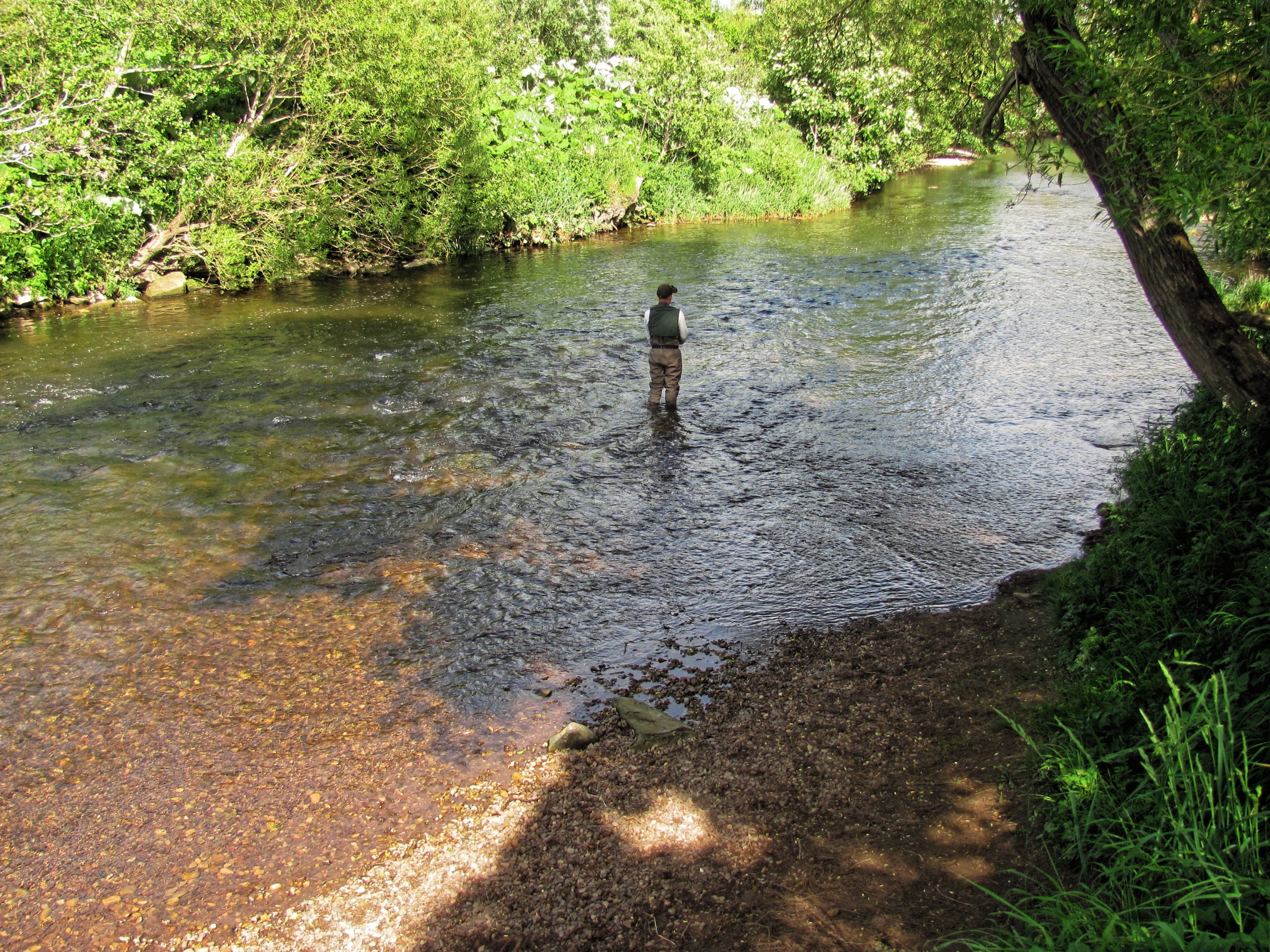
The name is pre-English and probably contains the Brittonic (Celtic) word cocc ‘red’, an older relative of modern Welsh coch. The ending is thought likely to be wedd, meaning ‘appearance’ and as Richard Coates notes, the name Coquet is a great rarity: a pre-English river-name containing two roots. The geology of Upper Coquetdale is rich in a pink-coloured porphyrite, and the river flows through reddish-brown rocks and soil for much of its lower course. The water has that colour especially at times of flood.

This interpretation is based especially on the evidence of a handful of early sources, beginning with the Ravenna Cosmography, a list of places in the world as known in the seventh century. Treating the place as both a river and an important settlement (Latin civitas), the Ravenna Cosmography offers a perplexing range of spellings, but they generally point to a form Cocuueda, and this is the form found in one of the most reliable manuscripts (‘B’). The second -u- in Cocuueda (which could be read as Cocuneda) would have a sound like English ‘w’. This would be matched in two works produced closer to home in Northumbria in the early eighth century. The Lives of St Cuthbert refer to the river as Cocuedi and to Coquet Island, just off the coast at Amble, as Cocwædesæ (adding a version of Old English ēg ‘island’). Fuller details of spellings are given below.
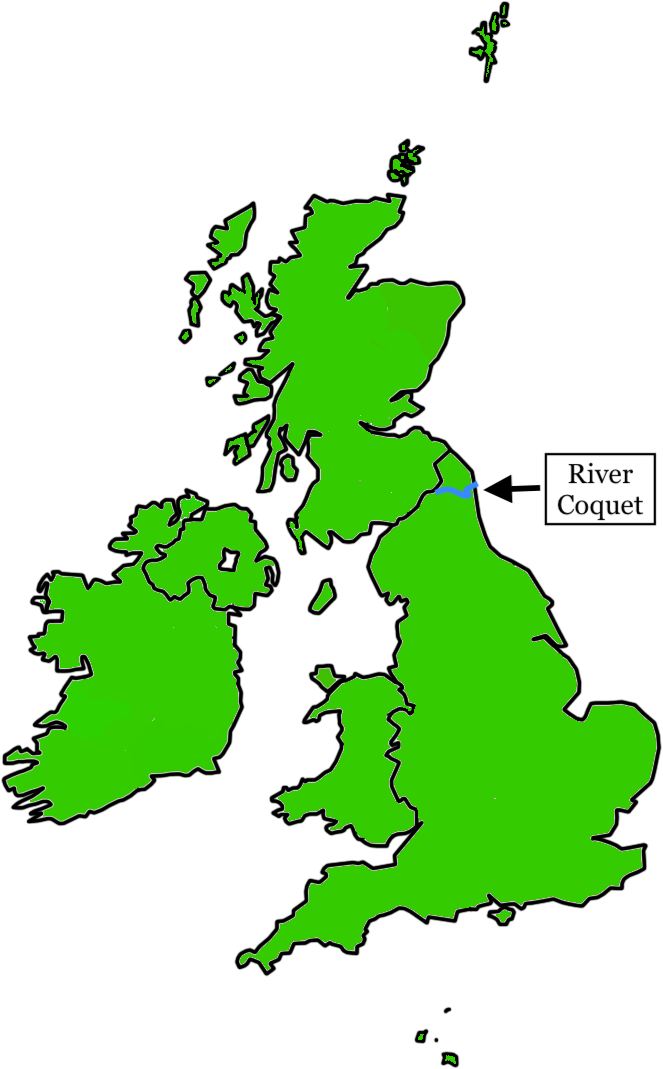
Map showing the River Coquet in Northumberland
Location of the River Coquet
Shallow river with reddish bottom
The Coquet east of Felton
© Diana Whaley

So just as the River Coquet rises deep in the Celtic-named Cheviot Hills (where Cheviot probably means ‘ridge’), its name arises from a Celtic language spoken widely throughout Britain from the first millennium BC; see Languages). And these early origins are shared with most of the great rivers of Britain. Some river-names such as Avon, Frome, Leven and Wear appear to be early Celtic but many, including Ouse, Severn, Thames, Trent and Wye, are believed to originate in a still older language. Since rivers are striking linear features in the landscape their names tend to be very widely known and easily transmitted from speakers of one language to another. However, it seems that the next group of speakers misunderstood the name of the Coquet.

River turned wood

The History of St Cuthbert (Historia de Sancto Cuthberto) of the late eleventh century shows the river-name transformed into a very English-looking Cocwudu ‘cock wood’, referring to male birds, perhaps woodcock. In a sense this is a mistake, a case of folk etymology or popular etymology where people re-form a name to make sense of it, but it is curiously appropriate since this central area of Northumberland was historically quite heavily wooded. (The great Swedish scholar Eilert Ekwall believed Cocwudu was the original name, applied to a wood but re-interpreted as a river-name, but this does not account so well for the earlier spellings.)

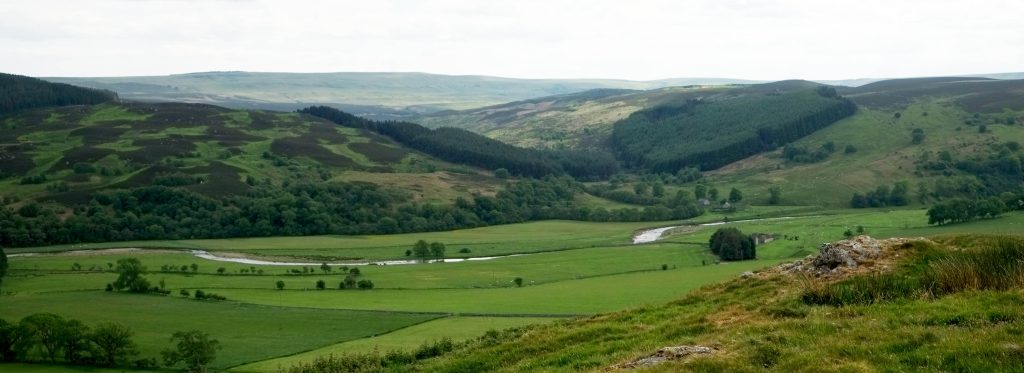
Photo showing a broad river-valley
Coquetdale from the south-west
© Ian Whaley

After the Norman Conquest: a French flavour

The spelling Coket then dominates in late medieval documents, perhaps influenced by French-trained scribes, but the still more French-influenced variant Coquet emerges as the standard modern spelling. The name doesn’t sound French, however: it’s pronounced with the stress on ‘Co-’, and not like the word ‘coquette’.

Coquet is not at all alone in looking more French than it is historically. Still in north-east England, Cambois on the Northumberland coast was named Commes in the Historia de Sancto Cuthberto and Kambus around 1150, and is evidently a Brittonic cambas or camas (like Welsh camas), meaning ‘bay’. Elsewhere, various names containing ville today, such as Clanville in both Hampshire and Somerset, go back to Old English feld ‘open country, field’ rather than a French word for town.

A Northumbrian dale

The valley of the Coquet has been known as Coquetdale at least since 1226–44, when it appears as Cokedale , and this brings another language into our story. An Old English word dæl ‘valley’ exists but is quite rare, and the use of dale in Middle and Modern English is believed to be strongly influenced by its Old Scandinavian or Old Norse cognate dalr. The heartlands of ‘dale’ names tend to be areas where traces of Scandinavian speakers are very strong: places such as the Yorkshire Dales, where Swaledale and Wharfedale contain river-names, and the Lake District, where Kendal is the ‘valley of the River Kent’; Borrowdale (two examples) is ‘fortress valley’; and Grisedale (two examples) and Grizedale are ‘pig valley’. The use of dale to refer to major valleys has spread further, however, including into Northumberland, where Allendale, Redesdale and others are already recorded in medieval documents.

Select early spellings

Cocuneda or Cocuueda 7th century (in 13th century copy) Ravenna Cosmography

Cocenneda 7th century (in 14th century copy) Ravenna Cosmography

Coguuensuron 7th century (in 14th century copy) Ravenna Cosmography (the ending is believed to result from blending with another river name)

Cocwædes(æ) c. 700 (in copy of about 900) Anonymous Life of St Cuthbert (referring to Coquet Island)

Cocuedi c. 721 (in 12th century copy) Bede’s Life of St Cuthbert

Cocwuda about 1080 (in copy of about 1100) Historia de Sancto Cuthberto (History of St Cuthbert)

Coket 1135–54 Vita Oswini (Life of Oswin)

Coquet c. 1540 Leland Itinerary

Select sources

Coates, Richard and Andrew Breeze (2000), Celtic Voices, English Places, p. 26.

Ekwall, Eilert (1928), English River-Names, pp. 93–94.

Ekwall, Eilert (1960), Oxford Dictionary of English Place-Names. 4th edition.

James, Alan (2023), Brittonic Language in the Old North, 2, p. 79.

Rivet, A. L. F. and Colin Smith (1979), Place-Names of Roman Britain, p. 311.

Watts, Victor (2004), Cambridge Dictionary of English Place-Names.

© Diana Whaley 2024