Introducing the place-names of Scotland

The place-names of Scotland reflect a wider range of languages than those of any other country in Britain and Ireland. The Celtic languages Gaelic, Pictish and Northern Brittonic are all strongly represented, as are the Germanic languages Old English and Old Norse, and their daughter language Scots. Whereas place-names from Gaelic and Scots are found in most parts of Scotland, the other languages are more geographically distinct, with Norse mainly in the north and parts of the west, Pictish in the north-east mainland, and Northern Brittonic and Old English further south. Of these, only Gaelic and Scots are still spoken at the present day. This means that most place-names have been preserved through the medium of other languages, which have often influenced their development and obscured their origins.

Chronologically as well as geographically, the linguistic strata overlap. The common ancestor of Pictish and Northern Brittonic was probably spoken throughout Scotland during the early part of the first millennium, although the Northern Isles in particular were so strongly Scandinavianised by the Norse settlements of around 800 that little if any trace is left of any earlier Pictish names. Similarly in the Western Isles, the earliest recorded names are Norse, leaving it uncertain whether the previous inhabitants spoke Pictish or, like subsequent settlers, Gaelic. On the mainland, Pictish place-names were created in the north-east until the area was taken over around 840 by Gaels expanding their existing territory from the west. Meanwhile, Northern Brittonic continued to be spoken in southern Scotland until at least the eleventh century, a time-span that makes place-names from this language particularly difficult to date. Old English was introduced by Northumbrian incomers from what became England from the seventh century onwards, initially into the border areas. From there, it spread across other parts of southern Scotland before developing into Scots from about the twelfth century.
City names

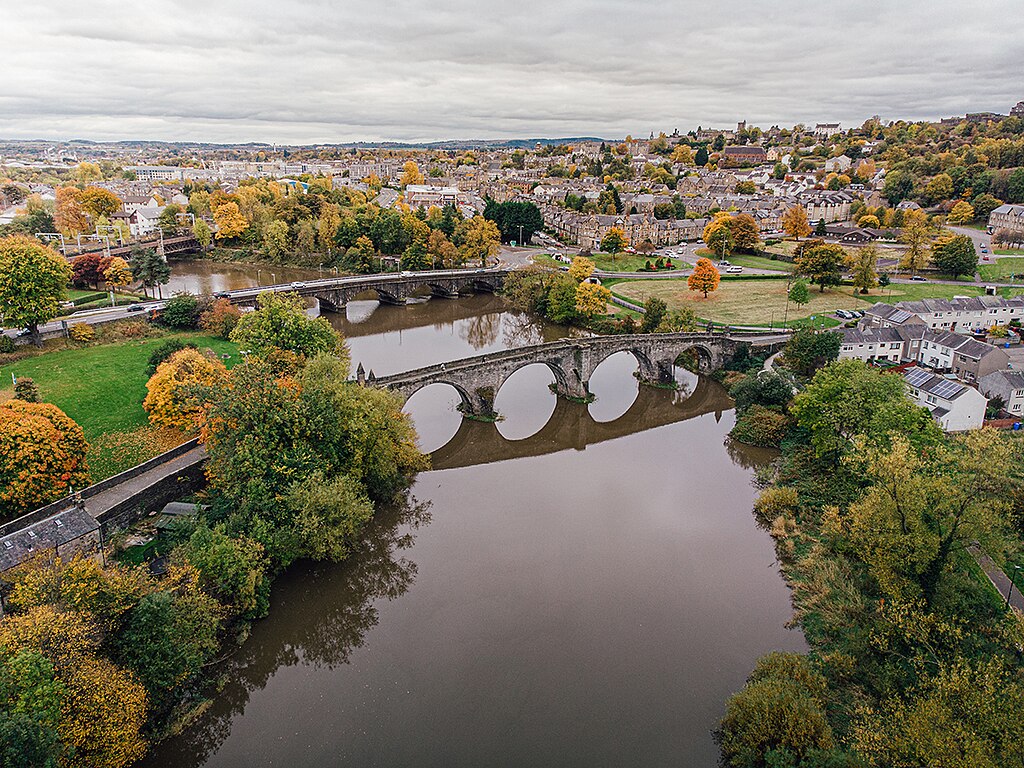
The names of Scotland’s eight cities reflect at least five historical languages. Aberdeen and Inverness both contain early Celtic river-names, Don and Ness, combined with words for a river-mouth in Pictish (aber) and Gaelic (inbhir) respectively. Dundee probably also contains a river-name, the Tay, dating from the even earlier ‘Old European’ stratum. The first element is Gaelic dùn, referring to a fortification or fortified hill, which also appears in Dunfermline, possibly again in combination with the names of water-courses, the Water of Ferm and the Lyne Burn. Alternatively, these may be back-formations from Dunfermline itself. The corresponding Northern Brittonic word, din, formed part of the earlier name for Edinburgh, Din Eidyn. When the Northumbrians captured it in 638, they replaced din with the Old English equivalent burh and reversed the order of elements to follow the usual pattern in Germanic place-names of specific followed by generic. The watery theme continues in Stirling, from Gaelic words for river (srib) and pool (linn), referring to the Forth estuary. Also describing landscape are the Pictish name Perth, from pert ‘copse’, and the Northern Brittonic name Glasgow, referring to a green (glas) hollow (ceu) close to the site of the present cathedral (see the place-name story on Glaschu ~ Glasgow).

River spanned by two stone bridges, with a city in the background
The River Forth at Stirling
Photo © Clementp.fr, CC BY-SA 4.0, via Wikimedia Commons

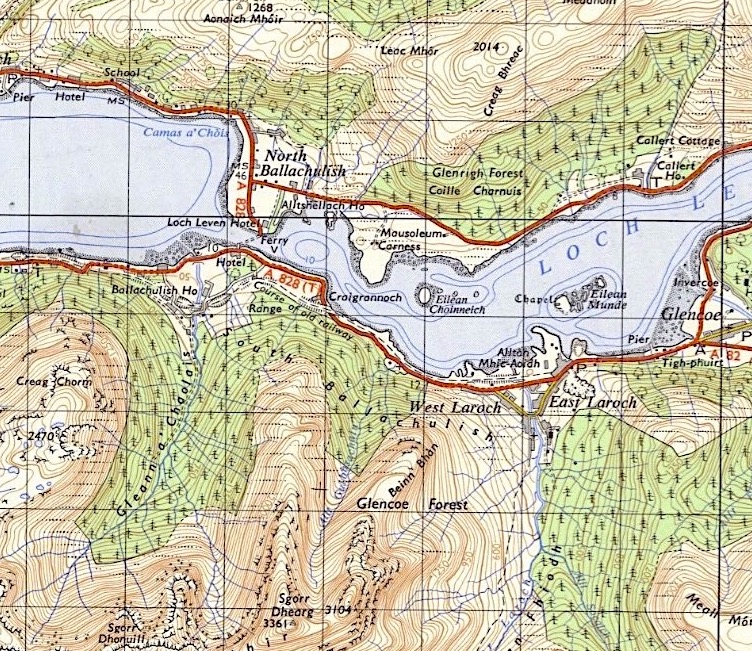
In areas where Gaelic is or was spoken, major names tend to have anglicised forms while smaller topographical features have only Gaelic forms. For example, in the area of Ballachulish — an anglicised form of Baile a’ Chaolais — we find also anglicised Glencoe (Gaelic Gleann Comhann) and Loch Leven (Gaelic Loch Liobhann). However, smaller topographical features have only Gaelic forms on Ordnance Survey maps. For example, the valley south of Ballachulish is Gleann a’ Chaolais, and nearby are hills with names containing Gaelic beinn ‘mountain, peak’, creag ‘crag, rock, cliff’ , meall ’round hill’ and sgòrr ‘rocky peak’, and islands named with eilean ‘island’.

Partly because of the different combinations of languages in different areas, place-names from the same origin may take different modern forms. Old Norse bólstaðr ‘farm’ tends to survive as -bister in Shetland (Isbister, Kirkabister) and as -bist(er) in Orkney (Eastabist, Grimbist, Kirbister, Swanbister), but as -(b)ster on the north-east mainland (Lybster, Scrabster, Thrumster). In areas that came under later Gaelic influence, the first syllable of bólstaðr was stressed at the expense of the second, leading to outcomes such as -bus on Islay (Cornabus, Cragabus), -bost on Lewis and Skye (Habost, Carbost), and -boll or -pool on the northern mainland (Eriboll, Ullapool).

Map of a sea-loch and surrounding land
Map of Ballachulish, 1956 (Grid Reference NN0857), showing Gaelic place-names in anglicised (Loch Leven and (North and South) Ballachulish) and non-anglicised forms (Gleann a' Chaolais, Sgorr Dhearg, Eilean Choinneich and Eilean Munde).
Image © Ordnance Survey/National Library of Scotland, CC-BY. Reproduced with the permission of the National Library of Scotland.

The equivalent Gaelic word for farm, baile, appears in names like Balbarton in Fife, Ballachulish in Argyllshire, and Ballantrae in Ayrshire. All have the main stress towards the middle or end, unlike the Norse names above which are stressed at the beginning. This is because the element order is different. Although some place-names comprise a single element, most combine a generic identifying the referent with a specific describing it in more detail. The Gaelic examples mean ‘farm of the Britons’ (Balbarton), ‘farm on the strait’ (Ballachulish) and ‘farm on the shore’ (Ballantrae), while Isbister means ‘easterly farm’, Lybster ‘slope farm’ and Habost ‘high farm’. The words for farm in these names (Old Norse bólstaðr and Gaelic baile) are the generics, which come second in Germanic names but first in Celtic names from the fifth or sixth century onwards. In both language families, stress falls on the specific. A Bal- name stressed at the beginning, such as Balloch in Dunbartonshire, is unlikely to be from baile. Indeed, it is a simplex name from Gaelic bealach ‘mountain pass’.

View looking over a bay wiht a church on the far side of the bay
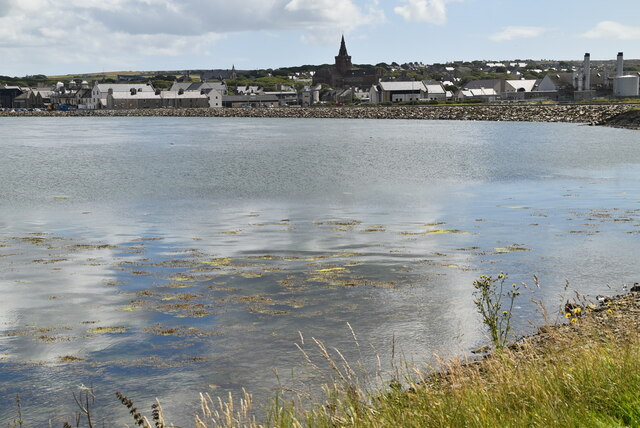
Bay of Kirkwall with St Magnus Cathedral
Photo © N Chadwick, CC BY-SA 2.0, via Geograph

Other false friends are Balfron in Stirlingshire and Balmoral in Aberdeenshire, both from Gaelic both ‘hut’ or ‘church’. Here and elsewhere, place-names from less common elements may be influenced by more familiar ones and again, the diversity of languages and contacts between them often play a part. With Broadford on Skye and Kirkwall on Orkney, Norse place-names with the generic elements fjǫrðr and vágr, both meaning ‘bay’, have been influenced by the unrelated Scottish Standard English words ford and wall, a process known as folk etymology. Similarly, while Kirkwall is indeed from Norse kirkja ‘church’, Kirkcaldy in Fife (‘place of the hard fort’) and Kirkintilloch in Dunbartonshire (‘fort at the end of the hillock’) are from caer ‘fort’, a word shared by Pictish (Fife) and Northern Brittonic (Dunbartonshire). The middle element of Kirkintilloch was Northern Brittonic pen ‘end’, later replaced by the synonymous Gaelic ceann. Gaelic ceann again appears in disguise in the Fife name Kinghorn (‘end of the bog’), where it combines with Gaelic gronn ‘bog’. Here folk etymology has affected both elements: there is no connection with kings or horns.

Contact between Gaelic and Pictish is also reflected in over 300 Pit- names in north-east Scotland, from a Pictish term pett ‘landholding’ that was borrowed into Gaelic before being used to create place-names with Gaelic specifics, such as Pitcaple (capall ‘mare’), Pitlochry (cloichreach ‘stones’) and Pittenweem (uaimh ‘cave’). These are Gaelic place-names rather than hybrids, genuine compounds from different languages. Hybrid place-names are generally rare, but it is not unusual for a later term to be added to an existing place-name, often to differentiate two places with the same name. Examples are East and West Kilbride, where Scottish Standard English east and west have been added to identical place-names from Gaelic cill ‘church’ and the name of St Brigid. Less obviously, Bannockburn in Stirlingshire is from Northern Brittonic bannauc ‘peaked’ with the later addition of Scots burn ‘stream’, and  Kirkliston in West Lothian is from an Old English place-name Liston ‘Lissa’s settlement’ with the later addition of Scots kirk ‘church’.

People in Scotland’s place-names

Whereas the identity of the eponymous Lissa is obscure, other place-names commemorate known individuals from various periods in Scottish history. These range from St Abbs in Berwickshire, named from Æbbe, the seventh-century Abbess of Coldingham, to Bettyhill in Sutherland, named from Elizabeth Leveson-Gower, Duchess of Sutherland in the nineteenth century. North and South Queensferry are on either side of the Firth of Forth, where the eleventh-century Queen Margaret established a ferry service, now replaced by the Forth Road Bridge. The ferry was for pilgrims heading to St Andrews, itself named from the patron saint of Scotland.

Two late-eighteenth-century names are Grantown-on-Spey in Moray and Helensburgh in Dunbartonshire. The first was named after the town’s founder, James Grant, while the second was founded by Sir James Colquhoun and named after his wife. Famous for its location at the far north of the Scottish mainland is John o’ Groats, possibly named from the John Grot who was granted land by the earl of Caithness in 1496. The medial o’, Scots for of, is first recorded in 1726, and may result from a misinterpretation of the diminutive form Johnny.

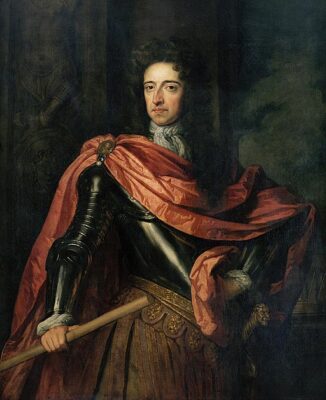
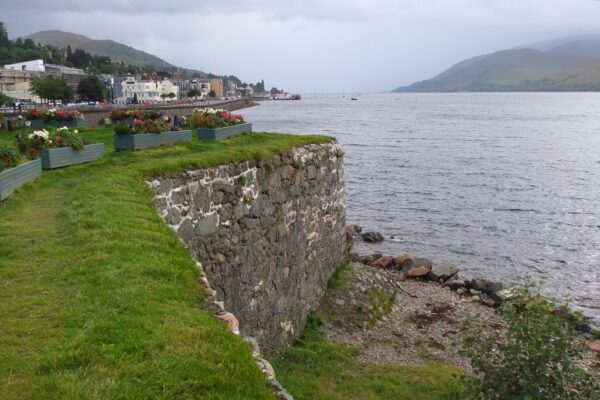
Some Scottish places have alternative names in different languages. Fort William in Inverness-shire commemorates King William III, but its Gaelic name is An Gearasdan ‘the garrison’. About thirty miles further north, Fort Augustus commemorates William Augustus, Duke of Cumberland in the eighteenth century, but is also known by the Gaelic name Cille Chuimein ‘St Cummein’s church’.  Cille Chuimein is an example of one of the many place-names which contain the names of saints to whom churches were dedicated.  Others include Kilbarchan in Renfrewshire and the Ayrshire names Kilbirnie, Kilmarnock and Kilwinning, from the names of saints Berchán, Brénainn, Ernán and Findbarr. As with Kilbride, they contain an Anglicised form of the Gaelic word cill ‘church’.

William III (of England) and II (of Scotland) by Godfrey Kneller (circa 1690)
Godfrey Kneller, Public domain, via Wikimedia Commons
A sea wall overlooking water, with a town in the background
The Old Fort, Fort William
Photo © Jim Barton, CC BY-SA 2.0, via Geograph

While place-names like Clydebank in Dunbartonshire and Tayport in Fife use the name of a local river as the qualifying element with the Scots generics bank and port, others consist solely of a river-name. These include the Ayrshire settlement-names Ayr, Girvan and Irvine, Luss on Loch Lomond, and Cullen, Findhorn, Nairn and Tain in the north. Ayr, Cullen, Leith and Nairn have historical spellings with Gaelic inbhir, showing that, like Inverness, they originally described a river-mouth. Despite the lack of documentary evidence, the same may apply to others, although it is also possible that the settlement-names were transferred directly from the name of the river itself.

Among large towns named from the Scots language are Bishopbriggs in Dunbartonshire, Falkirk and Grangemouth in Stirlingshire, and Wishaw in Lanarkshire. The first refers to cultivated land (riggs) allocated to the bishop of Glasgow, the second to a church (kirk) of variegated (faw) colour, the third to the mouth of the Grange Burn, and the fourth to a white (whit) or willow (withy) wood (shaw). Grangemouth is directly parallel to Aberdeen and Inverness, showing the same place-name formations across different languages. Like Edinburgh, Falkirk is an adaptation of an earlier Celtic name with the same meaning, recorded in the twelfth century as Egglesbreth. Related words for church in Gaelic (eaglais) and Northern Brittonic (eglēs) are difficult to tell apart both here and in other place-names such as Ecclefechan in Dumfriesshire and Ecclesmachan in West Lothian, containing the names of saints Féichine and Machan. The complex interaction between languages is illustrated by Kirkcudbright in south-west Scotland. Combining Norse kirkja ‘church’ with an Old English saint’s name, Cuthbert, it displays the Celtic element order of generic followed by specific. This raises the possibility that kirkja has replaced the Gaelic equivalent cill, an interchange documented in early spellings of names such as Kirkcormack in Kirkcudbrightshire and Kirkpatrick-Fleming in Dumfriesshire, referring to saints Cormac and Patrick.

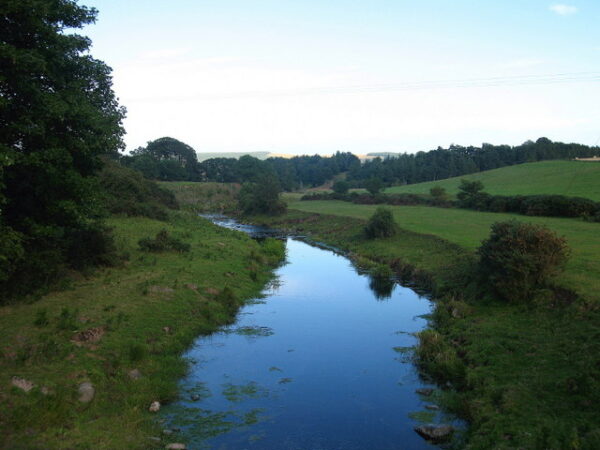
Some of the most transparent names for English speakers are found in southern Scotland and derive from Old English, the ancestor of Present-Day English as well as Scots. Coldstream and Swinewood are easily understandable, and it takes only a little thought to recognise Eyemouth as ‘mouth of the Eye Water’. Even here, however, changes through time create challenges. Ayton is less obviously ‘farm on the Eye Water’, from the ancestor of the word town, and only historical spellings reveal that Leitholm combines the name of the Leet Water with the ancestor of the word home. Many Old English words are now obsolete, including worð ‘enclosure’ in Polwarth (‘Paul’s enclosure’), and hōh ‘(heel-shaped) ridge’, the specific of Hutton (‘settlement by a ridge’) and the generic of Kelso (‘chalk ridge’). Another is wīc ‘(specialised) farm’, which appears in Hawick (hedge), North Berwick (barley) and Prestwick (priest), and should not be confused with Norse vík ‘bay’, the origin of Lerwick in Shetland and Wick in Caithness.

river meandering through farmland
The Eye Water at Ayton
Photo © Lisa Jarvis, CC BY-SA 2.0, via Geograph

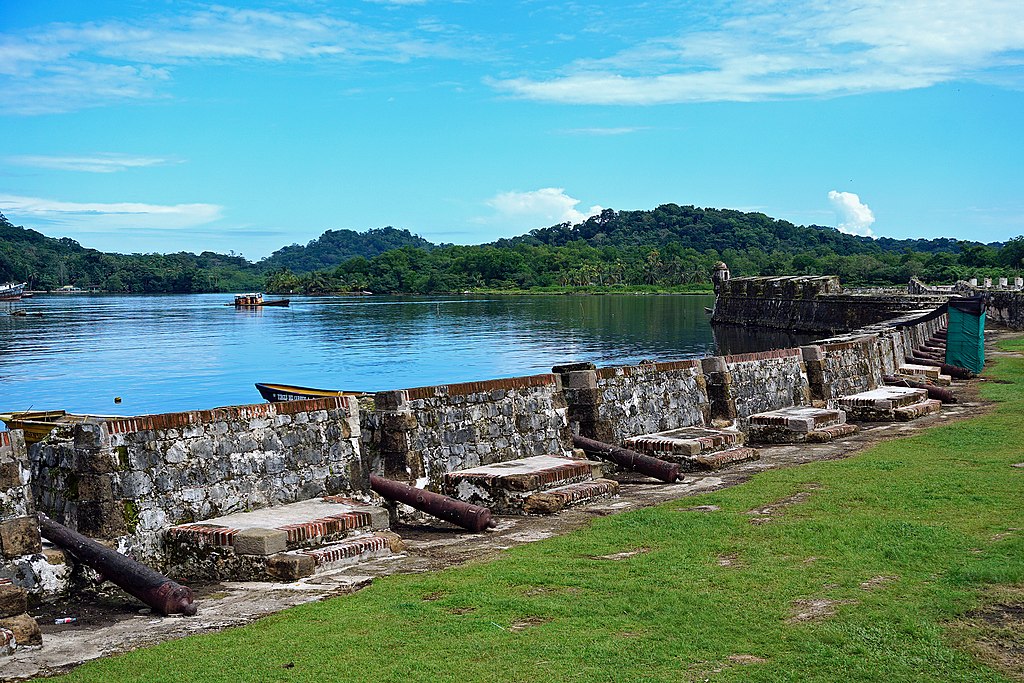
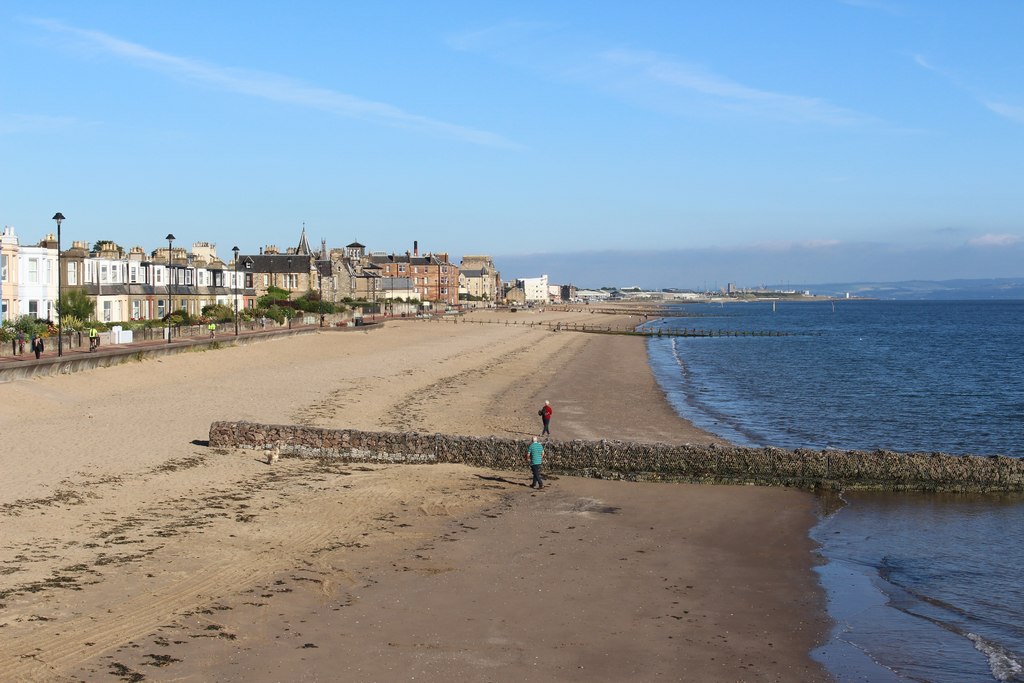
Finally, a minority of place-names are from languages not native to Scotland. Some were created here by incomers, as with Beauly in Inverness-shire, from French beau lieu ‘beautiful place’. It takes its name from Beauly Priory, founded by French-speaking Valliscaulian monks around 1230. Others were transferred from different parts of the world, as with Portobello near Edinburgh, named after Portobelo in Panama (compare Spanish puerto ‘harbour’ and bello ‘beautiful’) and probably commemorating the battle there in 1739.  Both are unlike native names in that they focus on aesthetics. Although Scotland has some of the most beautiful scenery in the world, its place-names more commonly refer to utilitarian aspects of the natural or built environment. An exception is Blinkbonny, from Scots blink ‘look’ and bonny ‘beautiful’, a recurrent minor name found in various parts of south-east Scotland including East Lothian and Fife.

A wall with a bay in the background
Ruins of the Castillo San Jerónimo, Portobelo, Panama
Photo © Mariordo (Mario Roberto Durán Ortiz), CC BY-SA 4.0, via Wikimedia Commons
beach with a row of buildings behind
Portobello Beach near Edinburgh
Photo © Graeme Yuill, CC BY-SA 2.0, via Geograph

Selected sources

Grant, Alison (2010), The Pocket Guide to Scottish Place-Names [an excellent short dictionary].

Nicolaisen, W. F. H. (2001), Scottish Place-Names: Their Study and Significance (new edn) [the standard book on Scottish place-names].

Scott, Maggie  (2008), Scottish Place-Names [a short and accessible overview].

An extensive bibliography on Scottish place-names is available on the Scottish Place-Name Society website.

Online resources for individual areas and types of place-name:

© Carole Hough 2024