Overview: what does interpreting place-names involve?
Interpreting place-names — looking for their origins and meanings — is an intriguing, complex and rewarding process that demands specialist knowledge and skills. Starting from the evidence of early spellings, the methodology involves forming and evaluating theories of origins in the light of the history of the languages involved, of known patterns of place-naming and of the contextual evidence of landscape, ecology and history. On this page you can find an attempt to summarise the main aspects involved.
Note: Clicking on a superscript number (e.g. ¹) will take you to the notes at the bottom of the page, which provide a little more detail.
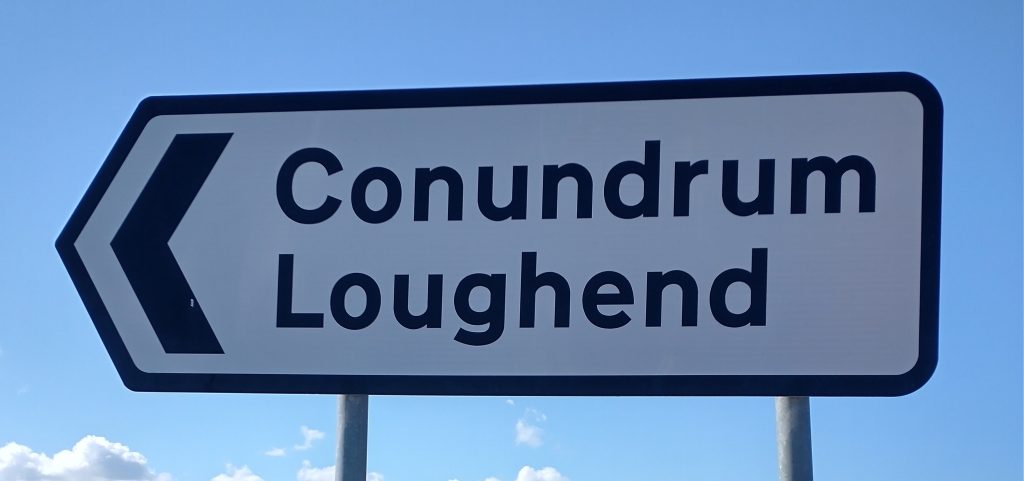
Some place-names look obvious and guessable, for instance Newcastle (upon Tyne), which truly does refer to a castle built around 1080. Others look obvious but are deceptive. For instance Bearpark in County Durham was Beaurepeyre ‘beautiful resort’ in 1267 – it was an estate of the monks of Durham. Similarly, Swansea has nothing to do with swans or sea, and linguistically it’s neither Welsh nor English in origin. It appears to be a Scandinavian name meaning ‘Sveinn’s island’ (as explained below).
Interpreting individual place-names, or finding their meaning, is first and foremost a search for the etymology or origin: the root words or names that make up the place-name. These may or may not have survived into modern usage. In many cases we can also go further and consider the referent: the real-world feature(s) referred to by the name, such as the castle in Newcastle or the hill in Solihull. We can also think in terms of motivation: the reason communities chose to highlight a real-world feature through naming it.
At the risk of sounding ‘preachy’, it cannot be over-stressed that these processes require a great deal of knowledge, experience and patience. The brief entries in dictionaries may appear to give simple solutions, but these are often very hard-won – the result of long hours of research and deliberation. In some cases we can access the detailed evidence and thought-processes that lie behind scholars’ interpretations, for instance in entries in full-scale place-name surveys and in articles in academic journals.
For many place-names we simply cannot know which is the correct explanation, as the evidence allows of more than one possibility, and most reliable dictionaries will reflect that. Nevertheless, a fair amount of certainty is often possible.
The golden rule: spelling evidence
Because modern forms can be opaque or misleading, the golden rule for interpreting place-names from any part of Britain and Ireland is that the evidence of early spellings is absolutely fundamental. It’s a spelling Sweynesse in a document of about 1165 that reveals the Scandinavian origins of Swansea (Old Norse Sveins-ey ‘Sveinn’s island’), and full-scale place-name surveys always begin with the mammoth task of collecting thousands of spellings from early documents.¹
The ideal is to collect as much spelling evidence as practically possible. Explanations on the basis of a single form need to be tentative, and in all cases we have to allow for the possibility that further spellings (uncollected, or in documents now lost) would alter the interpretation of a name. Nevertheless, although we may rarely have an ideally full set of spelling evidence, the consistent patterns that place- name corpora reveal give good reason to trust the evidence we have, and attempts at explanation that do not respect the evidence are hazardous. Unfortunately, some of these hazardous attempts can be found in print or online, sometimes challenging well-evidenced etymologies with guesswork.²
Interpreting spellings
Given a collection of spellings, the next question is: what do they tell us? A run of spellings for a particular name, taken together and carefully interpreted, will often reveal both what its probable etymology is and how it has developed into its present form. ‘Interpreting carefully’ will involve awareness of the source documents: their language, their reliability, their spelling conventions etc.³
Normally the earliest available spellings are the most useful, taking us as close as possible to the original form. Sometimes, however, they contain errors, as do several forms in Domesday Book (1086), although it still remains an exceptionally useful source.⁴ Meanwhile, some later documents are written using conservative spellings that reflect earlier pronunciations, and hence some later spellings may shed important light on origins.⁵
Finding the etymology
The spellings, then, have to be respected, and interpreted in the light of knowledge about documentary spelling conventions. The aim is to find the etymology by identifying a name’s element(s) (component words or names known from the vocabulary of the language or credible for various reasons), and accounting for any anomalies in the evidence. Crucial considerations in the quest for elements include these:
1. What languages were spoken in the time and place concerned
Varieties of Brittonic, Goidelic/Gaelic and English (itself a highly eclectic language) form the majority of names in Britain and Ireland, but Scandinavian, French, Latin and other languages have also contributed. (See Languages). Some names show influence from more than one language, though truly hybrid or bilingual names seem rare.
2. The detailed histories of those languages
Most often place-name forms match the rest of the language in question at the same time, and runs of spellings reflect regular sound-changes in the language. Many important linguistic developments reflect patterns of stress, and these differ across languages and periods.⁶
In names of Old English or Old Norse/Scandinavian origin the final syllables are often unstressed, and this can result in vowels losing their distinctive quality and place-name elements becoming confused with each other. This is partly through normal processes of sound change and partly because of the influence of common elements. For instance, there are three places called Embleton in northern England, and although the -ton ending makes all three look as though they may descend from Old English tūn ‘farmstead, village, estate’, only the Cumberland one does, while the Northumberland one is historically a dūn ‘(level-topped) hill’ and the Durham one a denu ‘valley’.⁷
Many more processes seen in place-names match those in the language as a whole. For instance the several places called Hampton are of various origins, but none of them originally contained a -p-. This is a so-called intrusive consonant, a sound that eases the pronunciation, just as it does in the word empty (Old English ǣmtig) or, if you listen carefully, in how you probably pronounce hamster! (The insertion of such sounds is known as epenthesis.)
3. Known patterns in place-naming (toponymy)
Scholars also use broader toponymic knowledge to throw light on whatever names they are studying. Over a century of dedicated research has revealed a lot about the ‘behaviour’ of place-names and their constituent elements, for instance what types of place-name formation exist; what words are applied to particular shapes of hill or valley; or at what period metaphorical or commemorative names come into vogue. Hence, for instance, it is often helpful to ask what type of elements typically combine with each other. Irish cill ‘church, monastic settlement’ is often qualified by a saint’s name or description of the site, or Old English ford is often qualified by terms for the material of the ford or the groups of people using it, and this kind of knowledge can help guide the thinking.
Contextual evidence
As we have seen, place-names are first and foremost linguistic items, and it’s hard to overstate the importance of the spelling evidence, and of well-informed interpretation of it in the light of known language developments and patterns in place-naming. But place-names exist in the real world, often arising as informal descriptions of places that come to be adopted as names, and they also reflect such things as:
- landscape, flora and fauna, climate, agriculture
- communications
- industry
- types of habitation or buildings, defences
- ownership and stakeholding
- administrative structures
Etymologies therefore also need to be plausible in the light of those contexts at the presumed time of naming. Very often more than one possible interpretation can be deduced from the spelling evidence, and contextual factors may help us identify the most likely one.
Local topography is perhaps the most useful context, always bearing in mind, of course, that over time settlements can be relocated, rivers can change their course, woods can be felled or planted, marshes drained and moorland improved. Exploring the landscape, whether on the map (and satellite photos) or on the ground, is for many people one of the great pleasures of place-name study, and local knowledge can be invaluable.
Even where an etymology is very clear, it’s important, and enriching, to consider names in these contexts, in other words to think not only about etymology but also, as far as possible, about referent and motivation: what exactly might the name refer to? what was important to the community who adopted the name? Both current names of the Irish capital, Baile Átha Cliath ‘town of the hurdle ford’ and Dublin ‘black pool’, refer to the River Liffey; while the Gall of Donegal ‘fort of the foreigners’ are believed to be ninth-century Vikings; many places named Stratford ‘street ford’ and similar are crossings over major Roman roads.
Exceptions – oddities?
The place-names mentioned so far arose in languages spoken locally, and they refer more or less literally to actual attributes of the place; and this is true of the vast majority of the place-names of Britain and Ireland. They can be interpreted using the approaches outlined here. However, there are some types of naming that enjoyed some popularity especially in the early modern period which have a completley different logic and call for different approaches. These include transferred names, transplanted from other parts of Britain and Ireland, or from other countries and coined in different languages. Their original meanings may well be irrelevant to their new situations, though many of them convey a sense of remoteness or are tinged with hope or despair, such as California, Gibraltar or Botany Bay. Another important group comprises Welsh names such as Bethel and Bethesda originating in the Bible and applied to chapels and then to whole settlements. Some transferred names are also clearly commemorative, such as Waterloo or Pondicherry (site of numerous sieges). Then there are figurative or metaphorical names such as Mousehole applied to a distinctive Cornish cave and hence the nearby village, or The Needle(s) or the Priest and the Clerk applied to dramatic rocks. Finally, verbal place-names such as Glororum (= ‘glower over them’), Make-me-rich, Labour-in-vain or Pity Me unusually contain verbs and often express some kind of emotional response to a place.
Because many place-names (such as Bearpark and Swansea, mentioned above) are not what they seem, it’s always right to beware of taking place-names at face value without further evidence. However, some eccentric-looking names that have been given obscure etymologies are in fact exactly what they seem, including the numerous places called Pity Me (see Pity Me (place-name)).
Text © Diana Whaley 2023
Notes
1. These documents were usually drawn up for practical, bureaucratic purposes – fiscal, legal, tenurial etc. — and so the more important habitations tend to be the best-recorded. Remote landscape features may be mentioned as boundary points in medieval charters, but equally they may go unrecorded until they appear in guides and histories in the eighteenth century or on the first Ordnance Survey maps in the nineteenth. Still others are first recorded by modern scholars collecting names from oral informants, for instance, from Gaelic speakers in the Hebrides. In most cases, a modern place-name and its early spellings can be matched up or identified with real confidence, but there are cases of uncertain identification, especially where there is more than one place with the same name.
2. There are undoubtedly ‘rogue’ spellings that seem to be corrupt, but most spellings reflect known spelling conventions (however diverse) and known patterns of language change. Hence the possibility of minor corruption is not usually a justification for proposing solutions that go against the spelling evidence – in other words, going out on a limb of guesswork without the check of the most objective and most definitely relevant evidence available – introduces randomness and risks a fall.
3. In medieval and early modern times, there was no standard spelling system for any of the languages concerned, and this means that spellings can generally be taken to reflect actual pronunciations. They do, however, need to be interpreted in the light of knowledge of the possible value of spellings at the time and place concerned, and this can vary between individual documents, scribes or centres of manuscript production. The initial sound of the English word sheep, for instance, will normally appear as sc in Old English documents, but in the twelfth century can be spelled sh, sch, sc, s, ss, sz etc. There are also some important general considerations. Some documents were produced locally while others were written by scribes unfamiliar with the local dialect or even the language.
4. Domesday Book (1086), the richest single source for English place-names, has numerous eccentric spellings that result from the scribe’s mishearing of spoken forms, misreading of letter forms in Anglo-Saxon documents, or unsuccessful attempts to re-anglicise names that had been given a French veneer in the original returns. A recent study of the earliest Domesday manuscript, covering South-West England, has thrown light on some of these processes (Exon Domesday).
5. For example, Enborne in Berkshire is recorded as Aneborne in Domesday Book (1086) but it’s the spelling Enedburn (1220) that reveals its origins as a ‘duck stream’ (OE ened ‘duck’ + OE burna ‘stream’).
6. For example, Prestatyn in Denbighshire and Preston in Lancashire have the same origin, in Old English Prēostatūn ‘estate of the priests’, but they have very different outcomes reflecting Welsh and English stress patterns respectively. Similarly, the strong stress on the final syllable of Aberdeen contrasts with the weak stress in Sunderland. The land in Sunderland, because it’s unstressed, has lost its quality so that it is pronounced with ‘schwa’, the unstressed neutral vowel which is so common in English (e.g. as the final vowel in famous or Canada).
7. In more detail: many place-names formed in Old English are compounds with the main stress on the first element. Swindon originates in Old English swīn ‘pig’ and Old English dūn ‘hill’. As words in the normal language these have developed into swine and down as in South Downs. (Descendant forms such as these are known as reflexes.) But in compound place-names the vowels tend to shorten, here to Swin-, just as the first element of Monday is a shortened version of moon. The vowel of the second element dūn, when unstressed, also loses its quality so that it is pronounced with the neutral vowel schwa (see Note 6). The same kind of shortening and loss of quality affects practically all second elements, as in Monmouth, Plymouth and Yarmouth (Tynemouth formerly sounded like ‘Tinmuth’ but now has ‘Tyne’ and ‘mouth’ pronounced fully). Old English denu ‘valley’ in compounds loses the quality of -e- and loses its final vowel –u (later schwa) altogether through time, and hence comes to sound the same as the reflex of dūn, so the spellings can be confused. Maldon and Basildon, both in Essex, are original dūn names but so is Malden, Surrey, while Basildon, Berkshire is historically a denu name.
The possible confusion goes even further. Because names have a special status, only referring and not (once established as names) needing to convey specific meanings, they are also more subject to non-standard changes than normal words (or lexical items). Often these changes result from the influence of common types of place-name (which we could term analogy), most of all the type ending in -ton from Old English tūn ‘settlement’ or specifically ‘farmstead, village, estate’. This is by far the most common element in English-language place-names and as already mentioned it has replaced dūn ‘hill’ and denu ‘valley’ in two of the three places called Embleton. Another kind of non-standard change is folk etymology or popular etymology, where users of a name modify its form in a more familiar direction, examples being Rosedale, North Yorkshire and Leatherhead, Surrey, which have nothing to do with roses, leather or head.
8. Hywel Wyn Owen and Richard Morgan (2007), A Dictionary of the Place-Names of Wales, 443.
Text © Diana Whaley 2023