Introducing the place-names of England

England’s place-names are full of interest and variety, and here we offer a brief introduction to some of the main themes, languages and recurrent elements that run through the name-stock. Where possible, examples are drawn from the most populous towns and cities in England today, especially the forty largest; individual links will take you to Names of England’s largest towns and cities for further details about the origins of their names. Other examples are wide-ranging but drawn especially from London and Suffolk; many of these are explained in the Key to English Place-Names. We note the historic (pre-1974) county in which places are located, except in the case of the forty largest towns, county towns, and major landscape features.  There is a separate page on Personal names in England’s place-names.

Jump to:

Celtic heritage

The most ancient names to be preserved in a region are often the names of major landscape features: especially rivers, but also forests, hills, headlands etc. Dominating large tracts of country, these features would have been widely known, and hence their names would also have been known and used far and wide, and so likely to be handed on from speakers of one language to another. A few of these names are believed to belong to a pre-Celtic stratum known as Old European (or a still older one), but most can be interpreted from Celtic roots, or more specifically Brittonic roots, dating back to the early centuries BC. Examples from among the great rivers are Avon, Exe, Frome, Lune, Peover and Tees. Some ranges of hills such as the Malverns and the Cheviots also have names with Celtic origins, as do the great historic forests of Arden and Wyre. Celtic names of settlements are less numerous, but among the most important are Leeds, York, Carlisle in Cumberland, Dover in Kent, and probably the enigmatic London. Other names of cities combine all or part of a pre-existing Celtic place-name or river-name with another element, among them Exeter, Gloucester, Leicester, Luton, Manchester, Lichfield in Staffordshire and the heavily disguised Cambridge. Celtic remained the chief language of what became England throughout the Roman occupation of the first to fifth centuries AD. The Romans left dramatic traces on the landscape but had very little impact on the names of places. Much of the great northern frontier of Hadrian’s Wall, for instance, is still a spectacular reminder of the Romano-British period, but the forts along it were almost all Latin versions of Celtic names.

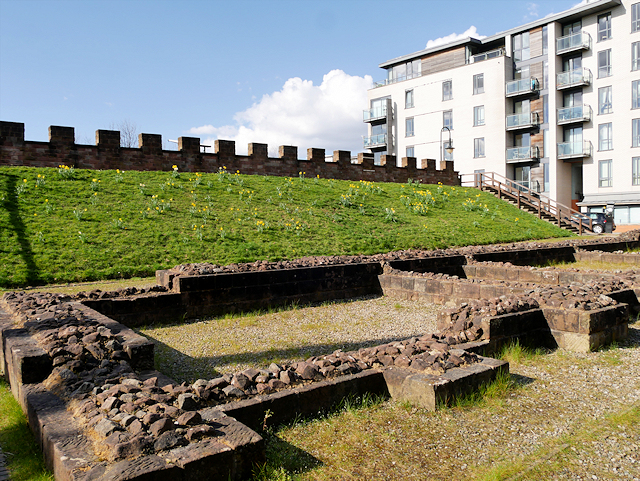
Roman fort Mamucium in Manchester, with reconstructed wall and excavated remains.
Remains and reconstruction: the Roman fort Mamucium at Castlefield, Manchester.
Photo © David Dixon, cc-by-sa/2.0 , via Geograph

The Anglo-Saxon period

After the Romans abandoned this outpost of their Empire, traditionally in 410 AD, Angles, Saxons and others from north-west Europe took advantage of the resulting turmoil and settled in England, first mainly in the south and east. Gradually, and only several centuries later in Cumbria and Cornwall, their Germanic language supplanted Celtic; we now call this Old English. The great majority of names of towns and villages in England are formed from Old English words or personal names, though as already seen some incorporate pre-existing place-names. (Old) English-speaking Anglo-Saxons held sway in England for some six centuries up to the Norman Conquest of 1066, and inevitably the period saw great changes, not least in religion, with the adoption of Christianity, starting traditionally in 597, and in politics, where numerous separate kingdoms evolved into increasingly large and bureaucratic polities, such as the midland kingdom of Mercia in the reign of Offa (757–796) or the south-western Wessex under Alfred the Great (871–899). The most dramatic external impact came from the arrival of Scandinavian speakers in the Viking Age, spanning the late ninth to early eleventh centuries; see the section on Viking-Age naming (below).

Old English settlement names

In the Anglo-Saxon period, from the fifth century onwards, we start to find numerous settlement names which seem to denote single-family farmsteads. Many of these place-names became our parish and village names, and so they are of interest to many people. Like most of the major names of England, they are formed in the Old English language, and typically have a two-element structure. We call the second element the generic, and the first element the specific or qualifier. The specific is often the name of a person who we assume was an early owner or occupant of the farmstead, or an adjective or noun describing some aspect of the settlement.

Two generics are especially important in naming settlements as such: hām ‘homestead’, the word which has given us modern home, and tūn ‘farmstead, village, estate’, the word which has given us modern town, though that was not at all the original meaning (see our Name story: Tūn: from rustic fence to urban sprawl). Various pieces of evidence tell us that hām was most used in the early Anglo-Saxon period, and eventually was not used for new names. Meanwhile tūn continued to be used in forming new farm-names throughout the early medieval period and was still frequently used at the time of Domesday Book (1086) and beyond. These two generics give us modern place-names ending in ‑ham and ‑ton. England’s second city, Birmingham, is a -hām name (combined with ‑ing‑, discussed below), as is Nottingham. Some modern examples are of different origin, for instance Oldham (Lancashire) and Durham were originally formed from holm ‘island of dry ground’, derived from Scandinavian. A few tūn places prospered and are among the forty largest cities in England today: Bolton, Brighton, Kingston upon Hull (known as Hull), Milton Keynes and Warrington. In the name Northampton hām and tūn join to form a compound element (but the ‑ham‑ in Southampton and Wolverhampton are of different origin).

Also extremely widespread as a settlement term is Old English wīc ‘secondary, specialised settlement, trading place’ as in Chiswick (London), Ipswich and Norwich. Other generics giving rise to settlement names include stōw and stoc, found in names such as Bristol and Felixstowe (Suffolk), and Stoke-on-Trent. The exact meanings of these two terms for ‘place’ are not always clear, but the sites include holy places and probably meeting places. Worth had the fundamental meaning of ‘enclosure’ and often appears attached to relatively humble sites. Letchworth in Hertfordshire and Tamworth in Staffordshire are the largest worth places (worth replaced earlier worthig in Tamworth).

Other common Old English generics used throughout the Anglo-Saxon period include two that highlight defensive sites, whether still used as such or not: burh ‘fortified site’ (as in Bury in Lancashire, Middlesbrough, Peterborough and Salisbury in Wiltshire) and ceaster ‘fort (often Roman)’, found in Caistor-by-Norwich in Norfolk, Gloucester, Lancaster, Leicester, Manchester and several others.

Although it’s useful, and natural, to focus on common generic elements when discussing place-names, it is names taken as a whole, complete with their specific, that often hint at fascinating aspects of history. Of the many places called Sunderland (‘detached land, detached part of an estate’), the largest, at the mouth of the River Wear in County Durham, is thought to be the detached part of the lands of Monkwearmouth-Jarrow monastery which a seventh-century abbot, Benedict Biscop, received from King Aldfrith in the late seventh century in exchange for two fine silk cloaks.

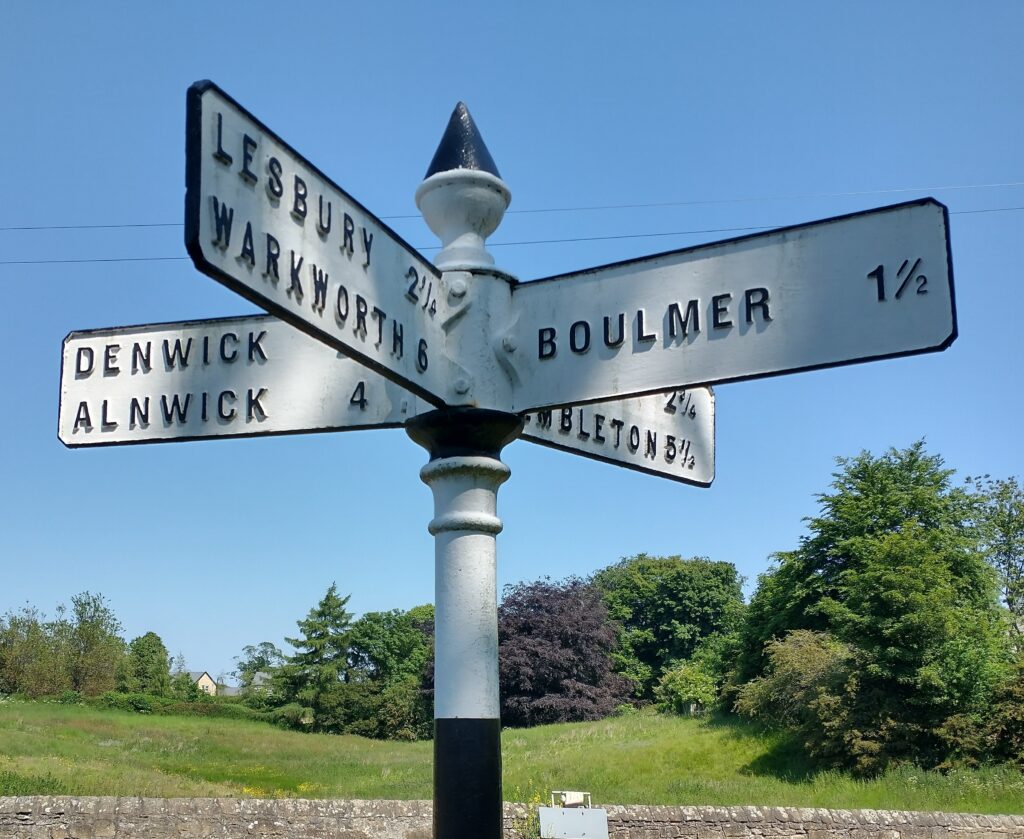
Signpost showing Northumberland place-names including Denwick, Alnwick and Warkworth
Place-names containing 'wic' (Denwick, Alnwick), 'worth' (Warkworth) and 'burh' (Lesbury), on a sign near Longhoughton, Northumberland. Embleton, however, derives from the hill-term 'dun', not the settlement-term 'tun' .
Photo © Diana Whaley

Landscape and environment

The natural environment is to the fore in many place-name elements that already appear in the earliest known Old English place-names and continued to be used in forming new names of both natural features and settlements for many centuries: words such as burna ‘stream’ (as in Blackburn, Lancashire or various places called Sherburn, Sherbourn or Sherbourne), ford ‘ford’ (Bradford, Hereford, Hertford, Oxford, Salford and Stamford (both in several counties)), denu ‘narrow valley’ (Dean in Sussex), dūn ‘hill, relative elevation’ (Swindon, Hendon in Middlesex), ēg ‘island, dry ground in a marsh’ (Battersea in London, Lindsey in Lincolnshire), feld ‘open land’ (Huddersfield, Sheffield), halh ‘nook or corner of land’ (Walsall in Staffordshire or Hales in several counties), hyll ‘hill’ (Solihull in Warwickshire), mūth ‘mouth, estuary’ in Plymouth, Portsmouth and later in Bournemouth, and pōl or *pull in Liverpool, Poole and later in Blackpool. Slough is simply Old English slōh ‘slough, muddy place’. Woodland is indicated by numerous terms including wald ‘(high) tract of woodland’, found in settlement-names such as Easingwold in North Yorkshire but also in The Cotswolds, The Weald, and The Wolds of East Yorkshire, Lincolnshire, and Leicestershire–Nottinghamshire. The vital importance of water supply to communities is registered in hundreds of names, including scores containing welle ‘stream, spring’ (for instance Shadwell and Stockwell, each in at least three counties).

Plants, animals and other aspects of local ecology are also highlighted in the first, specific, elements of names. Thus, plants and animals are mentioned in names such as these (each occurring in more than one county): Acton, Oakley (oak trees), Ollerton (alder trees), Apsley (aspen trees), Ashford (ash trees), Bentley (bent-grass), Bromley/Bramley (broom), Farnham (fern), Foxley (fox), Hawkridge (hawk), and Yaxley (cuckoo).

The Old English word lēah illustrates how place-names reflect the interaction of people with their natural environment. It seems to be applied to woods in otherwise open country, clearings in woods, or wood pasture, and is very common in names of habitations. The lēah places in Anglo-Saxon times tended to be relatively loose settlements compared with the more organised tūn places, and typically sited on less-than-prime land, but at least two, Crawley in Sussex and Barnsley in Yorkshire, have grown into significant modern towns.

Much more on ideas like these can by found in Gelling & Cole’s Landscape of place-names.

Anglo-Saxon society and economy

We get a small, but difficult to interpret, glimpse of the structure of Anglo-Saxon society in place-names which incorporate a specific element indicating social status. Suffolk alone has names commemorating a king in Kingston, a prince or princes in Athelington, churls in Carlton, children or young noblemen in Chilton, and perhaps servants in Boyton. The exact significance of these names is not known.

Place-names also give us information on products of the land, and of farm animals.  There are dozens of places called Barton in England, a name which means ‘barley farm’. Another common crop was wheat, found in names like Whatfield, Wheatcroft, and Wheatacre. Of very many other examples which could be cited, in Suffolk alone there are examples of corn in Cornard, cress in Kesgrave, rye in Raydon and Reydon, sheep in Shipmeadow, beans in Benacre and Benhall, peas in Peasenhall, bulls in Bulcamp, wethers (rams or castrated rams) in Wetherden, Withersdale, and Withersfield, and swine in Swilland.

Mills (usually water-mills, sometimes windmills) were fundamental to the medieval farming economy, and often gave rise to place-names. Recurring examples are Milburne, Milbrook, Millthorpe, and Milton (though not every Milton has this origin).  The distinctive Suffolk variant mell occurs in the place-names Melford, Mells, and Mellis.

Another valuable area of study is the names of medieval street and roads, which often describe the nature or function of the road.  Roads outside towns called Packway carried pack animals, and those called Peddars Way were used by pedlars.  The term Rodewey was used for roads suitable for riding horses, and this gives the modern name Radway, a place in Warwickshire, as well as further less well-known examples.

The problem of ‑ing‑

Complex questions are raised by the frequently occurring element ‑ing, as in Reading and Nottingham. This had various uses, and in some place-names the syllable ‑ing-‑could be interpreted in more than one way. In many Old English place-names, –ing(-) or -‑ngs have their origins in group-names or folk-names.  In many of the names, –ing(-) and –ings denote the group associated with a named individual. Thus Nottingham is to be analysed as Snot-inga-hām ‘the farmstead of Snot’s people’. Here Snot-inga is the genitive plural form (meaning ‘of Snot’s people’), while the nominative plural is Snot-ingas ‘Snot’s people’. This type is very common throughout England, with well-known examples like Gillingham (in Dorset, Norfolk and Kent), Wokingham (Berkshire) and probably Birmingham. Other place-names ending in ‑ing or -ings also have their origins in group- or folk-names, but standing alone and usually in the nominative plural. Reading and Hastings (Sussex) are examples of this type and are believed to be ‘(place of) *Rēada/*Hæsta’s people’ (where * indicates a postulated form). Other names in ‑ing can mean ‘place characterised by’, referring to a plant species or similar, such as Clavering (clover) in Essex or Wratting (crosswort) in Suffolk. A further use of ‑ing-‑ especially in later Old English, is simply to connect the two flanking elements, with a meaning such as ‘associated with’. Most often, it joins a personal name with tūn ‘settlement’, as in the Durham name Darlington (‘settlement associated with Dе̄ornо̄th’) or the London names Kennington and Kensington (the settlements associated with Cēna and Cynesige; the ing in Islington has a different origin). Finally, in some cases, a non-original middle syllable ‑ing‑ has developed by analogy from an original middle syllable ‑en- or -an- of a different origin, as in Islington (from Gislandune around 1000, ‘Gisla’s hill’).

The Viking Age

Contacts across the North Sea between Scandinavians and Anglo-Saxons certainly did not begin with the Viking Age, but they dramatically increased in the late eighth century, with a terrifying raid on the monastery of Lindisfarne, Northumberland in 793. This is widely taken as the symbolic start of the Viking Age, a period of raiding, over-wintering, and settlement in parts of Britain, Ireland and the Continent by increasingly large, organised forces. Historical sources, archaeology and place-names bear witness to the presence of Scandinavian (or Viking) people in parts of Britain during the ninth to eleventh centuries, either as a part of attacking armies, or as settlers. These people left many marks on our namescape, the Scandinavian speech giving rise to personal names and place-names which are still in use. Throughout this section, both the people and the language are referred to as Scandinavian. ‘Norse’ could be substituted in most contexts, and is used in many published discussions.

Scandinavian place-names

The processes of Scandinavian settlement are long and complex, and some parties of incomers were evidently mixed, hailing from various parts of Scandinavia, but it is useful to think in terms of two main areas, each settled by a dominant group. The so-called Danelaw was settled chiefly from Denmark and comprised modern Yorkshire, the East Midlands and East Anglia, while in northern and western Britain, Norwegians took sea-routes to the Northern and Western Isles of Scotland, south-west Scotland and Ireland, and then moved from there into north-west England, especially modern Cumbria and north-west Yorkshire. The two groups had slight differences in their languages, which are dialects of Old Scandinavian sometimes called Old East Scandinavian and Old West Scandinavian respectively.­­

The study of place-names of Scandinavian origin has long been an important technique for locating areas of Viking settlement. In the east of England, for instance, the influence of Scandinavian on place-names is much less in Suffolk than in Yorkshire, Lincolnshire, or Norfolk, and is almost non-existent in Essex.

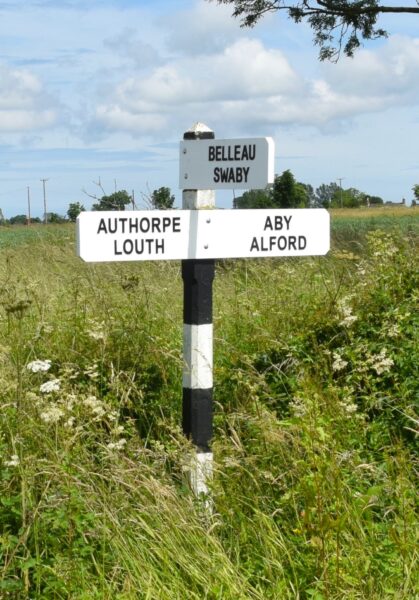
Scandinavian place-names in Lincolnshire: Alby, Swaby and, less obviously, Belleau

Among the most typical Scandinavian place-name elements, ‘farmstead, village’ is found in place-names including Derby, Grimsby in Lincolnshire and the Suffolk villages of Ashby, Barnby and Risby; toft ‘farmstead, farm plot’ occurs  in Lowestoft in Suffolk and many names of villages and small settlements; and thveit ‘clearing’ is found in the recurring Thwaite and in names such as Braithwaite and Micklethwaite, both with instances in Yorkshire and the Lake District. Thorp ‘outlying farmstead’ also occurs very commonly as a simplex, Thorpe, but also in compounds such as Grimethorpe and Kettlethorpe in West Yorkshire (both containing Scandinavian personal names).

Landscape terms often found in settlement names include lundr ‘grove’ as in Lound (several counties) and holmr ‘island of dry ground’ as in Holme (also several counties) and in the city- and county-name Durham. A rare Scandinavian element ‘meadow’ is found in heavy disguise in Belleau, Lincolshire, which was Elgelo in 1086 and Helgeloue in the 12th century, pointing to ‘Helgi’s meadow’.

Bekkr ‘stream’ appears in the Lake District village names Caldbeck and Whitbeck, and the word entered the dialect as beck and became the main term used for naming streams in the area. Similarly, other nature-describing words such as fell for a hill or unenclosed upland or gil for a ravine with a stream occur in medieval names of both natural features and settlements. They too were adopted into local dialect and are very productive in areas such as the Lake District and Yorkshire Dales.

Where Scandinavian and English meet

An important type of place-name is the so-called Grimston hybrid, in which Old English tūn ‘farmstead’ is qualified by a Scandinavian personal name. For example, Corton in Suffolk is from the personal name Kāri, and the two Suffolk instances of Flixton are both from Flik. Other types of compound that combine elements of Scandinavian and English origin include many places named Carlton (Old Scandinavian karl ‘churl, peasant’ plus tūn), and the Yorkshire names Osmotherley (personal name Ásmundr plus Old English lēah ‘woodland clearing or pasture’) and Almondbury (Old Scandinavian almanna ‘of all the people’ plus Old English burh ‘stronghold’). The interpretation of potential hybrids such as these can be uncertain, and in many cases the Old Scandinavian element could have replaced an Old English one. This seems especially likely in the case of ‘Carlton’ type names, where the two languages had cognate or related words (Scandinavian karl, English ceorl, both meaning ‘peasant’). Incomers seem to have had the impulse to make the name more familiar by substituting their own word (or perhaps only their own pronunciation, as in the example of Keswick below). In other cases the Scandinavian personal name or other element could have been borrowed into English, in which case the name is not a true hybrid but a late Old English or Middle English compound.

As well as coining new names, Scandinavian speakers adaped certain existing names to their speech, a process termed ‘Scandinavianisation’. Keswick and Skipton, for instance, are historically Old English and the equivalent of Cheswick (Northumberland) or Chiswick (London, both ‘cheese farm’) and the recurrent Shipton (‘sheep farm’), but they have initial consonants that match Scandinavian usage.

After the Norman Conquest

This period sees massive change at the top of society, but with a relatively modest effect on the toponymy of England. William, Duke of Normandy’s victory over the English at Hastings in 1066 opened the way for a ruthlessly wholesale transfer of power and territory from an (Old) English-speaking Anglo-Saxon élite to a Norman French one – as Domesday Book (1086) registers on every page of its monumental survey of most of England. However, by this point the main towns and villages of the land already had established names, and the conquerors, like the Romans a millennium earlier, were not interested in comprehensive renaming. Most existing major names survived and continued developing in line with general language change, and generic place-name elements common in Old English continued to be productive, among them lēah ‘woodland clearing or wood pasture’, tūn ‘settlement’ and wīc ‘secondary settlement’. Bý ‘village, farmstead’ and thveit ‘clearing’ (adopted into English as thwaite) are further examples of Old Scandinavian origin. Where Old French personal names introduced after the Conquest are combined with these elements, as in Willimontswyke (from the personal name Willimot) in Northumberland or Bassenthwaite (Bastun) and Ponsonby (Puncun) in Cumberland, and Walberswick in Suffolk (Walbert) there can be no doubt that the place-names were created after the Norman Conquest.

New settlements

A few existing names were replaced, however, several were adapted or expanded, and there were many places needing to be named in the centuries after the Conquest. Hundreds of new settlements were created, some centring on castles and monasteries founded or re-founded by the conquerors, and others reflecting the dramatic growth in the rural population that took place between the Conquest and 1300 or so. Minor landscape features, fields, and streets in a period of rapid urbanisation, also all attracted new names.

A trilingual situation

After the Conquest a trilingual situation across society emerged, making very diverse linguistic resources available for this new naming, with (Norman) French now as the language of the élite, French and Latin as the languages of bureaucracy, and English still the spoken vernacular of the vast majority of the population. English itself, now in the phase known as ‘Middle English’ (roughly 1100 to 1500), developed an increasingly rich and variegated vocabulary, adding loan-words from French and Latin to existing ones from Celtic (few), Scandinavian and earlier stages of Latin, and this could be selectively deployed in place-names — continuing right up to the present day. In some cases, it can be uncertain when and in what context a name arose, and hence whether it should be regarded as Scandinavian or French on the one hand, or as Middle English on the other, but Cecily Clark (1992a) analysed the names of some 140 new towns in post-Conquest England and found only nine French-language ones.

Adapting existing names

A number of existing place-names were ‘gallicised’, presumably by being spoken and written by French-speaking landowners, managers or clerks. (Great and Little) Hautbois in Norfolk, for instance, looks as if it must derive from French haut ‘high’ and bois ‘wood, but Hobuisse in Domesday Book (1086) and similar spellings point to origins in postulated Old English words *hobb  ‘a hummock’ and *wisse ‘a meadow’. This kind of process may be deliberate or not, but the editor of The Place-Names of Norfolk suspected ‘social pretensions’ showing through in the case of Hautbois. Names of former Roman towns such as Gloucester or Leicester with -cester pronounced [sɛstə] then [stə] [[sound file?]] contain the same element as Chester and Manchester, and the pronunciation with –c- sounding as [s] was long attributed by scholars to Norman-French influence. However, Cecily Clark (1992b) argued that the change was due to normal linguistic tendencies that are exaggerated in place-names. The same can be said of the transformation of Old English Snotingaham into Nottingham.

Adding to existing names: manorial affixes

The most widespread and visible way that Norman French landowners modified existing place-names was by adding so-called manorial affixes to them. These are family names which signal ownership, and often serve to distinguish places from each other: either identically-names ones in the same area, or different parts of a divided estate. Acton Burnell in Shropshire, already named Akton’ Burnell in 1198, is distinguished from many other Actons (usually with affixes) in Shropshire and elsewhere, and especially from nearby Acton Pigott – the two may have originated in a single estate.

Affixes are often attached to the simplest, commonest place-names. Stoke Mandeville and Stoke Poges in Buckinghamshire, and Stoke Lacy in Hereford, for example, were all simply Stoches in the 1086 Domesday Book (Old English stōc ‘a secondary, outlying settlement’, also found in Stoke-on-Trent); Thorp Morieux in Suffolk was Torp or Torpa in 1086 (Old Scandinavian thorp, with a similar meaning to stōc); and two ‘middle villages’, Milton Keynes in Buckinghamshire and Melton Mowbray in Leicestershire, were plain Middeltone or Medeltone in 1086.

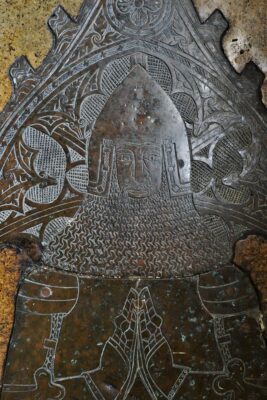
Brass of showing head and praying hands of Sir Nicholas Burnell, knight, dated 1382
1382 brass of Sir Nicholas Burnell, in St Mary's Church, Acton Burnell, Shropshire.
Photo © Michael Garlick, cc-by-sa/2.0 , via Geograph

Often the early records show affixes like these as quite unstable, readily replaced by other family names or by other types of affix. Marks Tey in Essex, for instance, contains the family name Merk but it appears in 1238 as Teye de Mandeville, from Geoffrey de Mandeville, the tenant named in Domesday Book, and in 1342 as Teye atte (N)elmes ‘Tey at the elms’. It’s distinguished from nearby Great Tey, which was Teye al Clocher in 1254 and Theye a la steple in 1286, referring to the church’s bell tower, and from Little Tey, which was Teya Godmar in 1286. (The word Tey (pronounced `tay’, or in IPA [tei]) is assumed to be from an Old English tīege, which may be related to tēag ‘small enclosure’.)

Occasionally, the primary name is dropped, leaving the family name to stand alone. In the North Riding of Yorkshire, Cowling is from Colling, a well documented family name. It was Torneton in 1086, Thornton Collinge in 1270 and simply Collyng in 1400. In a few cases, such as Tiptoe in Hampshire or Guyzance in Northumberland, a family name or surname stands alone and there is no record of a primary name being dropped. It is possible that these are rare examples of medieval place-names formed purely from family names.

Other affixes

As just noted, manorial affixes were by no means the only affixes. Some of England’s most quirky and seemingly comic names have affixes describing size, position in the landscape or other characteristics, such as Great and Little Snoring in Norfolk, Lower Slaughter or Chipping Sodbury (with Middle English cheping ‘a market’) in the Cotswolds, Over Wallop in Hampshire or the Cumbrian hill-names Great and Little Cockup. Some affixes take the form of phrases, as in Barton-in-the-Beans in Leicestershire and its Latin counterpart Barton in Fabis in Nottinghamshire. Again, behind the modern place-names the earlier forms often show great fluctuation, with affixes frequently switching languages or being replaced or lost. Chapel en le Frith ‘chapel in the scrubland’ in Derbyshire seems, however, to have been named as such from the beginning, in the thirteenth century.

Wholly French place-names

Of the wholly French place-names, several consist of a single noun, among them Battle in Sussex (site of the battle of Hastings), Devizes ‘boundary’ in Wiltshire, Pleshey ‘enclosure with interlaced fencing’ in Essex, and Roche ‘rock’, given both to a place by a rocky tor in Cornwall and to an abbey in Yorkshire. Others are compounds, many of them quite stereotyped and complimentary, with beau ‘beautiful’ or a form of it as the first element. Among the numerous places called Beaumont (Norman French beau mont ‘beautiful hill’) from medieval times are Beaumont in Cumberland and Beaumont Chase in Rutland. Unusually and rather charmingly, Beaumont, Essex replaced an Old English name with the opposite sense, ‘foul pit or hollow’. (Beaumont Hamel in Leicestershire is not medieval but transferred from a commune in the Somme, northern France, a significant place in the First World War.) Other place-names containing the highly productive beau or mont include Belper in Derbyshire and Bearpark in Durham (both from beau repaire ‘beautiful retreat’), Egremont in Cumberland and Montacute in Somerset (both ‘pointed hill’), Mountsorrel ‘sorrel-coloured hill’ in Leicestershire, and Richmond ‘strong hill’ in Yorkshire, which was further transferred to Surrey in the sixteenth century. Names of monasteries include Fountains and Haltemprice (‘high undertaking’) in Yorkshire, Blanchland (probably ‘white glade’ in Northumberland), and one that unusually contains a verb: Dieulacres (‘may God increase it’) in Staffordshire. Some French names may be descriptive of their sites, but many appear to be merely conventional and some are transferred from France.

French loan-words in English place-names

A glance at a modern map of almost anywhere in England (for instance maps in the Ordnance Survey Landranger series) will almost always reveal place-names from the Middle or Modern English period which contain originally French vocabulary. Park, lodge, grange and castle are especially common, but also frequent are words such as chase, close, fence, forest and glebe. Many of these words have shifted in meaning over time, but most of them were originally associated with the management of great estates and control of wider territories. The early places named grange were outlying farms of monasteries, for example, and forests were royal hunting preserves, wooded though not always densely so. The New Forest in Hampshire was created by William I, supplanting wasteland and numerous villages, and is already recorded in Domesday Book (1086) in the Latin form Nova Foresta.

New settlements with Middle English names

Many of the post-Conquest centres of population announced themselves as new: Newcastle upon Tyne, several other Newcastles, Newbroughs or Newboroughs, and the almost uncountable Newtowns or Newtons. Newbiggin, widespread especially in the north, contains a word derived from Old Scandinavian bygging ‘building’. Other recurrent names or elements signal the clearing of woodland, for example those containing riding or ridding such as Riddings in at least three counties (though not the three Ridings of Yorkshire), or refer to the draining of fens and building of dykes. Abbotsdik, recorded in Cambridgeshire in 1228, was a monastic boundary.

Modern English naming

As we have seen, the place-names of England take us back at least two or three millennia, and within the grand sweep of history the period from about 1500 is usually considered ‘Modern’, as distinct from medieval. It would be easy to think, perhaps on the basis of reading certain classic studies of English place-names whose focus is chiefly on the periods before 1500, that the five centuries after that date see few interesting developments in the place-names of England. It is true that, with foreign invasions all but over, historical developments tend to be more gradual in this period; that English is virtually the sole productive language (except in Cornwall and the Welsh Marches); and that most significant settlements and natural features have already been named, leaving little room for innovation in major names. Nevertheless, many of the names around us date from this period and they are far from uninteresting.

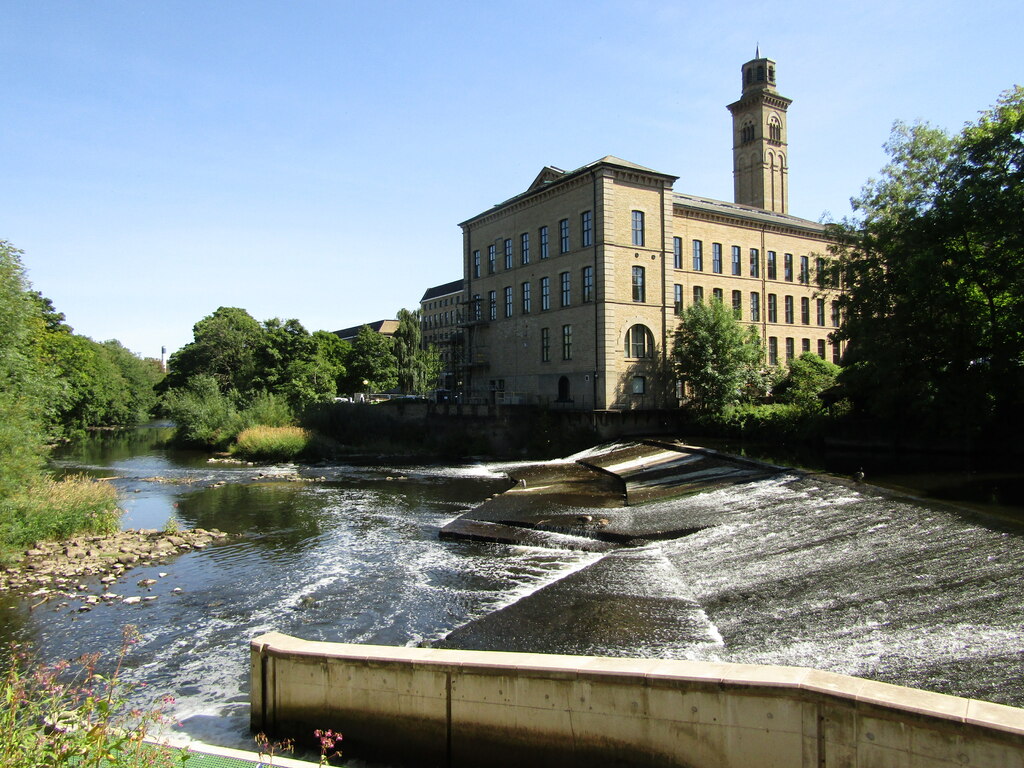
River with weir and nineteenth century mill building
Salt's Mill and the River Aire, Saltaire, West Yorkshire

Major and minor names

Some new major names were consciously coined in this period. Ironbridge in Shropshire — both the bridge built across the River Severn in 1779 and the place-name — is an outstanding icon of the Industrial Revolution, and the place-name Telford, given in 1968 to a Shropshire new town centred on Dawley, commemorates the Scottish engineer Thomas Telford (1757–1834). Other surnames conveniently formed plausible place-names in Fleetwood, Lancashire and Peterlee, Durham, while Saltaire, Yorkshire combines the surname of industrialist Sir Titus Salt with the river-name Aire, and Port Sunlight, Cheshire takes its name from a brand of soap produced there.

Different industries, and a different kind of naming history, are seen in Southend-on-Sea. Sowthende is recorded in 1481 as the southern end of the parish of Prittlewell, Essex, but the expansion of the place and the dominance of the name Southend began in the late eighteenth century with the exploitation of local oyster-beds and the emergence of Southend as a fashionable seaside resort.

Much of the interest of the modern phase of naming, however, lies in so-called minor names, whether of natural or manmade features, and thousands of these have been coined in the last five centuries. Indeed, some of the smallest features have the most beguiling names, for instance salmon pools on the River Tweed called Three Brethren (named in turn from distinctive rocks nearby) or White Cat, fields called Dung Cart Close or Three Cocked Hat, and a wood called Top Boot Plantation.

Traditional and derived names

The great majority of the more recent names seen on maps and around us in everyday life follow well-established models, such as the numerous Coldharbours, Cold Wells or West Hills. A very large number are secondary or dependent names derived from older ones, since every major settlement will spawn many offspring. Battersea, for instance, gives rise to Battersea Bridge, Battersea Park, Battersea Park Station, Battersea Power Station, Battersea Reach and many others. In a contrastingly remote, rural setting, a small valley named Bleadale in Lancashire (Grid Reference SD6049) gives its name to a Bleadale Nab, Ridge and Water; and clustering like this occurs almost everywhere.

New types of naming

Alongside the continuing use of established patterns there is fresh, inventive naming, and some trends emerge in the modern period that break traditional moulds and allow an element of whimsy into naming. Some of them are foreshadowed in the medieval period, and many are seen especially in field-names. In terms of structure, traditional English-language place-names typically take the form of a simplex comprising a single word (Slough, Poole) or more often a compound, with a noun or adjective acting as a specific qualifying a generic term (Oxford, Whitechapel in London). In terms of original meaning, such traditional names tend to convey information about a place, by describing an aspect of the landscape, referring to the place’s function or naming one or more stakeholder. Several types of modern naming depart from these norms in form or meaning or both, including the following.

Verbal place-names such as Glororum (‘Glower o’er ’em’) and Pity Me are distinctive in containing verbs, and they often express a subjective response to a place (see our Place-name story: Pity Me).

Many transferred names reflect exploration and colonial expansion. California in Norfolk is one of over twenty examples of this name, and all parts of the world are represented. The Place-Names of Cambridgeshire, for example, lists the following field-names: America, Bunkers Hill, China Close, Dunkirk, Flanders Ground, Gibraltar Close, Isle of Elba, Jamaica, Jerusalem, New England, New Zealand, Scotland and Yorkshire. Many of these convey a sense of remoteness (and similar names are sometimes applied to farms or dwellings on the outer parts of their parishes), but some are clearly commemorative. Bunker Hill or Bunkers Hill is common nationally and refers to the battle of Bunker Hill (1775) in the American Revolutionary War. References to Trafalgar, Waterloo and other climactic events in the Napoleonic Wars are extremely frequent. The most outstanding example, since attached to the most populous place, is the Lancashire town of Nelson, derived from a pub-name.

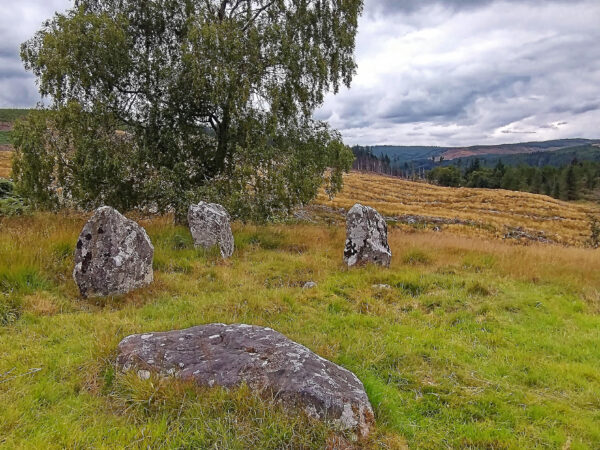
Three low standing stones and a fourth on the ground, with background of forested low hills
The Three Kings, Redesdale, Northumberland
Photo © Diana Whaley

Returning to Cambridgeshire, the use of irony in place-names is illustrated by Hundred Acres and Thousand Acres applied to very small fields, and another widespread form of irony is the use of ‘hall’ for modest farmhouses, such as instances of Lark Hall or Sparrow Hall in many counties.

Figurative or metaphorical names imagine distinctive rocks and other landforms as animals, humans or objects, on the basis of chance resemblances. Dramatic chalk stacks off the Isle of Wight are already named The Needles (Nedlen) in 1333, and other examples include Devil’s Punchbowl in several counties and The Tailor and his Man in Northumberland. The Three Kings in Redesdale, Northumberland, were formerly ‘Three Kings of Denmark’, but originally four standing stones formed a ‘4-poster’ stone circle of the second century BC.

Names on the map: an example

Many or most of the place-names on a small-scale map such as a road map or an Ordnance Survey Landranger map (scale of 1: 50,000) will be of medieval origin. Yet if we go to a larger scale as in the Explorer map series (1:25,000) a much more fine-grained namescape emerges, with plentiful names that look much more recent, and probably are in most cases. And these always offer the potential for seeing patterns or noting names that seem to stand out as exotic or eccentric.

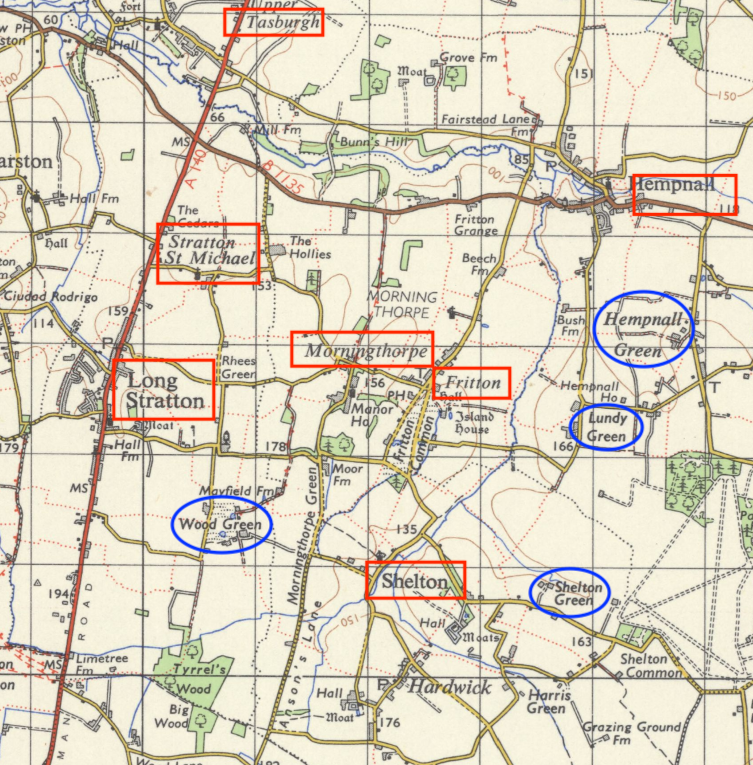
To take a random example: in the area around the village of Fritton in south Norfolk (Grid Reference TM2292) the names of main settlements tend to date from the Anglo-Saxon period. Fritton itself is recorded in Domesday Book of 1086, as are its neighbours Hempnall, Morningthorpe, Shelton and Stratton (Long Stratton and Stratton St Mary, situated, as the name Stratton hints, on a Roman road) and Tasburgh. Very striking also is the frequent use of the element green ‘grassy spot, village green’ in names of hamlets and farmsteads such as Hempnall Green, Lundy Green, Shelton Green and Wood Green. There is already an instance of this usage in Domesday Book, where Mangreen (now Mangreen Hall in Swardeston parish, Norfolk) appears, but it was clearly productive over several centuries (Suffolk has over 500 instances, the oldest known being Wickham Green from the thirteenth century). Outside East Anglia, it is also characteristic of South-East England and the West Midlands. Minor names shown on the Explorer map but not the Landranger, and likely to be relatively recent include farm-names such as Beech Farm, Bush Farm, Hollies Farm and Malthouse Farm, routeways such as Blacksmith’s Lane and Boudica Way, a wood called Devil’s Wood and a piece of land named California, which takes us into the new types of naming in the modern period outlined in the previous section.

Map of Fritton Common, Norfolk, 1969 (Grid Reference TM2292). Photo © Ordnance Survey/National Library of Scotland, CC-BY. Reproduced (with added labels) with the permission of the National Library of Scotland.

Names such as these all have stories to tell, if time and sources permit  them to be researched in full by place-name scholars or by local historians (who are often in the best position to throw light on recent naming). Wherever on the map of England you might choose to look, there will be patterns and points of interest in the place-names, and we hope that this introduction, together with ‘Selected sources’ here and Reading Suggestions, will suggest some useful starting-points for thinking about them.

Read about personal names in England’s place-names.

Selected sources

Briggs, Keith and Kelly Kilpatrick (2016), A Dictionary of Suffolk Place-Names.

Cavill, Paul (2018), A New Dictionary of English Field-Names.

Clark, Cecily (1992a), ‘Onomastics’, in The Cambridge History of the English Language II. 1066-1476, ed. Norman Blake; pp. 542–606.

Clark, Cecily (1992b), ‘The myth of the “Anglo-Norman scribe”‘, History of Englishes. New Methods and Interpretations in Historical Linguistics, ed. Matti Rissanen et al., pp. 117-29.

Digital Survey of English Place-Names [a digitised version of the County Surveys of the English Place-Name Society].

Gelling, Margaret and Ann Cole (2014), The Landscape of Place-Names.

Jones, Richard (2011), ‘Thinking through the manorial affix: people and place in medieval England’, in Life in Medieval Landscapes: People and Place in the Middle Ages, ed. Sam Turner and Robert Silvester, pp. 251–67 [distribution map on p. 253].

Mills, A. D. (2011), A Dictionary of British Place-Names [for introduction and place-name etymologies].

Reaney, P. H. (1943), The Place-Names of Cambridgeshire and the Isle of Ely [field-names on p. 357].

Watts, Victor (2002), A Dictionary of County Durham Place-Names [for detail on Sunderland].

Watts, Victor (2004), The Cambridge Dictionary of English Place-Names [for place-name etymologies, and for discussion and map of green in place-names, by Watts and Brian Roberts, pp. l and lix].

Whaley, Diana (2015), ‘The other millennium: place-naming after the Conquest’. Journal of the English Place-Name Society 46, pp. 5–31 .

Text © Diana Whaley and Keith Briggs 2024