Walker, Fuller and Tucker

Walker, Fuller and Tucker: workers of cloth

Walker is the twelfth commonest surname in Britain; there were 100,114 persons with this name in the 1881 census and over 133,000 by 2011. Contrary to the Johnnie Walker whisky logo, it has nothing to do with a gentleman striding along in a topper and tails. It is an occupational name, the third most common category of surname, after toponymics and patronymics. In medieval Britain, when the surname was coined, a walker was a fuller of raw woollen cloth and a vital operator in the woollen cloth trade on which the later medieval English economy heavily depended. Fulling meant scouring and cleansing the woven material to remove oil and dirt, and also to thicken and strengthen the cloth by shrinking and felting the fibres. It was done using either the bare hands or a club or the feet to pound the cloth in warm water, to which had been added a cleansing agent such as stale urine or lye, a strong alkaline solution made with ashes.
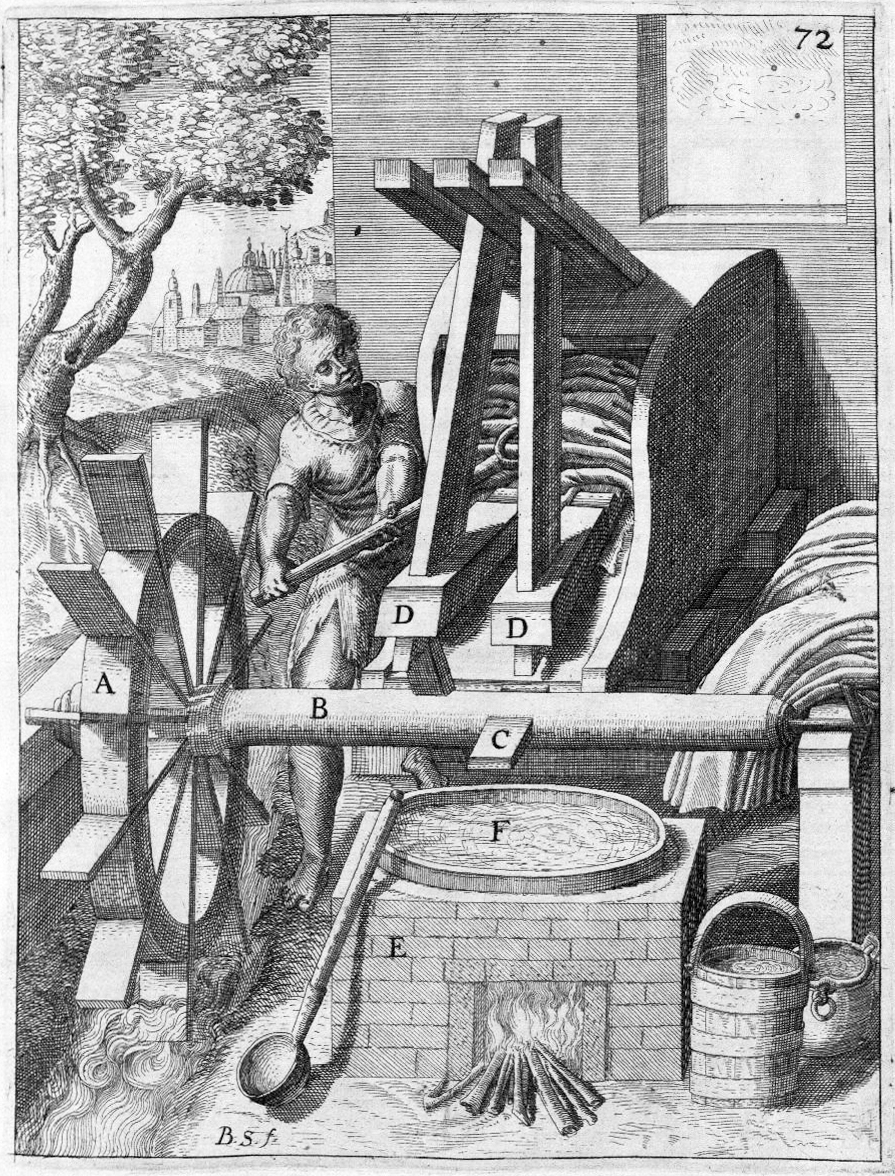
Engraving showing a person working at a fulling mill. A pan of liquid is bubbling over a fire. A waterwheel is driving a machine, into or out of which cloth is being taken.
Engraving of a water wheel driving a German fulling stock from Böckler's Theatrum Machinarum Novum (1661)
Georg Andreas Böckler, Public domain, via Wikimedia Commons

Trampling or ‘walking’ the cloth underfoot in wooden troughs was the most common method until the thirteenth century, when the growth of the cloth trade led to the introduction of water-powered fulling mills and the use of fuller’s earth (a finely-grained type of clay) as the cleansing agent. The ‘walking’ was now done automatically by a wooden mallet in a trough called a fulling stock. Beverley in the East Riding of Yorkshire was one of the centres of the medieval cloth trade and it is no accident that the street known as Walkergate (gate is a northern dialect word for ‘street’) ran along one of the town’s watercourses, called Walkerbek in 1355. This stream would have powered the walker’s fulling mills.

Fuller is naturally another surname derived from this occupation and so is Tucker.  Once fulled, the cloths needed careful drying out to prevent further shrinking. This was done by stretching or ‘tucking’ them out in the open air on wooden frames known as tenters, to which they were attached by tenterhooks. Tenter fields or tenter grounds were common outside towns from medieval times onward.If you want to see what tenterhooks look like, this page has a photograph showing blankets being removed from tenterhooks in Witney in Oxfordshire in the early twentieth century. Walkers, fullers or tuckers (the terms were synonymous) did the tentering as well as the fulling right into the twentieth century.

Continuing with the cloth-making process

After tentering came teaseling, when walkers used the dried heads of what was known as fuller’s teasel (Dipsacus fullonem) to raise the nap of the cloth into a fine softness. Surnames from this part of the process, Tesler and Teslar, are rare, with only 14 instances (six families) in the 1881 census. Excess nap was then trimmed off with shears (whence the surnames Shearer, Sherman and Sharman ‘shear-man’). After a final pressing, the cloth was sent to a Dyer if required, before being sold on by a Draper and either tailored into clothes or made into blankets and other coverings. William Langland encapsulated the process in his Vision of Piers the Plowman, c. 1378:

Clooth that cometh fro the wevyng is noght comly to were

Til it be fulled under fote or in fullyng stokkes,

Wasshen wel with water and with taseles cracched,

Ytouked and yteynted and under tailloures hande   [B text, xv. 450–53].

(Cloth that comes from the weaving process isn’t fit to wear / until it has been fulled under foot or in fulling stocks / washed well with water and combed with teasels / tucked and stretched and in a tailor’s hands.)

The distributions of Walker, Fuller and Tucker

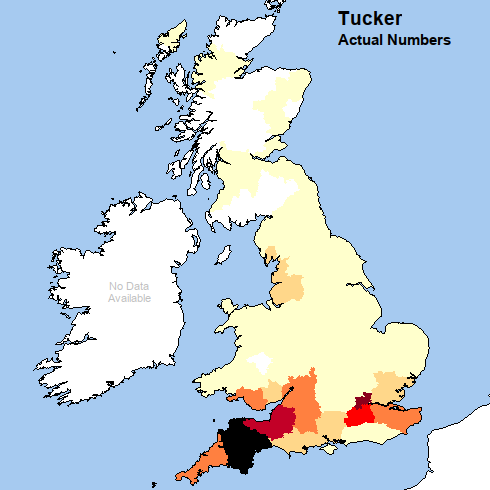
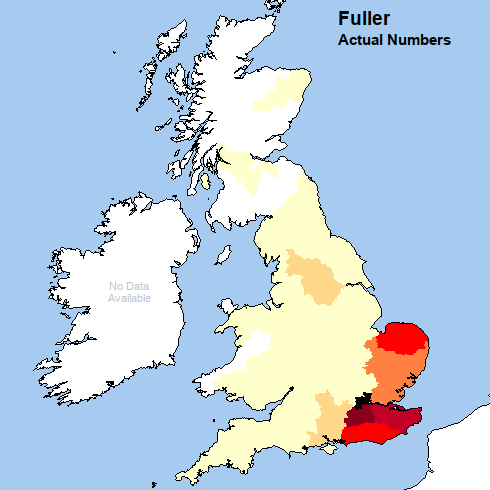
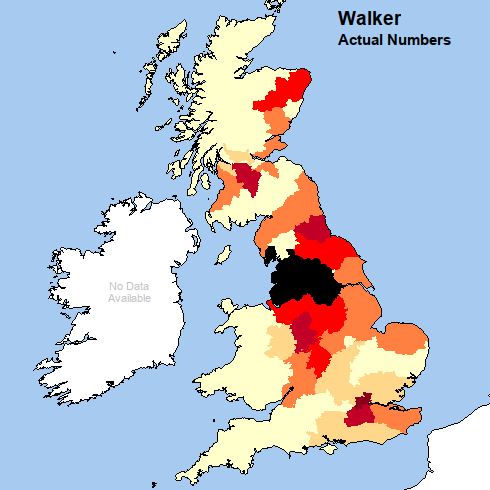
As occupational terms and surnames, the synonyms Walker, Fuller and Tucker are characteristic of different parts of Britain. In medieval Britain Walker belonged mainly to the west and north, Fuller to the south-east, and Tucker to the south-west. This was still true in the 1881 census. While the numbers for Fuller (12,054) and Tucker (16,489) are smaller than Walker (100,114), they are quite large in themselves in their more limited distribution.

Map of Britain with title 'Walker: actual numbers'. Lancashire and West Yorkshire are shaded black and many counties in England and Scotland are shaded red or orange.
Distribution and frequency of Walker in 1881 (darker colours indicate higher numbers)
Map of Britain with title 'Tucker: actual numbers'. Devon is shaded black, Somerset, Middlesex and Surrey are mid red and some other counties are shaded deep orange (Cornwall, Glamorgan, Gloucestershire, Kent, Wiltshire). Other coutnies have lighter shading or no shading.
Distribution and frequency of Tucker in 1881 (darker colours indicate higher numbers)
Map of Britain with title 'Fuller: actual numbers'. Middlesex is shaded black, Kent and Surrey are deep red, Sussex and Norfolk are mid-red and Essex, Suffolk and Cambridgeshire are deep oange.All other counties have lighter shading or no shading
Distribution and frequency of Fuller in 1881 (darker colours indicate higher numbers)
© Steve Archer, British 19th Century Surname Atlas, version 1.20 (2003–2015)

Select Sources

Fransson, G. (1935), Middle English Surnames of Occupation 1100–1350.

Hanks, P., R. Coates and P. McClure eds (2016), Oxford Dictionary of Family Names in Britain and Ireland.

Salzmann, L. F. (1913), English Industries of the Middle Ages

Schmidt, A. V. C.  (1978), The Vision of Piers Plowman. A Critical Edition of the B-Text.

Text © Peter McClure 2023