Since the 1930s ‘Mills & Boon’ has been a byword for escapist romantic fiction. The firm was established in 1908 as a general fiction publisher by Gerald Musgrove Mills and Charles Boon, who had known each other for ten years as managers in the publisher Methuen and Co. of London. Their backgrounds were at opposite ends of the social scale. Mills was the son of a well-to-do West Midlands solicitor and was educated at a university college in Birmingham and Caius College Cambridge. Boon was born into a poor, London household, eldest son of a brewer’s servant. His father’s death forced him to leave school at the age of 12 to earn money for his family through doing odd jobs. He later joined Methuen’s as office boy and warehouse clerk and worked his way up to being its general manager. But their surnames tell quite opposite stories of ancestral origins and changes in social fortune. And London, as ever, is the magnet that for the last 700 years has attracted migrants from all over England, seeking work.
Mills & Boon part 1: Mills
The family name Mills
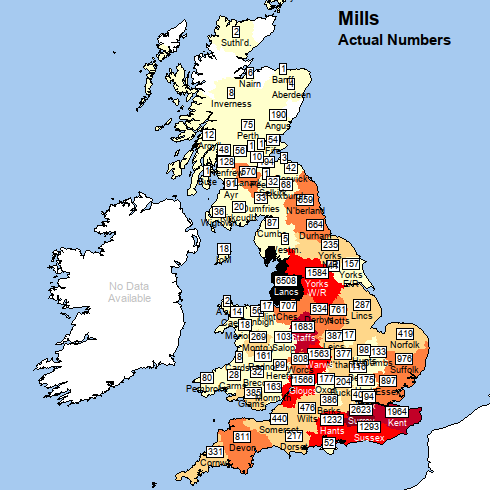
Gerald Mills’s father, Harry, was born in Wordsley (Staffordshire), two miles from Old Swinford (in Stourbridge, Worcestershire), where Harry’s mother was born, and two miles from Halesowen, where Harry grew up, fatherless, with his mother and his uncle, a master tailor. The name has a long history in the locality. In 1573 a William Mills is recorded in Kidderminster, six miles from Old Swinford; in 1641 a Thomas Mills is recorded in Old Swinford itself; and in 1769 a Nancy Mills is recorded in Halesowen. The surname is in fact common and widespread across the UK, ranking 80th, with 38,742 bearers in the 1881 census.
Its distribution is weighted, however, towards Lancashire, the West Midlands and southern England counties. The Lancashire and London area figures are swelled by migrants from Ireland, especially its northern counties, where the surname was introduced by English migrants from the 17th century onward. In Worcestershire, however, the name is mainly indigenous and has its epicentre in the districts of Kidderminster, Stourbridge and King’s Norton. It has several possible origins. It could be a patronymic from the Middle English male personal name Miles, or a metronymic from Mille, a pet form of the female personal name Millicent. Patronymics (from the name of a father) are the second largest category of English surnames but metronymics (from a mother’s name, probably often a widow) are far less common. Mills might once have meant ‘Mille’s (son)’ or perhaps ‘Mille’s (servant)’, an occupational surname. On the other hand, Miles and Mille are far from common as baptismal names in medieval England.
The chief source of Mills is a common Middle English topographical expression, atte mille ‘at the mill’, to which a meaningless -s was added after Mill had become a hereditary surname, i.e. a family name, in the 15th century or earlier. Surnames with a meaningless excrescent -s became increasingly frequent in the 16th and 17th centuries, especially in the West Midlands, where the habit may have been imitating hereditary patronymic surnames with final -s (e.g. Jones (surname) and Williams), which were also exceptionally common in that area of England. Topographical surnames such as Brook(s), Mill(s), Style(s) and Wood(s) were the first to be altered in this way. Names such as this, alluding to a person’s residence or occupation at a feature of the townscape or landscape, form the fifth most common type of English surname, with or without an excrescent -s. In theory, the -s could have denoted residence or occupation at a plurality of mills but, while there are some medieval examples of more than one mill at a single site, the medieval surname atte milles is so vanishingly rare that it cannot be a usual source of the surname.
Mills and Millers
The medieval name atte Mille will often have been given to the miller, although such men were more often surnamed Miller. Both surnames are common because it was to the profit of any lord of the manor to require his unfree tenants not to use hand-querns at home for grinding their corn but to use his mill and pay a toll (a percentage of the grain). The miller himself was one of the wealthier of the lord’s peasants and, like Chaucer’s Miller in the Canterbury Tales, was stereotypically a thief of his customers’ grain – a popular reputation that Chaucer comically exploited again in the Reeve’s Tale, where two university students take revenge on a thieving miller. The earliest mills were driven by water and this remained the normal type in all areas where there were good supplies of running water. In the 12th century, windmills were introduced to England, which solved the shortage of watermills in drier areas. These were not the fixed, brick-built tower mills that became almost universal in the 19th century but wooden post mills, where the whole body of the mill could be turned on its centre post to face the wind; the sails were cloth-covered, and the entire mill could be moved to a different site if needed.
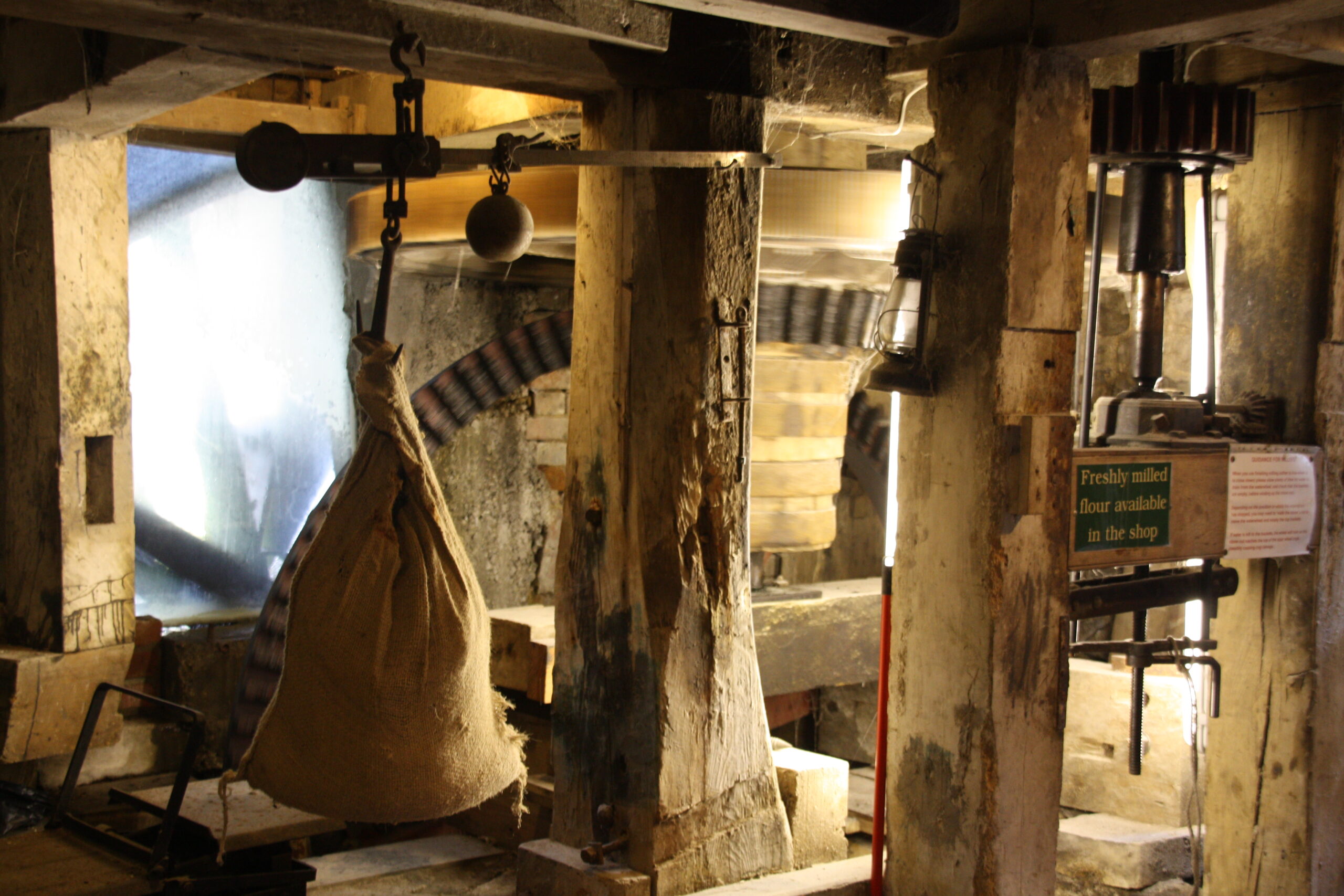

We cannot know which of its several possible sources lie behind Gerald Mills’s surname, but the probability is that it originated in one of the essential peasant occupations of medieval Britain.
Read about the surname Boon in Mills & Boon part 2: Boon
Select Sources
Ancestry (2002–2024), Ancestry.co.uk.
Archer, S. (2003–15), British 19th Century Surname Atlas, version 1.20.
Bennett, H. S. (1962), Life on the English Manor, pp. 129–35.
Hanks, P., R. Coates and P. McClure eds (2016), Oxford Dictionary of Family Names in Britain and Ireland.
Intellectual Reserve, Inc. (–2024), FamilySearch.
McKinley, R. A. (1990), A History of British Surnames, pp. 85–87.
Moore, C. (2010), Windmills: A New History.
Muhr, K. and L. Ó hAisibéil eds (2021), The Oxford Dictionary of Family Names of Ireland.
Text © Peter McClure 2025