Pet-forms of personal names
In ordinary familiar speech, these names of Norman introduction were commonly expressed in a wide variety of pet-forms (hypocorisms). The simplest move was to shorten a name back to its main-stressed syllable, as in Nick (or Col) for Nicholas, Rob, Tom, Will, and so on. To these were added diminutive suffixes, including Old French ‑et, ‑in, ‑ot and double diminutives such as ‑elin, ‑elet and ‑elot. These can be seen in Huet (Hugh), Willot, Raulin (Ralph), Robin, Colin, Perot, Tomelin, Robelet and Hughelot, from which come the modern surnames Hewitt, Willett, Rawlin, Robinson, Collins, Parrot, Tomlinson, Roblett and Hewlett. These were ready-made French pet-forms, borrowed into English from Norman usage along with the full name-forms. The most productive hypocoristic suffix in post-Conquest England was Middle Dutch ‑kin, which the Normans had picked up from their neighbours in Picardy and Flanders. Many Flemings and Picards also settled in England under the protection of Norman and later kings. Jankin, Jenkin, Jonkin (all for John), Larkin (Laurence), Perkin, Tomkin and Wilkin are common examples of the type in late medieval records and they survive in modern surnames.
Hitchcock, however, represents a peculiarly English way in which ordinary folk familiarised these new Norman names as pet-forms. The suffix ‑cok is not French but English, probably a double diminutive ‑k-oc, giving rise to pet-forms such as Hancock (Henry), Tomcock and Wilcock. An even more striking novelty was to play with the initial consonant to produce a rhyming form. Hitch and Hick are pet-forms of Richard (alias Rickard) and belong to a set that are rhymed on a name beginning with R-, such as Hob (Robert) and Hodge (Roger). An alternative was to rhyme these names with an initial D-, as in Dick, Dob and Dodge. These rhyming pet-forms, as well as the hypocoristic suffix -cok, were largely associated with the English rural peasantry (free and unfree) and the labouring folk in towns. Most of the Norman R- names, including Richard, Robert and Roger, have continued as English first names at all levels of society up the present time, a span of around 900 years. It shows how strong traditions can be in the naming of children. It is a different matter with pet-forms, which tend to be less stable over time. Since the 16th century many of the medieval English pet-forms have been progressively abandoned. But the old usages are still with us, largely unrecognised, in patronymic surnames that had become hereditary before 1500, including rhyming ones such as Hitchcock, Hickox, Higgs, Higson, Dixon, Dobson, Dodgson, Hobson and Hopkins.
Hitchcock: a tale of conquest and patriarchy
Some surnames from medieval English baptismal names are metronymic (from a mother’s name), such as Dyson from the female name Dye, a pet-form of Dinis (modern Denise). But most of them are patronymics, i.e. from the names of fathers, and these names are overwhelmingly continental in origin, a direct consequence of the Norman Conquest. As such, Hitchcock has two stories to tell. It exemplifies the primarily patriarchal nature of family life in England’s long history, and it shows how personal naming reflects and manages social change. The Norman Conquest brought a radical upheaval to all levels of English society. The English adoption and adaptation of the Norman baptismal name stock was both a public and an intimate process by which the ruled and their rulers began to develop a new, continentally English identity.
Select sources
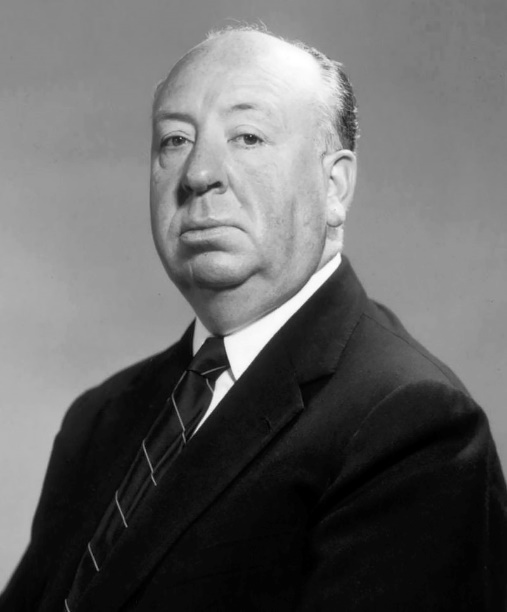
Alfred Hitchcock Wiki (–2023).
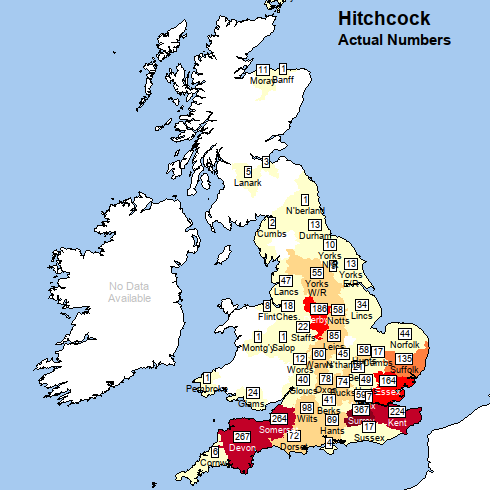
Archer, S. (2003–15), British 19th Century Surname Atlas, version 1.20.
Hanks, P., R. Coates and P. McClure, eds (2016), Oxford Dictionary of Family Names in Britain and Ireland.
McClure, P. (1998) ‘The interpretation of hypocoristic forms of Middle English baptismal names’, Nomina 21, 101–31.
McClure, P. (2005), ‘The kinship of Jack: II, pet-forms of Middle English personal names with the suffixes ‑cok and ‑cus’, Nomina 28, 5–42.
Reaney, P. H. (1967), The Origin of English Surnames, chapter 7.
Text © Peter McClure 2025