Attenborough

Sir David Attenborough, naturalist, broadcaster and environmental campaigner, and his brother the late Lord (Richard) Attenborough, actor and film maker, have made this surname a household name. It is an outstanding example of a monogenetic surname—a surname where most modern bearers probably descend from a single ancestor.

The two brothers were sons of Frederick Attenborough, principal of University College Leicester (1932–1951), who was born in 1887 in Stapleford (Nottinghamshire), just four miles from the barely populated hamlet of Attenborough.

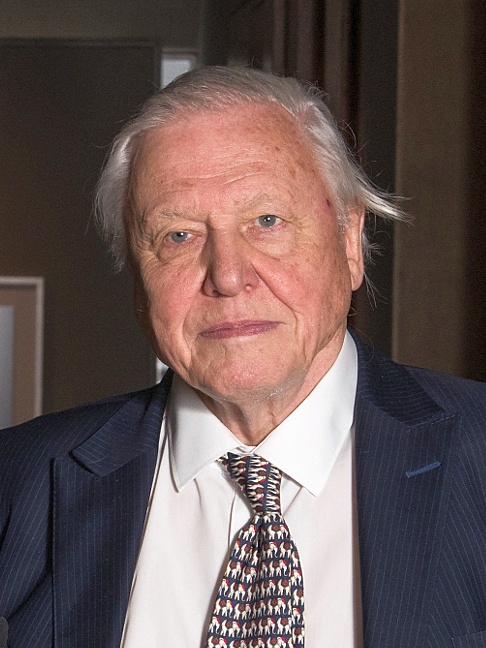
David Attenborough (1926–).
Photo © John Cairns, CC BY 4.0, via Wikimedia Commons
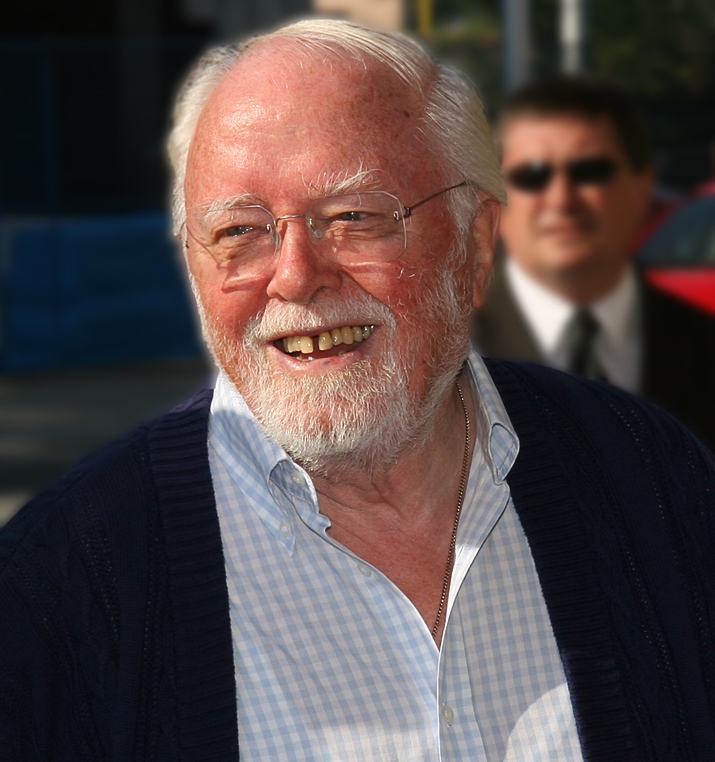
Richard Attenborough (1923–2014)
Photo © gdcgraphics, CC BY 2.0, via Wikimedia Commons
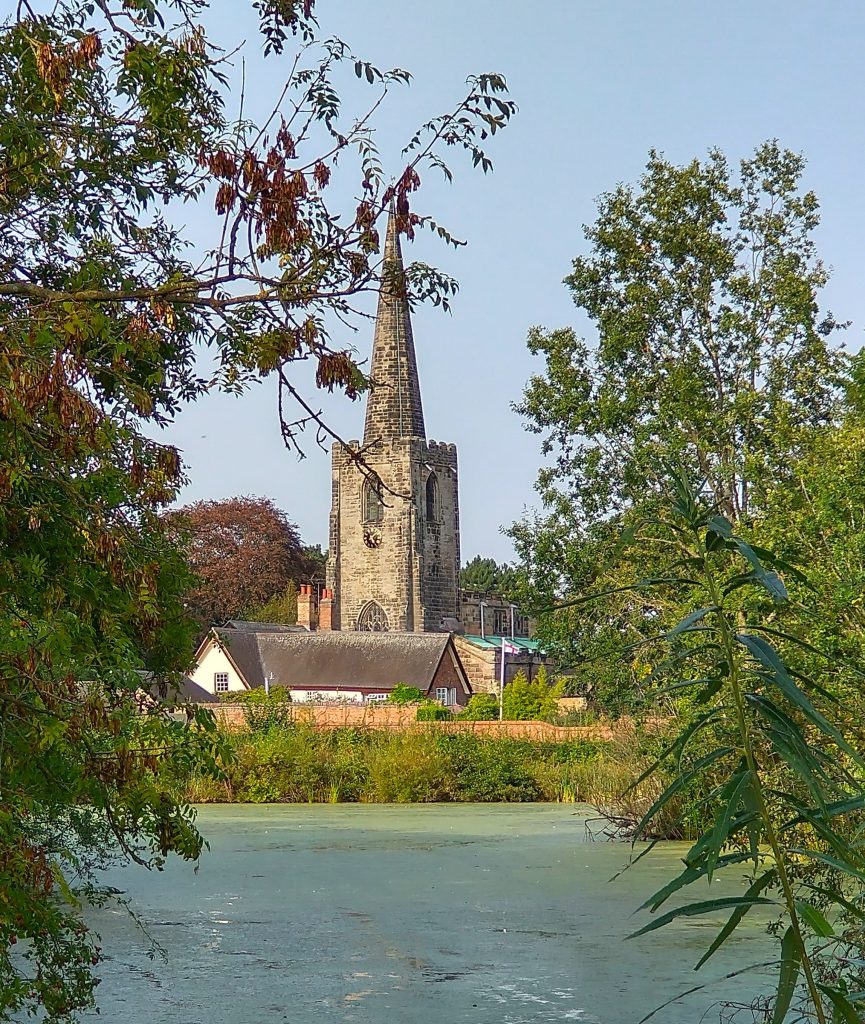
Church with tower and spire viewed across a lake
St Mary's Church, Attenborough
© Diana Whaley

The place

It was Attenborough’s church that was important in medieval times, when it served the inhabitants of Chilwell and Toton and was endowed by the aristocratic Nottinghamshire families of Babington, Nevil and Leake. It lies close to the river Trent on a ridge of gravel, and gravel pits along the north bank of the river here have been turned into the wonderful Attenborough Nature Reserve. How appropriate for a place-name that gave rise to a surname borne by a naturalist!

The place-name

There is only one place in England called Attenborough, and there is no doubt that this is where the surname comes from, in spite of its tiny population at the time of surname creation (13th and 14th centuries). The place is first recorded in the late twelfth century as Adingburg, denoting the burh (‘stronghold’ or ‘manor’) associated with a man named Adda. Adda’s name was an Old English personal name for which we have no evidence after the Norman Conquest in 1066, so the place-name is possibly of pre-Conquest (or Anglo-Saxon) origin even though it’s not recorded until the twelfth century.

The surname

The surname derived from the place-name is first recorded in about 1200 (as Adigburc) and it occurs as the name of a Nottingham baker (John de Addingburgh) in 1352. It was not until the sixteenth century that the pronunciation Attenborough began to take hold. A Frances Attenborrow is recorded in 1587 in the parish registers of Clifton (two miles from Attenborough on the south bank of the Trent), while in the parish registers of Attenborough itself are recorded William Adenborowe in 1601 and Ann Attenborow in 1603. Deborah Attenborough, registered in 1704 in Stapleford, is a direct forbear of the family of Frederick, David and Richard Attenborough.

How common is Attenborough as a surname?

Attenborough belongs to the commonest category of English family names, toponymic surnames. Toponymic surnames are so called because they derive from specific place-names.

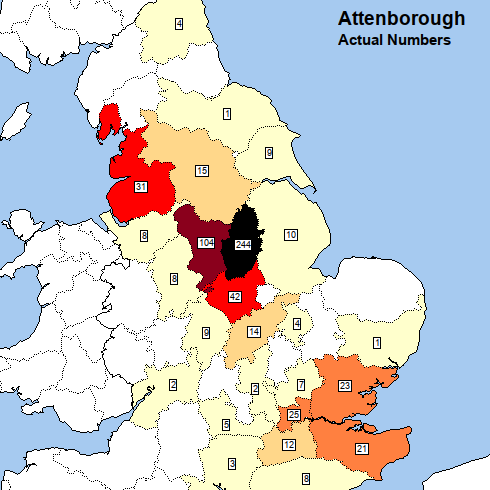
This particular name is rare and has remained remarkably localised over eight centuries. This is not as unusual as you might think. The majority of modern English surnames are relatively uncommon, occurring in the low thousands or less. Most surnames are still found fairly close to where the families who initially bore the name proliferated. This is in spite of the recurrent mobility of most families since the late medieval period, when English surnames generally became hereditary. Surnames have, of course, also migrated with their bearers, sometimes over long distances, especially to London. In the 1881 census there are 621 persons named Attenborough, 244 of them in Nottinghamshire, 104 in Derbyshire, 42 in Leicestershire and fewer elsewhere, including some around London.

Map of central and northern England with title 'Attenborough: actual numbers'. Nottinghamshire is shaded black and labelled 244. Derbyshire is shaded deep red and labelled 104. Lancashire and Leicestershire are shaded mid red and labelled 31 and 42 respectively. All other counties have lighter shading.
Distribution and frequency of Attenborough in 1881 (darker colours indicate higher numbers)
© Steve Archer, British 19th Century Surname Atlas, version 1.20 (2003–2015)

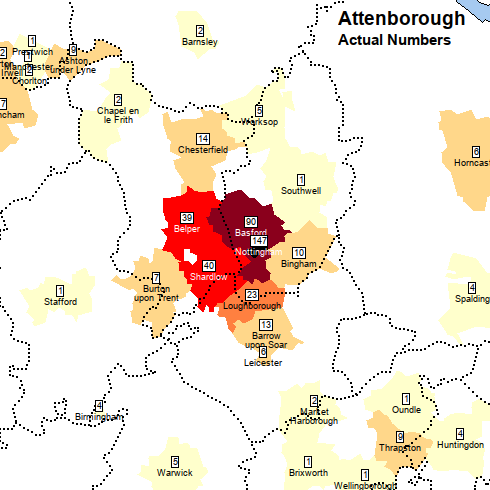
If we add in some spelling variants of the same family name, such as Attenbrough, Attenborrow, Attenburrow and Attenbury, the distribution pattern does not change substantially. And if we look at Archer’s mapping of this surname at the level of the Poor Law Union (which was used as the census registration unit), we can see that its epicentre, with 147 bearers, is in the Nottingham Poor Law Union, which contains Stapleford, Toton and Attenborough.

Map of parts of Nottinghamshire and Derbyshire with label 'Attenborough: actual numbers'. Nottingham is shaded black and labelled 147. To the north, Basford is shaded deep red and labelled 90. Immediately to the east of Nottingham and Basford, Belper and Shardlow are shaded mid red and labelled 39 and 40 respectively. To the south of Nottingham. Loughborough is shaded orange and labelled 23.
Distribution and frequency of Attenborough at the level of Poor Law Union in 1881 (darker colours indicate higher numbers)
© Steve Archer, British 19th Century Surname Atlas, version 1.20 (2003–2015)

Surnames and DNA

Archer’s mapping of the surnames in the 1881 census has revolutionised family name research. This and the earlier documentary evidence provide convincing evidence that Attenborough has a single origin, but that does not necessarily mean that all modern bearers of the name have the same ancestor. There could have been two or more unrelated men from Attenborough who were known by that name and who might have fathered a long line of descendants.

This is where DNA evidence has recently become a vital new tool in researching family origins. Turi King and Mark Jobling of Leicester University have shown that the Attenboroughs do share a common ancestor, since their DNA exhibits a haplogroup that is rare in Britain. (A haplogroup is a group of related genetic variants sharing a common ancestor.) This means that there probably was a single founder for the surname Attenborough.  Professors King and Jobling point out, however, that DNA is no magic bullet in family research. Its evidence can be complex and inconclusive, and even in fairly clear instances of surnames that reflect a shared family origin, the Y-chromosome (inherited down the male line like most surnames historically) is not usually borne by all male members of the family, thanks to what genealogists politely call ‘non-paternity events’.

Select Sources

Ancestry (2002–2024), Ancestry.co.uk.

Archer, S. (2003–15), British 19th Century Surname Atlas, version 1.20.

Gover, J. E. B., A. Mawer and F. M. Stenton (1940), Place-Names of Nottinghamshire, pp. 142–43.

Hanks, P., R. Coates and P. McClure eds (2016), Oxford Dictionary of Family Names in Britain and Ireland.

Intellectual Reserve, Inc. (–2024), FamilySearch.

King, T. E. and M. A. Jobling (2009), ‘Founders, drift, and infidelity: the relationship between Y chromosome diversity and patrilineal surnames’Molecular Biology and Evolution 26,  1093–1102.

Redmonds, G., T. King and D. Hey (2011), Surnames, DNA, and Family History, pp. 185–86.

Text © Peter McClure 2023