Golden Hopes

Forty-eight Dunstable jurors could not solve the mystery of Goldenlowe. It was a burial mound, like many a hlāw, and in 1290 a jury reported that Matthew Tyler found treasure there. Instead of reporting this as the law required, he kept the money, which passed to Adam Rouse. While Adam kicked his heels in jail, a second double jury overturned the verdict of the first, and finally a third unprejudiced set from outside the town found he was the victim of attempted blackmail and let him free.

Whether the claims were real or invented, people evidently associated Goldenlowe with treasure. It’s not unusual for places to be named after valuables that have been found there. At Wallasey, over the Mersey from Liverpool, some boys had run through a gap – a path down to the beach – to go swimming when one of them felt something hard under his toes. It turned out to be a golden guinea, and soon many more were uncovered. This was in 1847, and by 1859 the spot was well known as Guinea Gap. On the Northumberland coast, sands near Guile Point opposite Holy Island were called Dollar Banks after coins washed up from the wreck of a foreign ship. Mitford, also in Northumberland, has Money Banks named after a hoard of early coins discovered there.
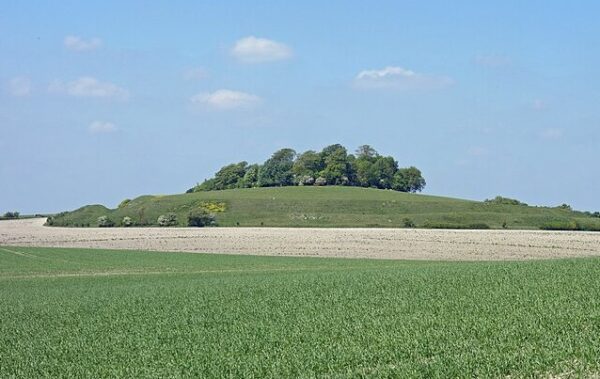
Money is a popular element in these names. Money Hill at Ashby de la Zouch (Leicestershire) got its name when a Roman hoard was discovered in 1818, while copper bars were found in 1861 by antiquarians excavating a barrow afterwards named Money Hill at Therfield (Hertfordshire). Money Field inside the hillfort of Ruborough Camp (Somerset) was the source of many valuable relics, though despite local claims it is unlikely to have concealed ‘an iron castle full of gold and silver, guarded by gnomes and spirits’. The trail of treasure place-names soon leads us into a twilight zone between legend and archaeology. Money Pit within the ramparts of Castle Hill at Long Wittenham (Berkshire) was explored by a villager who, they say, got as far as an iron chest before a raven appeared, croaking ‘He is not born yet!’ to warn the rash excavator to stop.

Photo of wooded hill
Castle Hill, the site of Money Pit, at Wittenham Clumps, Berkshire (formerly Oxfordshire)

Like the legends, these names are all modern: the earliest (to my knowledge) is Money Pit, dating to 1768, at Ketton in Rutland. Some earlier names look similar, for instance Monyash in Derbyshire or Moneylaws Hill in Northumberland, but these have been reworked from the specific manig ‘many’. When people talked about money in the Middle Ages, they spoke of seolfor ‘silver’, the ordinary medium of exchange. The Silver-field at Sowerby near Halifax was named after a find of Roman coins. There is a Silverpit at Kinderton cum Hulme (Cheshire) and Leicestershire has five Silver Hills, the earliest recorded in 1645. Names like this were being coined in the Middle Ages, for there is a Sylverehowe 1422 at Hemsby (Norfolk), from haugr ‘burial mound’, the Old Norse equivalent to hlāw. (Both words can refer to natural hills as well as burial mounds.)

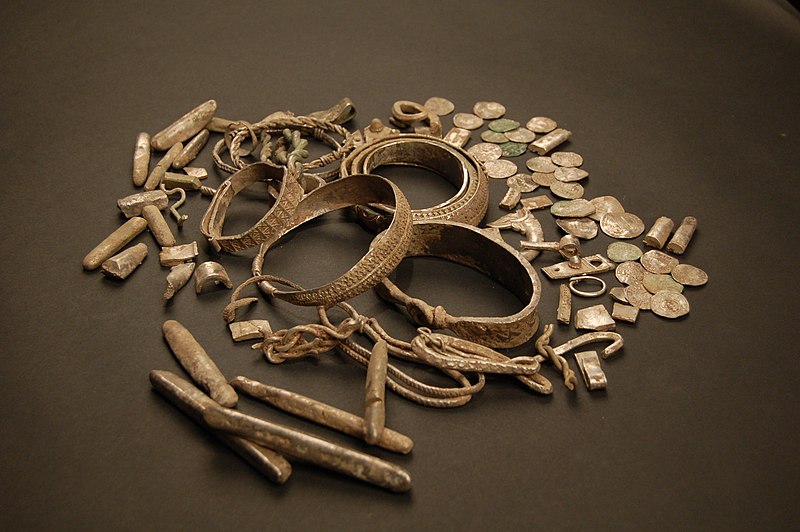
In 1785 a thistle brooch from Viking times was found at Flusco in Cumberland at a location already called Silver Field. Of course the name cannot go back to the time when the brooch was hidden, for treasures are concealed in secret, but their discovery is usually a very public affair, as at Wallasey. More brooches came to light at Flusco in 1830 and 1989 so it is not unlikely that some had been found before. Ancient treasures were often buried in groups, one pot or bag at a time. This would explain the early name of Silverdale in Lancashire, Selredal in 1199. Part of a hoard could well have been unearthed here in the tenth or eleventh century, for another came to light in 2011: this was concealed in about 905.

Hord was the Old English term for treasure. The boundary clauses of Anglo-Saxon charters take us to hord hlince ufeweardum ‘to the top part of the hoard linchet’ at Welford (Berkshire, in 949); on hord dene ‘to the hoard valley’ at Hawkesbury (Gloucestershire, in 972); and on hord burh ‘to the hoard hillfort’ at Manaton (Devon, eleventh century). Records of Hordelawe in 1244 at Hurdlow Town (Derbyshire) and Hordberia in the thirteenth century at Shipton (Gloucestershire) show that these hoards were associated with mounds; there is a Hordpit of 1467–84 at South Croxton (Leicestershire,) and two springs (OE wella): an Orduuelle of 1086 which is now Orwell Bury (Hertfordshire) and a Hordella 1100–35 which is now Hordle (Hampshire). A charter relating to Compton Beauchamp in Berkshire, and dated 856 but suspected to be spurious and twelfth century, mentions another: on hordwyllæ ‘to the hoard spring’.

The charters never refer to discoveries of gold, and this word is very rare even in later names inspired by the discovery of precious things. Certainly there are many names beginning Gold– but some of these seem to contain golde ‘marigold’, while others may refer to bright sandy features or are otherwise metaphorical. It seems as if poor Adam of Dunstable was the victim of a mistaken etymology.

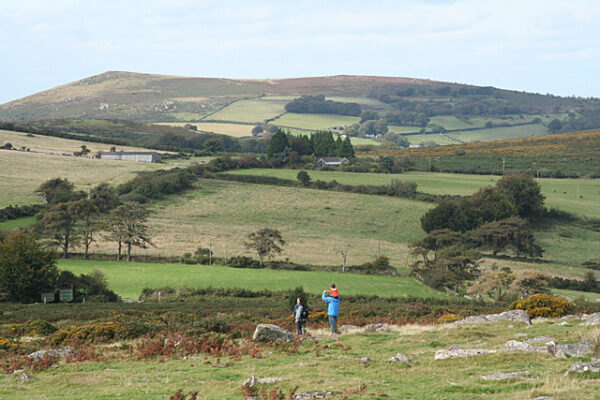
Manaton on Houndtor Down, Devon, the site of a hoard mentioned in the eleventh century.

Selected sources

Primary sources

Northumberland Name Books project (n.d.), Ordnance Survey Name Books: Northumberland.

Sawyer, Peter Hayes (1968).  Anglo-Saxon Charters, nos. 317, 552, 786; and 1547.

Volumes of the Survey of English Place-Names

Cameron, Kenneth (1959), The Place-Names of Derbyshire 2, p. 366.

Cox, Barrie (1998–2019), The Place-Names of Leicestershire, 2, p. 266; 3, p. 78; 4, pp 85 and 271; 6, p. 311; 7, pp. 9 and 217.

Cox, Barrie (1994), The Place-Names of Rutland, p. 155

Dodgson, John McNeal (1970–97), The Place-Names of Cheshire,  2, p. 240.

Gover, J. E. B., Allen Mawer and Frank Merry Stenton (1938), The Place-Names of Hertfordshire, 83, pp. 108 and 159-60.

Sandred, Karl Inge and others (1989–2002), The Place-Names of Norfolk 2, p. 56.

Smith, A. H. (1964–65), The Place-Names of Gloucestershire, 1, p. 182.

Other sources

Bygone Liverpool (n.d.), The Guinea Gap, buried treasure in Wallasey

Coates, Richard (1993), Hampshire Place-Names, p. 95.

Collins, Joseph William (1857), ‘On Ruborough Camp, Somerset’, Journal of the British Archaeological Association 13, 294–98.

Feld, John Edward (1913), The Myth of the Pent Cuckoo: A Study in Folklore, pp. 137–8.

Grinsell, Leslie V. (1976), Folklore of Prehistoric Sites in Britain, p. 131.

Hough, Carole (2017), ‘Silverdale in Lancashire: the place-name and the hoard’, Notes and Queries 64, 223–27.

Watson, John (1775), The History and Antiquities of the Parish of Halifax, pp. 54–55.

Webster, Harriett, ed., and David Preest, transl., The Annals of Dunstable Priory ,  p. 347.

Whaley, Diana (2019-21), ‘Putting Northumberland names on the map: insights from the Ordnance Survey name books c.1860’, Nomina 40, 1–28.

Text © Jeremy Harte 2025