Smith and Smythe

Smith has the distinction of being the most common family name in Britain. 421,703 individuals are recorded with this name in the 1881 census. They occur as frequently in Scotland as in England, with NE Scotland and the English Midlands having the heaviest concentrations per 100,000 people, as shown in Steve Archer’s British 19th Century Surname Atlas, where the coding, light to dark, indicates increasing numbers.

The simple reason for this is that every self-reliant community in pre-industrial Britain needed at least one smith to provide the basic iron equipment for daily living and farming. From the lord of the manor to the humblest peasant a good blacksmith was a man to be grateful to, admired and perhaps wary of. His fuel was charcoal and the work required exceptional strength and a tolerance of intense heat, smoke and physical injury.

Village smiths were blacksmiths, forging the business ends of hammers, tongs, knives, daggers, axes, scythes, ploughshares, harrows, rakes, spades and pitchforks; the griddles and grates of fireplaces; pots, pans and kettles; nails, pins, bolts, bars, locks, hinges and brackets; chains, wheel rims and cart-fixings. They were also farriers, making and fitting horseshoes, a service discriminatingly prized by the horse-riding gentry, clergy and merchants.
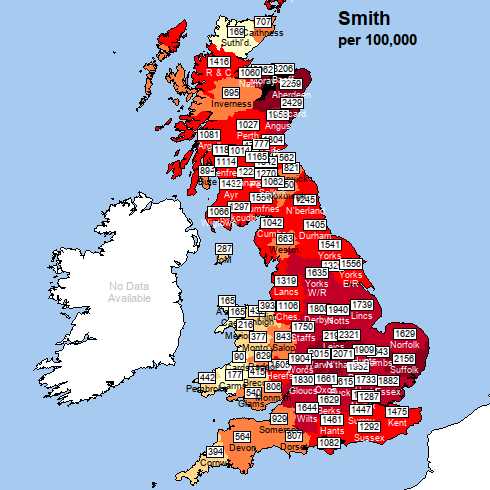
Map of Britain with title "Smith per 100,000". The whole of Britain is shaded and most English and Scottish counties are shaded mid red or darker shades of red or black. Counties in Wales, south-west England, Sutherland and Caithness in Scotland and a few other counties have lighter shading.
Numbers of Smiths per 100,000 people in 1881 (darker colours indicate higher numbers)
© Steve Archer, British 19th Century Surname Atlas, version 1.20 (2003–2015)

Blacksmith itself is a rare medieval surname and is absent in the 1881 census, presumably owing to the preference for plain Smith to denote the usual worker in iron, but the synonymous Farrar is quite numerous by comparison, with 3,997 bearers in 1881, most of them in the West Riding of Yorkshire. It is a borrowing of Old French ferrour ‘ironworker, blacksmith’, one of many French words that came into English after the Norman Conquest.

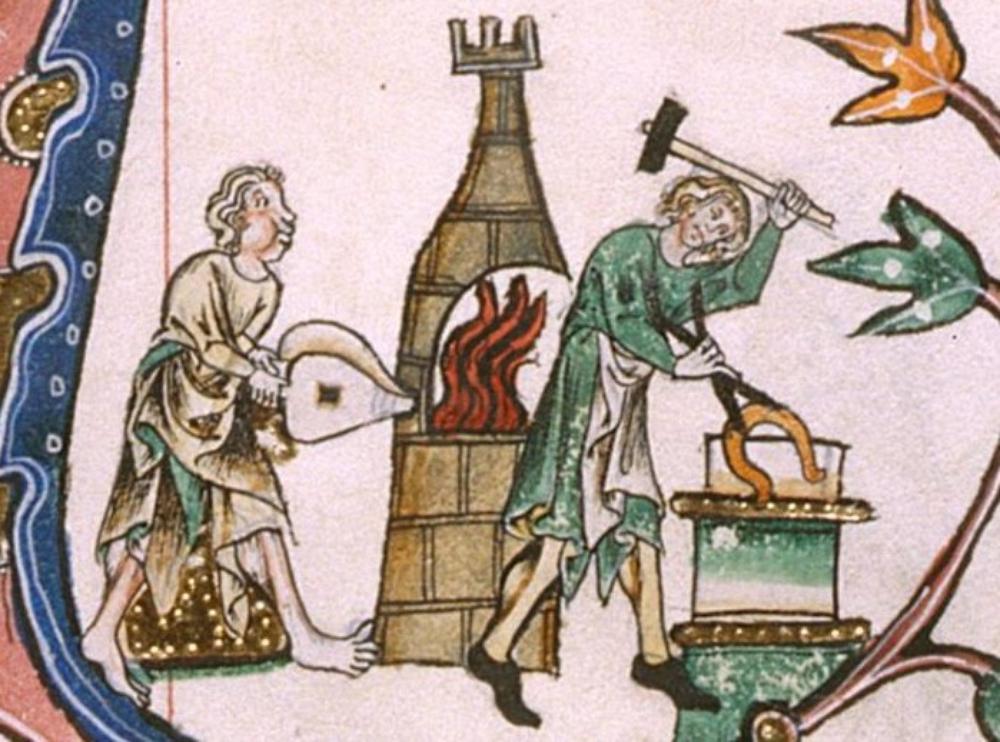
Manuscript illustration showing one person working bellows for a forge and another holding tongs and a raised hammer.
Gorleston Psalter f. 154v (1310–24)

In towns there was more specialisation of the smith’s activities, both in terms of the metals they worked and the objects they made. From them come surnames such as Arrowsmith, Brownsmith (probably a worker in copper and brass), Coppersmith, Goldsmith, Greensmith (probably a copper smith), Locksmith, Naismith (a nail smith), Shoesmith alias Sucksmith and Sixsmith (for a maker either of horseshoes or of blades called shoes fitted to wooden-handled cutting implements such as spades and ploughshares), Whitesmith (a tin smith), and Wildsmith (probably in many cases an altered form of Whelesmith, a maker of wheels or the iron parts of a wheel). Not all of these specialised ‘smith’ terms have survived as hereditary surnames, for example Bladesmith, Silversmith and Swordsmith. In castle forges, smiths specialised in making swords, lances, shields, helmets and armour.

Since the smithing craft was frequently handed down from father to son, it is difficult to generalise when an occupational surname such as Smith became truly independent of the occupation. Broadly speaking, hereditary surnaming was well established by the early 14th century in the southern half of England and a century later in most of the northern half of England and lowland Scotland. However, occupational surnames (the third largest category of English and Scottish surnames) tended to remain meaningful descriptors of their bearers for much longer than other types of name, often well into the 15th century in England and even later in Scotland.

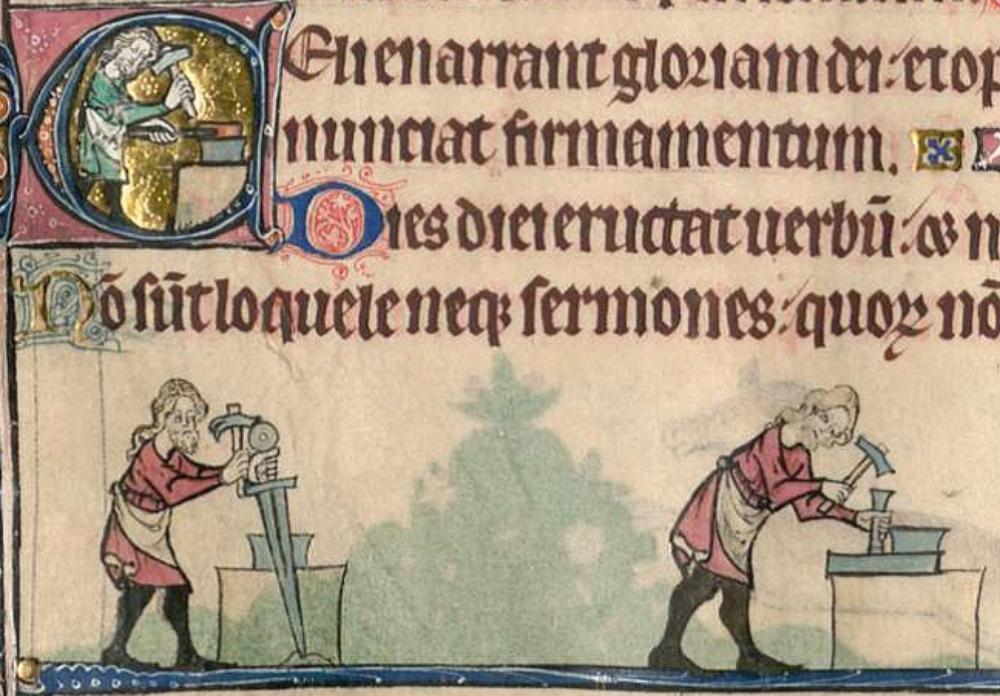
Manuscript illustration showing two men working at anvils. One is hammering a sword and the other is hammering something else.
Psalter of Queen Isabella of England (Munich, Bayerische Staatsbibliothek, Cod. gall. 16; 1303–08)

Smith is an exceptionally common surname but it is also uncommon in one sense because it heads a group of only 12 surnames whose numbers in the 1881 census run into the hundreds of thousands (Jones, Williams, Brown, Taylor, Davies, Wilson, Evans, Thomas, Roberts, Johnson and Walker). To put that into perspective, there were over 50,000 different surnames in Britain in 1881 with at least 20 or more bearers, and over 90% of these had fewer than 1,000 bearers. It is far more common to have an uncommon surname.

We can see this in the surnames of smiths who took their name from the place where they worked, the forge or smithy. Forge is from an Old French word that was borrowed into English after the Norman Conquest. There are just 271 bearers in the 1881 census and it has a long history in the East Riding of Yorkshire (41 bearers in 1881). Smithey is from a borrowing into northern English of Old Norse smiðja, following the conquest of much of eastern and northern England by Scandinavians in the ninth and tenth centuries. It had only 19 bearers in 1881, 12 of them in the West Riding of Yorkshire. Smeath (alias Smeeth, Smeed and Smee) and Smythe (alias Smithe, Smyth and Smy) have slightly larger numbers in 1881, some of them into the low hundreds. They have several possible derivations, especially Middle English smith, smyth (Old English smið ‘smith’) and a variant, Middle English smēth(e), but they are also sometimes from native English words for a forge, Middle English smethe and smithe (Old English smeðe and smiððe).

It is typical for uncommon names to have distinctive regional distributions. Smeath is mainly found in Devon and Smeeth in Devon and Kent (where Smeeth is also the name of a settlement once distinguished by its forge). Smeed is another Kent name referring to a forge, its main source being a place called Smeed (Farm) in Hastingleigh. Smee is mainly found in Essex and Smy in Suffolk, in each case showing the loss of the final ‑th in local pronunciation.

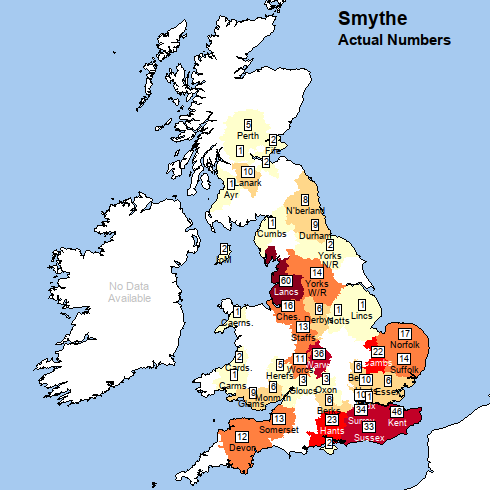
Smythe is the only one of this group to have a fairly evenly wide distribution and its numbers in 1881 (579) have grown to more than 1,700 by the late 20th century. This suggests that it has become increasingly adopted as an attractively distinctive spelling of Smith, allowing it to be re-pronounced as /smaɪð/, with the vowel lengthened to a diphthong on the model of words such as scythe, where the vowel was originally long.

Select Sources

Archer, S. (2003–15), British 19th Century Surname Atlas, version 1.20.

Hanks, P., R. Coates and P. McClure eds (2016), Oxford Dictionary of Family Names in Britain and Ireland.

Map of Britain with title 'Smythe: actual numbers'. The map shows Lancashire shaded deep red and labelled 60 and several other counties shaded mid red (Cambridgeshire, Essex, Hampshire, Kent, Sussex, Surrey, Warwickshire). Several further counties are shaded orange or pale yellow.
Distribution and frequency of Smythe in 1881 (darker colours indicate higher numbers)
© Steve Archer, British 19th Century Surname Atlas, version 1.20 (2003–2015)

Text © Peter McClure 2023