Surnames and DNA
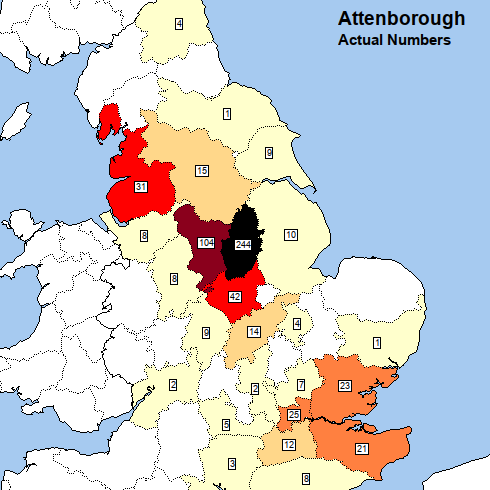
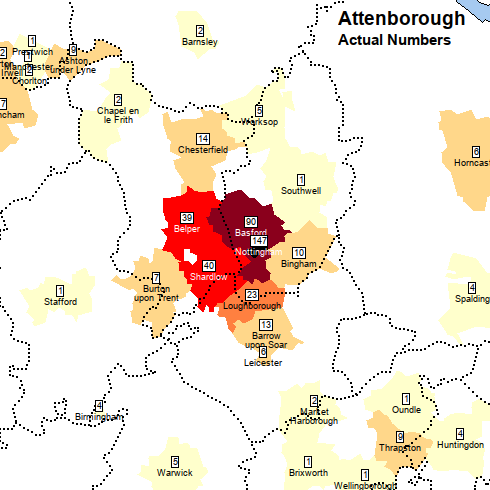
Archer’s mapping of the surnames in the 1881 census has revolutionised family name research. This and the earlier documentary evidence provide convincing evidence that Attenborough has a single origin, but that does not necessarily mean that all modern bearers of the name have the same ancestor. There could have been two or more unrelated men from Attenborough who were known by that name and who might have fathered a long line of descendants.
This is where DNA evidence has recently become a vital new tool in researching family origins. Turi King and Mark Jobling of Leicester University have shown that the Attenboroughs do share a common ancestor, since their DNA exhibits a haplogroup that is rare in Britain. (A haplogroup is a group of related genetic variants sharing a common ancestor.) This means that there probably was a single founder for the surname Attenborough. Professors King and Jobling point out, however, that DNA is no magic bullet in family research. Its evidence can be complex and inconclusive, and even in fairly clear instances of surnames that reflect a shared family origin, the Y-chromosome (inherited down the male line like most surnames historically) is not usually borne by all male members of the family, thanks to what genealogists politely call ‘non-paternity events’.
Select Sources
Ancestry (2002–2024), Ancestry.co.uk.
Archer, S. (2003–15), British 19th Century Surname Atlas, version 1.20.
Gover, J. E. B., A. Mawer and F. M. Stenton (1940), Place-Names of Nottinghamshire, pp. 142–43.
Hanks, P., R. Coates and P. McClure eds (2016), Oxford Dictionary of Family Names in Britain and Ireland.
Intellectual Reserve, Inc. (–2024), FamilySearch.
King, T. E. and M. A. Jobling (2009), ‘Founders, drift, and infidelity: the relationship between Y chromosome diversity and patrilineal surnames’, Molecular Biology and Evolution 26, 1093–1102.
Redmonds, G., T. King and D. Hey (2011), Surnames, DNA, and Family History, pp. 185–86.
Text © Peter McClure 2023