Jones, Tom

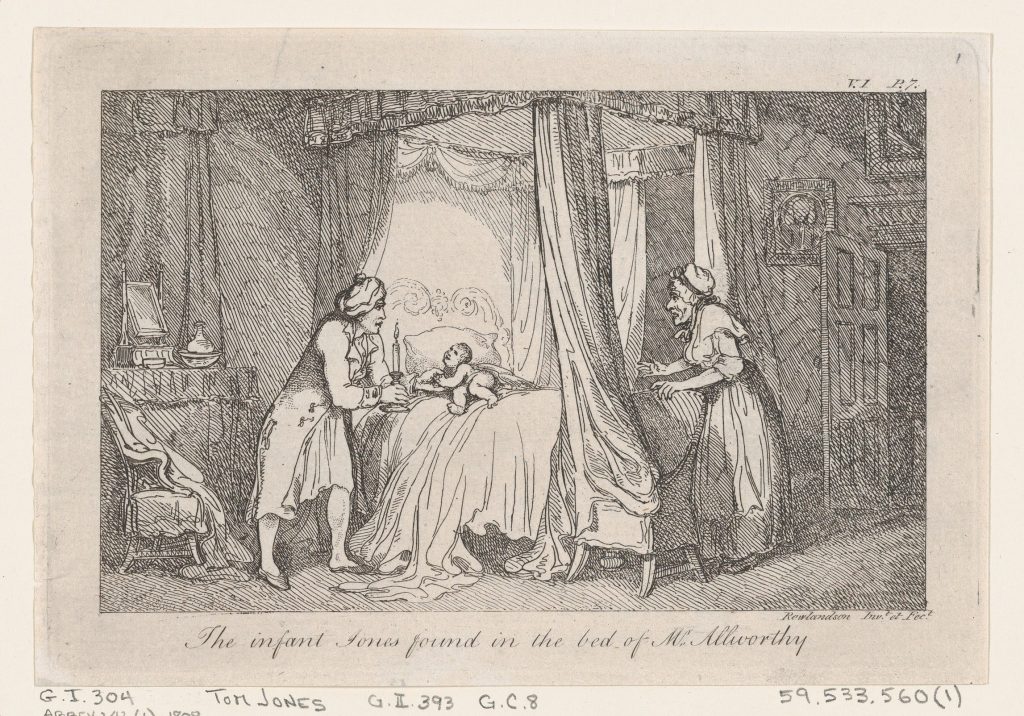
The infant Jones found in the bed of Mr Allworthy.
Illustration from a 1791 edition of Fielding's The History of Tom Jones, a Foundling, via Wikimedia Commons

Tom Jones: the novel and the film

‘Tom Jones’ was one of the most successful films of the 1960s, winning four Oscars, two Golden Globe Awards and three BAFTAs. It was an adaptation of Henry Fielding’s comic novel, which was set in Somerset and published in 1749. He describes it as ‘an allegory of human nature’ and gives some of his characters symbolic names. The good squire, who had taken Tom as a foundling into his family, is called Mr Allworthy. Tom’s cane-wielding, hypocritical tutor is the Rev. Thwackum. The young lady that Tom falls in love with is called Sophia (from the Greek word for wisdom). Fielding’s hero is supposedly the illegitimate son of two of the squire’s servants. He is high-spirited, good-hearted, attractive to and attracted by beautiful women, and naively gets into all kinds of trouble before it is revealed that he is actually the illegitimate son of the squire’s sister and, chastened by his adventures, wins Sophia as his bride. What to call him? Fielding chose two names, Tom and Jones, that would signify his hero’s supposed commonness of birth and his allegorical role as a type of immature young man.

The baptismal name Tom

It was possible for Fielding to do this thanks to the surprising fact that a tiny number of English names had dominated the baptismal name-stock for the previous 400–500 years and would do so for another century or more. In the Poll Tax Returns of 1377–1381, for example, Thomas was the third most used male forename, borne by about 10% of all males, behind John (33.4%) and William (21.3%). It remained either in that position or in second place well into the eighteenth century. Its main pet form since the thirteenth century has been Tom, which was then so common that it was already in use a generic term for the average male, along with Jack, Dick (for Richard) and Harry (an everyday pronunciation of Henry). By the eighteenth century, the phrase ‘Tom, Dick and Harry’ was the most familiar way of referring to ordinary men as a class of people.

The family name Jones and its relations

Tom’s surname Jones is similarly so common that it has long been used as a generic, in phrases such as ‘keeping up with the Joneses’. In the 1881 census Jones, with 338,373 bearers, was second in frequency only to Smith (with 421,703 bearers). Indeed, patronymics (surnames based on the name of a father) form the second most common category of English surnames. Jones tops the list of patronymic surnames partly because of the overwhelming popularity in late medieval England of the baptismal name John (often spelled Johan and Jon in the records). It naturally produced a common surname, which in medieval England and Scotland took three forms, John, Jones and Johnson. Jones employs the Middle English genitival (possessive) -s and usually means ‘John’s (son)’, occasionally perhaps ‘John’s (servant)’. The numbers of people named Jones were increased in early modern England by the frequent addition of a meaningless -s to the hereditary surname John. The most explicit form of this patronymic was Johnson or Jonson, which between them had 100,425 bearers in the 1881 census, ranking eleventh in frequency. If we add to this the surname John (10,795) and surnames from pet forms of John, such as Jack (6,347), Jacks (677), Jackson (83,525), Jenkin (2,361), Jenkins (35,170) and Jenkinson (5,237), the total of 582,910 bearers in 1881 easily outstrips that for Smith.

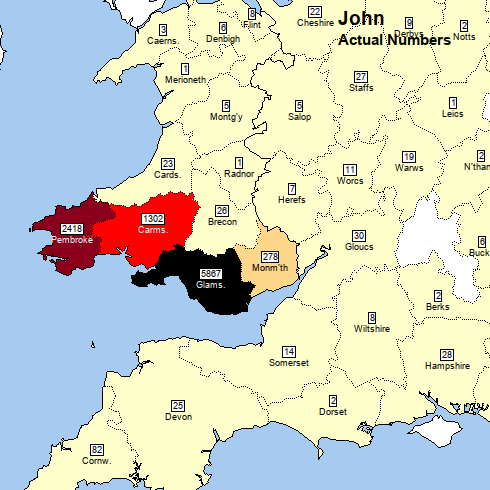
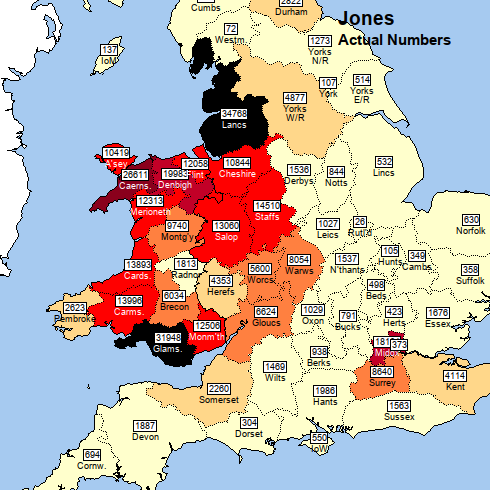
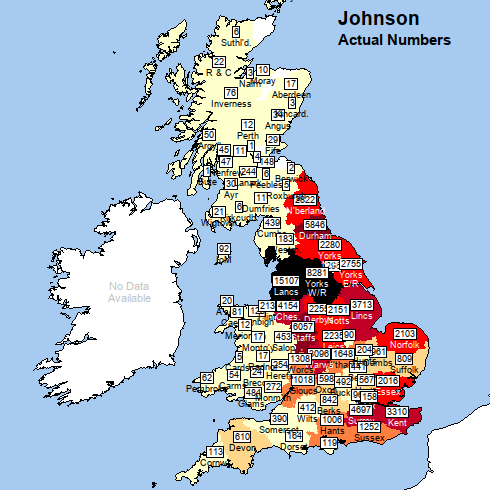
The great variation in numbers of bearers, even for different surnames derived from the same, exceptionally common baptismal name, is typical of English family names. Low numbers are in fact the norm. Of the 50,000 or so different family names in Britain in 1881 with at least 20 or more bearers, over 90% had fewer than 1,000 bearers. Names such as Johnson and Jones, running into more than a hundred thousand bearers, are rare. The three different name-forms – those with no suffix, those with the suffix -s and those with the suffix -son – also have distinct regional distributions. Jack is mainly found in Scotland, John in south Wales and Jenkin in Cornwall and Glamorgan. Jacks is mostly concentrated in Shropshire and Jones and Jenkins, though widespread in England, are most heavily evident in south-west England, the west midlands and Wales. Johnson and Jenkinson, like most surnames in -son, are mainly found in northern England, the north midlands and Norfolk, although they do occur further south (especially in the London area) through family migration.
Map of Wales with title 'John: actual numbers'. Glamorgan is shaded black, Pembrokeshire is shaded deep red and Carmarthenshire is shaded mid red. Other counties have lighter shading.
Distribution and frequency of John in 1881 (darker colours indicate higher numbers)
Map of England and Wales with title 'Jones: actual numbers'. Lancashire and Glamorgan are shaded black. Most counties in Wales and the north-west Midlands in England are deep red or mid red. Counties in the south-west Midlands of England are orange. There is also a cluster in London (mid red) and Surrey (orange). All other counties have lighter shading.
Distribution and frequency of Jones in 1881 (darker colours indicate higher numbers)
Map of Britain with title 'Johnson: actual numbers. Lancashire and the West Riding of Yorkshire are shaded black. In England, counties in north-east England, the north Midlands, the counties around London and Norfolk are shaded mid red. other counties have lighter shading.
Distribution and frequency of Johnson in 1881 (darker colours indicate higher numbers)

© Steve Archer, British 19th Century Surname Atlas, version 1.20 (2003–2015)

Jones in Wales

The very large numbers for Jones in the western regions owe much to its later adoption in Wales. The name was already hereditary in south-western and western England by the early fourteenth century, particularly in Somerset (the county of Fielding’s Squire Allworthy), Gloucestershire, Wiltshire and Herefordshire. Families with this name later migrated to nearby south Wales. In the sixteenth century, Welsh speakers in English-language contexts occasionally translated the patronymic ab Iefan ‘son of John’ as Jones, but relatively few of them used a fixed family name before the late eighteenth and nineteenth centuries. When fixed family names were adopted, some families retained ab Iefan, in the form Bevan, and in other cases the name was partly anglicised as Evans on the model of western English surnames ending in -s. In south Wales it was sometimes rendered as John. The most common practice, however, was to substitute English Jones. Welsh migrants to England, seeking work, greatly reinforced that name in England itself, especially in the west midlands and Lancashire.

Tom Jones and Janis Joplin (1969)
ABC Television, Public domain, via Wikimedia Commons

From Thomas Woodward to Sir Tom Jones

Jones has thus become identified in many people’s minds with Welshness, although in truth the surname belongs to the English as well. The ethnic ambiguity of the name has been cleverly exploited in the professional name of the Welsh singer (Sir) Tom Jones, who won popular acclaim in 1965 with the song ‘It’s Not Unusual’, and with the theme song from the James Bond film ‘Thunderball’. They were followed by many songs that topped the charts.

Jones is not his real surname, however, and his Welshness is mingled with an English ancestry that reflects the toing and froing of men and women across county boundaries and the England-Wales border for work and for marriage. According to his Wikipedia entry:

Thomas John Woodward was born at 57 Kingsland Terrace in Treforest on 7 June 1940, the son of Freda Jones (1914–2003) and coal miner Thomas Woodward (1910–1981). He is primarily of English descent; his maternal grandfather was Welsh, his maternal grandmother was born in Wales to English parents from Somerset and Wiltshire, his English paternal grandfather was from Gloucestershire, and his English paternal grandmother was from Wiltshire.

Wikipedia also  records that the singer’s manager, Gordon Mills, felt that Tom needed a more memorable surname than Woodward. Learning that Tom’s Welsh mother’s maiden name was Jones, he decided to capitalise on the popularity of the award-winning 1963 film, where, of course, the hero’s surname was chosen by Fielding for its popularity not in Wales but in Somerset, where Jones was the tenth most common surname in 1881.

Select Sources

Archer, S. (2003–15), British 19th Century Surname Atlas, version 1.20.

Hanks, P., R. Coates and P. McClure eds (2016), Oxford Dictionary of Family Names in Britain and Ireland.

McKinley, R. A.  (1990), A History of British Surnames, pages 97—121

Morgan T. J., and P. Morgan (1985), Welsh Surnames.

Rowlands, J. and S. Rowlands (2013), The Surnames of Wales.

Wikipedia contributors. (–2024), Tom Jones (singer).

© Peter McClure 2023