Sturgeon

The family name Sturgeon in Scotland and Ireland

The surname Sturgeon is well-known nationally as that of the former leader of the Scottish Nationalist Party and First Minister of Scotland from 2014 to 2023, Nicola Sturgeon. She was born in Irvine, Ayrshire, one of the counties in south-west Scotland where the surname has a history going back to at least 1544, when Andrew and John Sturgioun were witnesses in Dumfries. They may be ancestors of the men named Andrew Sturgeon and John Sturgeon, both of Scottish birth, who are recorded in Ulster in 1619, perhaps as planters. There were 212 persons so named in south-west Scotland in the 1881 census and 265 in northern Ireland in 1911. Thanks to migration across the Atlantic, it is currently far more common in America, where 9,007 individuals were registered with this name in the 2010 US census.

The Scottish and Irish name probably did not originate in south-west Scotland but more likely just over the border at Liddel Strength, Cumberland, overlooking Liddel Water, where a William Sturjon is recorded in 1281. Nor is it limited to that locality, as one can see on Steve Archer’s British 19th Century Surname Atlas, based on the 1881 census.
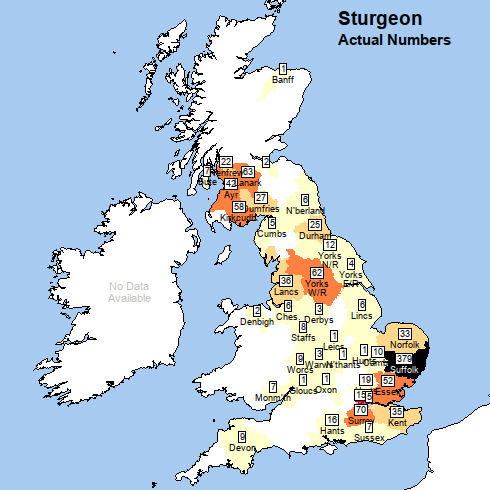
Map of Britain with title 'Sturgeon: actual numbers'. The map shows three clusters. In the south eats of England, Suffolk is shaded black and labelled 379. Nearby, London is shaded mid red and Surrey and Essex are shaded orange. In northern England, the West Riding of Yorkshire is also shaded orange. In south-west Scotland, Lanarkshire, Kirkcudbrightshire and Ayrshire are shaded in orange.
Distribution and frequency of Sturgeon in 1881 (darker colours indicate higher numbers)
© Steve Archer, British 19th Century Surname Atlas, version 1.20 (2003–2015)

The family name Sturgeon in England

Its main home in modern times is East Anglia, especially Suffolk, in the Bury St Edmunds area. A Richard Sturjoun was taxed in 1327 in Dedham, Essex, on the river Stour, close to the Suffolk border, and the name is later recorded in 16th- and 17th-century Essex (Sandon) and Suffolk (Pakenham and Ipswich). In Ashburton (Devon) and in Bickerton (formerly in the West Riding of Yorkshire, now in North Yorkshire) the surname occurs from the 14th century onward. Clearly the surname became hereditary but the scattered distribution of the medieval and modern bearers of the name makes it unlikely that it has a single progenitor.

What all the eponymous ancestors of this family name had in common was an association with one of the largest and fleshiest fish in British waters, the sturgeon. The sturgeon was considered to be such a scarce and magnificent delicacy that in 1324 Edward II declared it to be a royal fish, the property of the crown in all freshwaters and within 3 miles of the coast. The size of a European sturgeon can be anything between four foot and twenty foot in length. Perhaps the original nickname was metaphorical in origin, given to someone with an exceptionally large physique, or it may have been metonymic for a provisioner of such fish for royal or noble tables.

Other fishy family names from nicknames

Nicknames form the fourth main category of English and Scottish surnames. Sturgeon is not the only one derived from the name of a fish, many of which were associated with particular characteristics. Fish, Pike, Pickerell and Trout, when not metonyms for fishermen or fishmongers, may have originated as complimentary nicknames. To be ‘as healthy as a fish’ or more specifically as a pike, a pickerel or a trout, was a medieval expression for robust good health. Middle English fish-hal or fish-hol, literally ‘fish-whole’, meant ‘hail and sound’. By contrast, the fish that the surnames Chubb and Chevin refer to was regarded as a slow, fat creature that was easily caught.  In sixteenth-century English, its names were used as words for ‘a lazy person, simpleton, or fool’ (see the OED entry for chub). Gudgeon is similarly uncomplimentary; the word is recorded in OED with the sense ‘gullible person’ from 1584. As one writer put it, the fish called ‘Chevins and Millers thumbs are a kind of jolt-headed Gudgeons’ (1655, OED entry for gudgeon). The gudgeon is a small, freshwater fish with a large head and is easily caught. Not so the sturgeon. That giant predator of sea and river commanded respect, even awe.

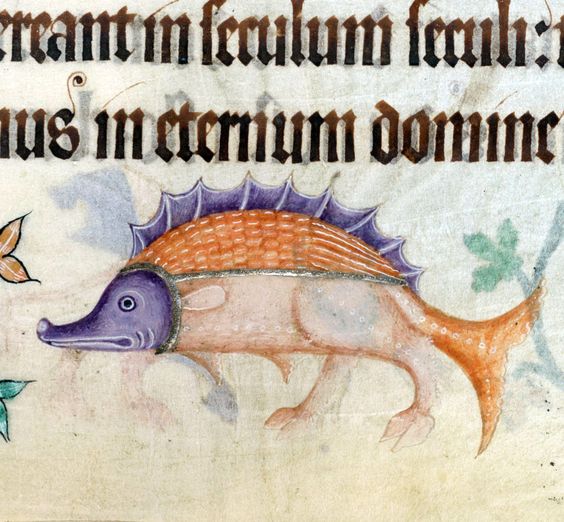
Drawing of an fish with spines and legs. Handwritten late medieval text is also visible on the page
Imaginary sturgeon with legs, Luttrell Psalter, c. 1320-1340, British Library, Add 42130, fol. 167r

Select Sources

Archer, S. (2003–15), British 19th Century Surname Atlas, version 1.20.

Hanks, P., R. Coates and P. McClure eds (2016), Oxford Dictionary of Family Names in Britain and Ireland.

OED = The Oxford English Dictionary.

Text © Peter McClure 2023