Nicknames form the fourth most common type of surname, many of them originating from words for animals, birds and fish, mostly because of their resemblance to some human characteristic of appearance or behaviour. Outnumbering them all is Fox, with 27,777 individuals so named in the 1881 census of England, Wales and Scotland.
Fox
Foxes in medieval literature
The wily fox was a frequent intruder in medieval farmyards, stealing ducks, hens and geese. It was regularly hunted with hounds and became a byword for trickery and stealth. In folklore and literature, tales abounded of the fox’s cunning and duplicity. The animal was often reviled but also secretly admired as an icon of the clever subversion of overweening power. The 12th-century Roman de Renart was a cycle of allegorical stories about Reynard the Fox, which grew in number as they circulated around the courts of Europe, personifying treachery and violence among the nobility. Chaucer’s Nun’s Priest’s Tale retells one of these stories in a domestic henyard, picturing the fox (named Daun Russell ‘Lord Red One’) as an accomplished flatterer, duping the cock Chantecleer into shutting his eyes while crowing so that he can be caught. Church carvers in wood or stone used the animal to satirise the hypocrisy of the clergy, depicting a fox dressed as a pilgrim leading a flock of birds astray, or dressed in a friar’s habit preaching to foolish geese from the pulpit.
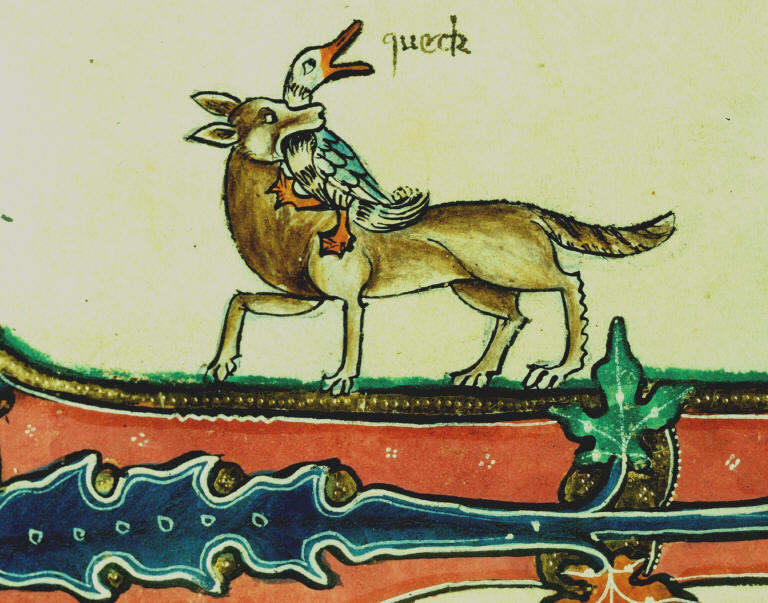

Fox, red hair and distribution of the family name Fox in Britain
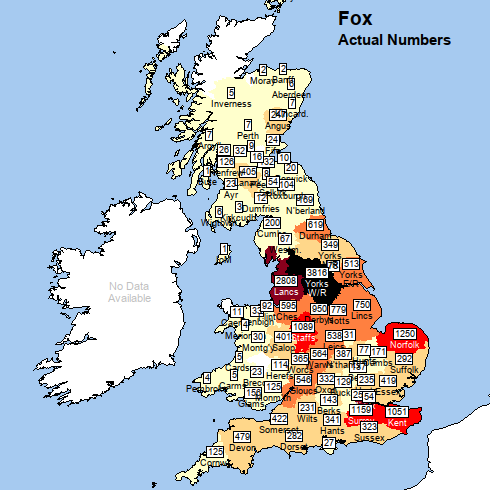
The surname is found in significant numbers in all English counties and this can be explained by the abundance of it in the records of late medieval England, from the 12th century onward. Perhaps it reflects not so much the ubiquity of tricksters in medieval communities but of people with red hair. Nicknaming typically picks on appearances that deviate from the norm, and having red hair has always set people apart. For medieval Europeans both the animal and its colour symbolised treachery. Judas Iscariot was supposed to be red-haired and so was Chaucer’s Miller in the Canterbury Tales. ‘His berd as any fox … was reed’, a fitting attribute of the miller stereotype, who stole corn and meal from his customers. To be red-haired was to be marked out, for friendly banter at best and suspicion of dishonesty and thieving at worst.
In a BBC News broadcast of 2 October 2013 Jonathan Rees, Professor of Dermatology at the University of Edinburgh and one of a team of scientists that identified the gene responsible for red hair, commented that red-headedness might occur in about 10% of the population in the UK as a whole, with slightly higher numbers in Scotland, and that in the Republic of Ireland the percentage might be a little higher still. Surname evidence in the 1881 census, mapped in Steve Archer’s British 19th Century Surname Atlas, shows a spike in Fox numbers in the West Riding of Yorkshire, especially in the area around Dewsbury and Bradford, and also in west Lancashire. The reason for this is unclear but it may be a random consequence of multiple sons in a few families producing several generations of multiple male descendants.
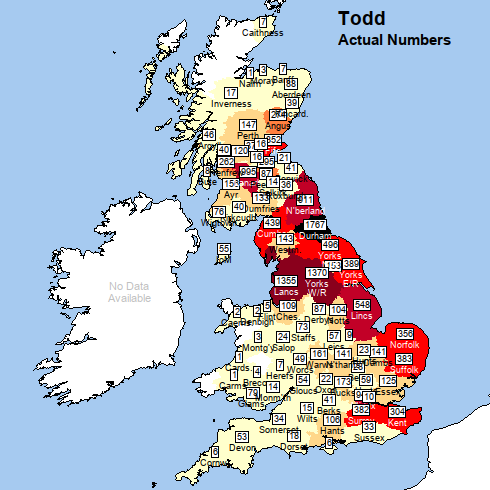
Fox and other ‘foxy’ family names in Scotland and Ireland
In Scotland the name is not on record before 1567 in Roxburghshire and 1622 in Brechin (Angus). It may be an introduction from England, for the native Scots equivalent is Todd, from Middle English and Older Scots todd(e) ‘fox’. This surname has 15,210 bearers in the 1881 and is first recorded in about 1270 in Berwickshire and earlier still in Norfolk (1168–75), Oxfordshire (1225) and Northumberland (1231).
As for Ireland, there were 5,484 persons called Fox in the census of 1911. Some of these may be descendants of immigrant Englishmen or Scots from the 16th century onward. Others will be descendants of native Irish families whose Irish name, Mac an tSionnaigh ‘son of the fox’, had been translated into English as Fox. A notable instance is ‘Brassel Shennaghe alias Foxe, chief of his nation’, who was addressed in this way in 1559 in a royal warrant from Queen Elizabeth, herself a red-head as it happens.
More red-heads: Read, Reid Redhead, Redknap and Gough
Nicknaming people as ‘the fox’ was deliberately stigmatising but there are several British surnames derived from plain descriptions of redness in hair and perhaps complexion, if alluding to freckles. Read alias Reed (with 41,050 bearers in the 1881 census) is commonly from Middle English read, rede ‘red’. The numbers are to some extent swelled by other origins, from place-names called Read (Lancashire), Reed (Hertfordshire) or Rede (Suffolk), or from a landscape feature denoting a clearing. But the nickname is certainly attested in Hugo le Rede of Lancashire, who is mentioned in 1220, Walter le Read, who was taxed in 1327 in Ringmer (Sussex), and Gilbert le Rede of Coull in Aberdeenshire, who was committed to prison in 1296. In modern times the Scottish name is usually spelled Reid (31,433 in the 1881 census).
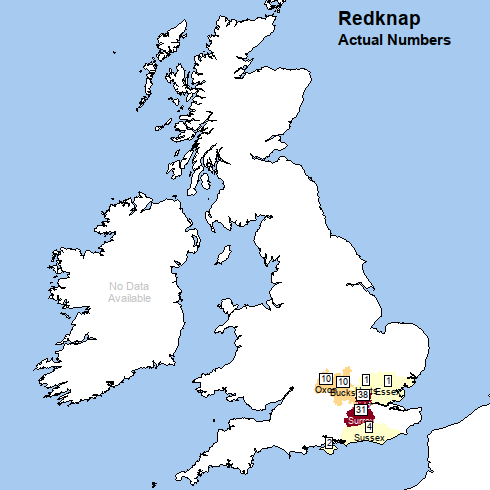
In 1256 Adam Redhed appeared in a court case in Northumberland; it is here and in County Durham and Lancashire where most of the 1,795 people named Redhead or Readhead are recorded in 1881. The rarest of these surnames is Redknap with 97 bearers in 1881, mostly in London and the home counties. Middle English knap meant ‘boy, servant’. The maps for these four names in Archer’s British 19th Century Surname Atlas can be compared using his colour coding of light to dark to represent increasing numbers of bearers.
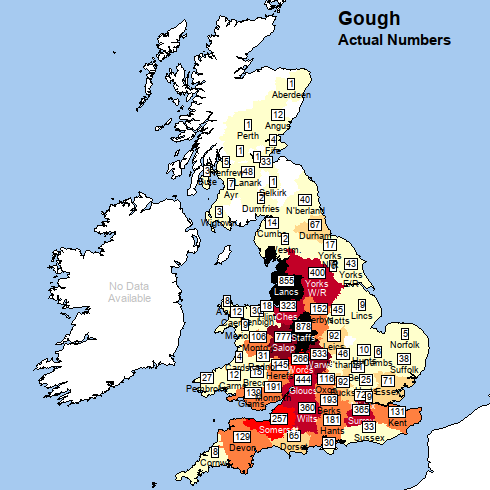
Distribution and frequency of Read, Reid, Redhead and Redknap in 1881 (darker colours indicate higher numbers)
© Steve Archer, British 19th Century Surname Atlas, version 1.20 (2003–2015)
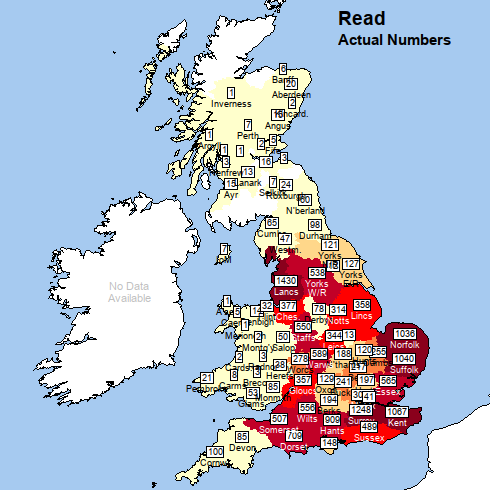
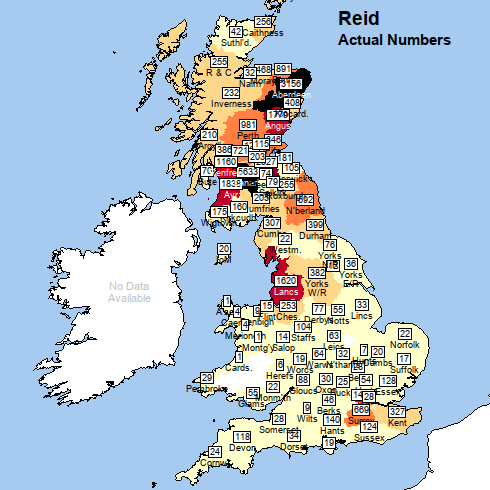
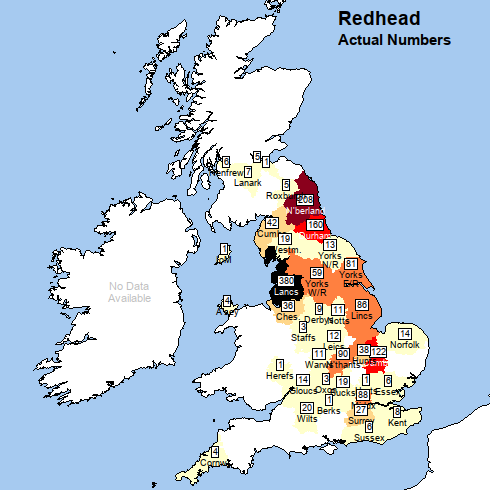
In Wales, the red-heads of the native population were singled out with the Welsh nickname coch, goch ‘red’. The form goch (a mutated form) is normal after a personal name. The final consonant, spelled -ch, was the sound found in Welsh bach and Scottish English loch (described by linguists as a voiceless velar fricative and represented as /x/ in the International Phonetic Alphabet). This frequently became /f/ after back vowels in Modern English, hence the anglicized spelling Gough, modelled on words like cough. In England, where the surname occurs from Welsh migration, it may have become hereditary in medieval times, but this development was probably much later in Welsh-speaking parts of Wales, where hereditary surnaming did not become normal until well into the 18th and 19th centuries. There are 8,765 bearers of the name in Archer’s British 19th Century Surname Atlas.
To be red-haired in Britain and Ireland has always attracted attention, much of it unwelcome, even though for some powerful people, such as Elizabeth I, it could contrarily be a source of admiration. No wonder it produced so many nicknames that grew into hereditary surnames. By the end of the 19th century over 100,000 people may have borne a surname that was derived from an ancestor with red hair. The gene responsible for it, the melanocortin 1 receptor (MC1R), is recessive. It would be interesting to know what proportion of current bearers of these surnames have red hair in the family.
Select Sources
Archer, S. (2003–15), British 19th Century Surname Atlas, version 1.20.
Hanks, P., R. Coates and P. McClure eds (2016), Oxford Dictionary of Family Names in Britain and Ireland.
Jones, M. (2002), The Secret Middle Ages.
Morgan, T. J and P. (1985), Welsh Surnames.
Muhr, K. and L. Ó hAisibéil eds (2021), The Oxford Dictionary of Family Names of Ireland.
Redmonds, G. (2015), A Dictionary of Yorkshire Surnames.
Kenneth Varty, K. (1967), Reynard the Fox.
Whiting, B. J. (1968), Proverbs, Sentences, and Proverbial Phrases From English Writings Mainly Before 1500.
Text © Peter McClure 2023