Introducing the place-names of Wales

Welsh and English names

Before the nineteenth century the vast majority of the population of Wales were first-language, and often monoglot, Welsh-speakers. With a handful of regional exceptions, the country’s place-names still largely reflect this linguistic inheritence even in areas where English is now practically universal. Thus, although fewer than 20% of the modern population speaks Welsh regularly, the proportion of Welsh-language place-names in use is far higher. Many exist in two distinct forms, an anglicised one and a ‘standard’ Welsh one – the latter nowadays officially established by a place-names standardisation panel appointed to advise the devolved Welsh government’s Welsh Language Commissioner.
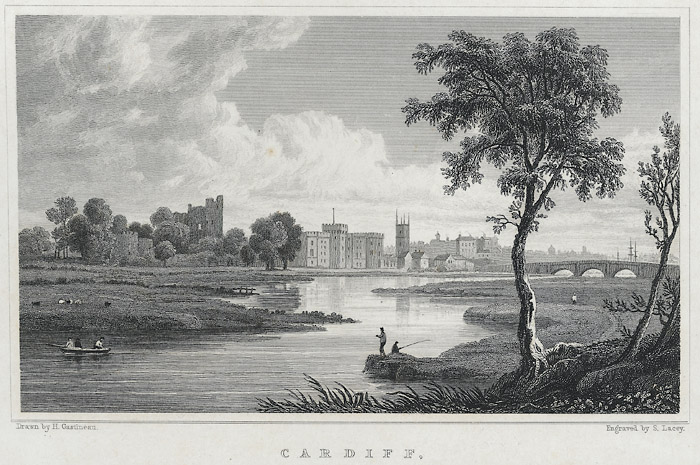
A view of a river with Cardiff castle in the background and a bridge on one side. Two figures are fishing in the foreground whilst three others are rowing a small boat
A view of Cardiff (Henry Gastineau, c. 1830)
National Library of Wales, Public domain, via Wikimedia Commons

Differences between English (E) and Welsh (W) versions often involve (relatively) minor distinctions in spelling or pronunciation (as W Cricieth versus E Criccieth, W Sgeti versus E Sketty, W Lacharn versus E Laugharne), but they can be more marked and interesting. Very occasionally the English form of a name preserves features of earlier Welsh that have been lost from the current Welsh name: examples include the capital city Cardiff (‘fort on the R. Taf/Taff’ – Dyf is an early and notable genitival form of the river-name), while the connection with the river has been obscured by a later change in the Welsh form Caerdydd; and the town and county of Pembroke/Penfro (‘land’s end’), in which the k of the English form appears to represent a final consonant that disappeared from the word bro ‘region, district, land’ very early in the medieval period.

In other cases the names are wholly distinct, sometimes because one translates the other (as W Y Drenewydd, E Newtown; W Gwenffrwd, E Whitebrook; W Pontsenni, E Sennybridge), sometimes because the two languages characterise the place in different ways (as W Caergybi ‘fort of [St] Cybi’, E Holyhead ‘holy headland’; W Yr Wyddfa ‘the prominent place’, E Snowdon ‘snow hill’), and sometimes because English usage applies an originally Welsh name in a different way to later Welsh (so the town known in Welsh as Aberteifi, ‘mouth of the R. Teifi’, in English is Cardigan, a name transferred from the medieval province, and now modern county, of Ceredigion; while the place of W Y Waun ‘the moorland’ is taken by E Chirk, a form of the local river-name, Ceiriog’. In some other cases, mentioned below, the names now current in English are derived from other languages, particularly Scandinavian and French.

Welsh habitative names: 1 ecclesiastical

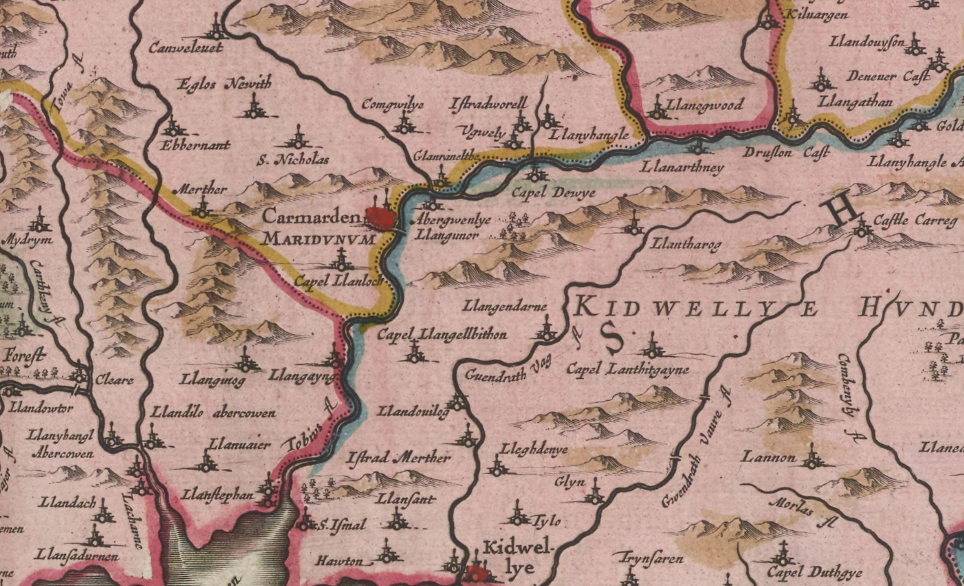
As with the other languages of Britain, Welsh-language place-names divide fairly readily into two categories: habitative, explicitly denoting settlements (together with human institutions and activities), and topographical, descriptive of landscape and natural features. In Wales, unlike in England – though with close parallels in other Celtic-speaking countries – a particularly prominent group of habitative names reflects the influence of the Church. The element llan, which originally meant ‘enclosure’ but came to be applied specifically to a church with its cemetery, is especially pervasive: across almost all of Wales llan, combined usually with a personal name, dominates the map. The personal names are those of saints, or at least people who came to be locally regarded as saints during the medieval period: some are central figures of medieval hagiography, as Dewi/David of Llanddewi (and St Davids, of course), Padarn of Llanbadarn, Teilo of Llandeilo, Cadog of Llangadog. Some are otherwise practically unknown, as Gwrdaf of Llanwrda or Ilid (apparently a female name) of Llanilid; while others are the familiar saints of European Christianity, as Peter/Pedr of Llanbedr, Michael/Mihangel of Llanfihangel, Mary/Mair of Llanfair.  Note, incidentally, the softening or so-called lenition of consonants, as Pedr >-bedr, Mair >-fair (pronounced ‘vair’), which is a notable characteristic of the Welsh language.

Llan names on Blaeu’s map of c.1665
Reproduced with the permission of the National Library of Scotland, CC-BY

Besides llan, other Welsh ecclesiastical terminology includes eglwys, the regular modern word for ‘church’ and ultimately a borrowing of Latin ecclesia, in names like Eglwys Nunydd and Eglwyswrw (the qualifiers in both cases again probably being personal names). Merthyr is an early term which may in origin have meant ‘Christian burial-place’, but in form it is identical to the word for ‘martyr’ (to which it is clearly related), and in consequence medieval and modern stories abound about the circumstances that gave rise to the names. For instance, Tudful of Merthyr Tydfil, accounted a daughter of the eponymous Brychan of Brycheiniog (Breconshire), is said to have been murdered by pagan Saxons – but that tale seems to originate with the arch inventor of tradition, Iolo Morganwg, at the end of the eighteenth century. A full survey of ecclesiastical name-types would include a number of other terms too, such as betws and capel, both ‘chapel’, mynachdy ‘monastery’ and bangor ‘wattle fence’, apparently a distinctive feature of some early church settlements.

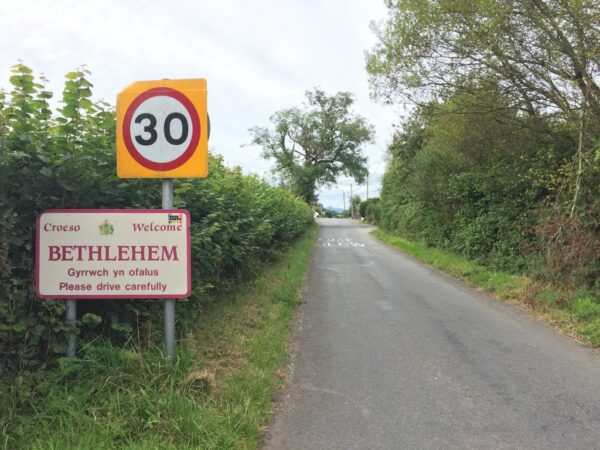
The importance of the church in the naming of medieval Wales had a modern sequel as eighteenth- and nineteenth-century non-conformists dotted the landscape with chapels which they called after Biblical sites. Many of these chapels became the focal points of settlements – in a process that can be compared with the growth of llan churches and settlements a thousand years or so earlier – and thus we have hamlets and villages called by such names as Bethania, Bethlehem, Carmel, Horeb, Nebo and Salem; in the case of Bethesda in Gwynedd, the chapel-settlement grew into a sizable industrial town as a centre of slate-quarrying in the nineteenth century.

The importance of the church in the naming of medieval Wales had a modern sequel as eighteenth- and nineteenth-century non-conformists dotted the landscape with chapels which they called after Biblical sites. Many of these chapels became the focal points of settlements – in a process that can be compared with the growth of llan churches and settlements a thousand years or so earlier – and thus we have hamlets and villages called by such names as Bethania, Bethlehem, Carmel, Horeb, Nebo and Salem; in the case of Bethesda in Gwynedd, the chapel-settlement grew into a sizable industrial town as a centre of slate-quarrying in the nineteenth century.

Roadsign showing the name Bethlehem
Bethlehem, near Llandovery
Photo © Alan Hughes Alan Hughes, CC-BY-SA 2.0

Welsh habitative names: 2 secular

Not all habitative names relate to the Church, of course. Wales has numerous place-names in Tre- or Dre- from tref ‘settlement, farm’, in modern Welsh the word for ‘town’ (compare the development of Old English tūn ‘enclosure, settlement, farm, estate’ which became modern town). These span the medieval period – e.g. Trewalchmai on Anglesey, named from the twelfth-century poet, Gwalchmai ap Meilyr – to the modern, e.g. Tremadog, Caernarfonshire, a village (together with the harbour of Porthmadog) developed by a landowner, William Madocks, early in the nineteenth-century.  In a good number of cases along the border and in south Wales there is interplay between Welsh tref and English tūn: Middletown and Treberfedd in Montgomeryshire, for instance, clearly translate one another, but it is unclear which came first – forms of both first appear in the middle of the thirteenth century and are well represented thereafter. Another recurrent Welsh habitative element is bod ‘dwelling’, a word principally found in north Wales (even though its Brittonic cognate bos is familiar from parts of Cornwall). This appears to be a straightforwardly secular element in many cases, e.g. Bodelwyddan (with a personal name) and Bodffordd (with ffordd, now‘road’ but perhaps here with the earlier meaning ‘ford’). However,in other instances there seems to be a crossover with ecclesiastical naming, since names like Bodedern and Bodfari have been thought to involve locally venerated saints. Other habitative words often found are ‘house’, llety ‘lodging’ and the pair hendre and hafod, both of which refer to the practice of transhumance, the seasonal movement of livestock between the lowland home-farm (hendre) and upland summer pasture (hafod).

Some of the oldest surviving settlement-names in Wales are likely to be names denoting strongholds. This is clearly the case in Carmarthen, the present form of which is a layered place-name in which Welsh caer ‘fort’ was added – by the early twelfth century – to Roman Moridunum. This name is a British (i.e. British Celtic, antedating the language’s evolution into Welsh) meaning ‘sea-fort’, or perhaps rather ‘fortified settlement with access to the sea’, since the town is some eight miles up the River Tywi from the coast. The medieval Welsh descendant of Brittonic *douno– (the second element of Moridunum) was din which survives as the first element of names such as Tenby and Denbigh (both W Dinbych ‘little fort’) and Tintern (with an uncertain qualifier as the second element, possibly a personal name). Din is now obsolete in modern Welsh, but a derivative, dinas, is the usual word for ‘city’: it too earlier meant ‘stronghold, fort’ and is found in names like Dinas Mawddwy and Dinas Powys.

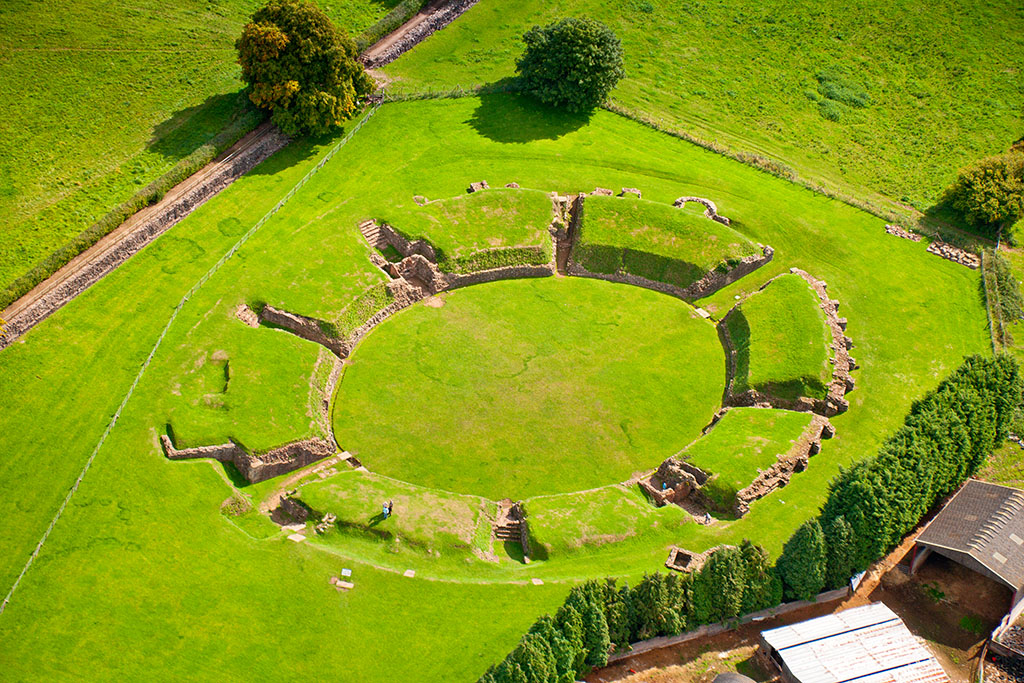
Grassy field with remains of an amphitheatre. A level central circle can be seen, surrounded by eight raised segments forming a ring around it.
Aerial view of Caerleon Roman amphitheatre
CADW, CC BY-SA 3.0, via Wikimedia Commons

Caer is often used for former Roman strongholds in much the same way as English chester (and the city of Chester is of course known as Caer in Welsh). Caernarfon, ‘fort in [the district of] Arfon’, was Roman Segontium; Caerwent was Venta Silurum (the second element of the modern name continues the obscure Venta, as also in the district-name Gwent); Caerleon, ‘fort of the legions’, was Roman Isca, etc. [6] In some other cases the term may form relatively late names, applied to features recognised as antiquities, though not necessarily Roman: some instances of the plural name Caerau may belong here.

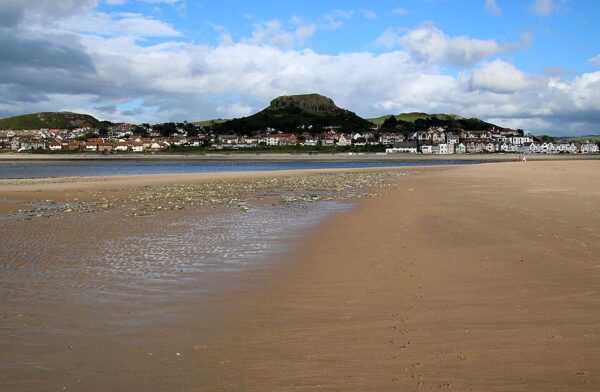
One other early type may be mentioned here, though it is somewhat distinct from other habitative names. The names of districts and regions were commonly formed from the name of a person or of a population-group, usually with the addition of a ‘territorial’ suffix. So Ceredigion is ‘the territory of Ceredig’ where a suffix –ion is added to a personal name Ceredig. He was supposed, during the Middle Ages, to be one of the sons of a legendary early post-Roman ruler of Gwynedd, but so much medieval myth-making went into his story – like those of many of the ‘saints’ – that any underlying truth is now wholly lost. Similar is Morgannwg, with the personal name Morgan and a suffix –wg; the English version Glamorgan derives from an alternative Welsh version, Gwlad Morgan ‘Morgan’s country’. In Deganwy an early group-name *Decanti (otherwise unknown from Wales) is combined with another suffix, –wy: the district-name is now restricted to a particular settlement. [7] In other names such early groups, or ‘tribes’ or polities, are recorded, apparently without territorial suffixes: examples include Dyfed, from the attested Romano-British Demetae, Powys, which reflects a Welsh borrowing of Latin pagenses ‘country-dwellers’ (as opposed to ‘civilized’ town-dwellers), and Llŷn, the end of the north-western peninsular of Wales, which is *Lageni, equivalent to the same group-name in the name Leinster, and apparently indicating immigration from Ireland.

View across a beach to a town below a prominent hill surrounded by cliffs
Deganwy. The striking hill was the site of the medieval Arx Decantorum, ‘fortress of the Decanti people’
Photo by Steve Daniels, CC BY-SA 2.0, via Wikimedia Commons

Welsh topographical names

Welsh has a rich topographical vocabulary which is widely employed in naming. A hill might, for instance, be termed bre, bryn, moel or mynydd; slopes and hillsides are garth, allt, llethr or bron; mounds and hillocks are crug, gorsedd, pelan or crug; ridges cefn, drum or esgair. Distinctions between terms of similar meaning sometimes reflect nuances of sense, though chronological and dialectal variation is also part of the picture – in general the exact nature and extent of this variety remains under-researched.

Topographical names are so prevalent that it is a challenge to exemplify them briefly: landscape pervades the namescape. From Mynydd Epynt (‘mountain/upland crossed by a horse-path’) [8] to Rhosllanerchrugog (‘moor of the heathy clearing’); Pwllheli (‘salt-water pool’) to Penrhyndeudraeth (‘headland of [i.e. between] two beaches’); Esgairgeiliog (‘rooster ridge’) to Rhydargaeau (‘ford at the weirs’); Cerrig-y-bleiddiau (‘wolves’ rocks’) to Llwyncelyn (‘holly grove’) – names reflect people’s perceptions of topography, flora and fauna. Sometimes this extends into the world of myth and the imagination, introducing heroes (Bwrdd Arthur ‘Arthur’s table’), and saints (Eisteddfa Gurig, ‘[St] Curig’s seat’), giants (Bedd y cawr ‘giant’s grave’) and witches (Rhyd-y-wrach ‘witch’s ford’).

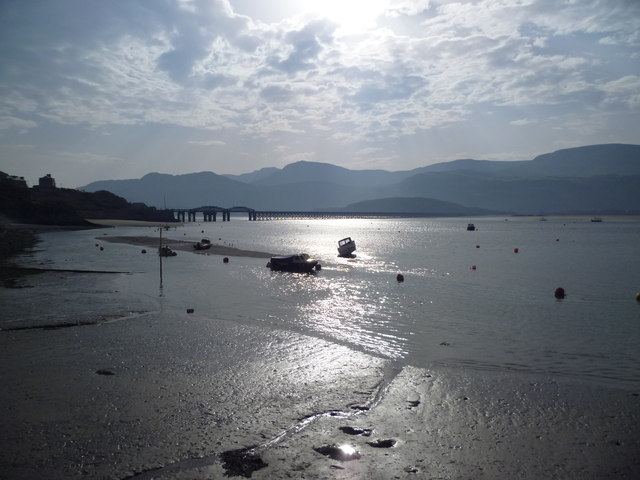
Wide river estuary with hills in the background on the opposite shore of the river
The estuary at Barmouth

One topographical element which perhaps deserves special notice is aber, ‘river-mouth, estuary’, common in the names of settlements and indicative of the significance of harbours and riverine transport. In most instances the qualifying element is the river-name, whether the river runs into the sea as at Aberystwyth or Aberaeron, or whether the aber is at the confluence with a larger stream, as at Abercynon (at the confluence of the Cynon and the Taf). In Barmouth the element is disguised in both languages: Aber Mawdd was the original name, ‘the mouth of the [river] Mawdd’. In the compound name the stress moved to the penultimate syllable, as is regular in Welsh, and the first syllable became unstressed. In Welsh, the unstressed first syllable was taken to be the definite article y, and a dialectal loss of the final consonant produced the common form Y Bermo; in English the unstressed syllable was lost, and Mawdd re-analysed as E ‘mouth’. Not all qualifiers are river-names: Abergwyngregyn is the ‘estuary of white shells’, Aberporth the ‘port-estuary’, at the mouth of Nant Howni.

River-names

One particularly interesting category in Welsh topographical nomenclature is the naming of rivers. In early times, the names of rivers in Wales naturally have much in common with those of the British Isles more generally, beginning with names of major waterways which defy straightforward explanation and which may possibly belong to linguistic strata antedating the arrival or development of Celtic, or which represent such early stages of Celtic in Britain that the terminology had dropped out of use long before surviving records of Celtic languages begin: the River Severn (Romano-British Sabrina, modern Welsh Hafren) is one example; the Wye (W Gwy) is another candidate. Taff (W Taf), Tawe, and perhaps Teifi, can be compared to a large group, including Thames, Tamar, Tame and Teviot, which seem to share a common root, which seems likely from its distribution to be British Celtic, but which has left no obvious trace in surviving Celtic languages. The most recent scholarly suggestion is that the root may be *tamo– ‘cutting, cutter’.

Many other Welsh river- and stream-names are clearer in their meanings, involving appearance (e.g. Dulais, Dyfi, from du ‘black, dark’), size or shape (e.g. Ystwyth ‘bendy’, Morlais ‘big stream’), sound (e.g. Llafar ‘loud’), or what we might call temperament (e.g. Ffraw ‘lively’, Honddu, from hawdd ‘easy, pleasant’). Two distinctive types are notable: some rivers are named from animals, perhaps because they frequented the waterway, but in some cases perhaps because they can be imagined to share their characteristics (e.g. Twrch ‘wild boar’, Arth ‘bear’). With the last idea we can compare a group of rivers named from boring and cutting tools and weapons (Taradr ‘auger’, Nodwydd ‘needle’, Cleddau ‘sword’), as well as that new suggestion for the Thames group.

English names

As mentioned above, many ‘English’ names in Wales are anglicisations, variant versions or translations of Welsh names. Many others were coined in English. In the north-east, Flintshire was part of England at the time of the Domesday Book, and its settlement-names were already predominantly English: Buckley and Whitford are obvious examples, but in cases like Prestatyn transmission across generations of Welsh-speakers has rather concealed the names’ English origins: Bagillt is ‘Bacca’s wood or clearing’, with OE lēah, while Prestatyn is the same name as Preston ‘priests’ farm’, altered by Welsh stress-patterns. In the south, the Anglo-Norman colonisation which followed the Norman Conquest of 1066 similarly introduced a significant early English element into local naming. The language has been established in areas such as the Vale of Glamorgan, the Gower peninsula and the southern half of Pembrokeshire for nearly a thousand years. Many place-names reflect this history by recording the given names and surnames of early Anglo-Norman settlers: Bonvilston, Bosherston, Clarbeston and Reynoldston are examples. A high proportion of these Marcher village-names are simple formations in –ton, but a full range of other types are represented, as in Cowbridge, Haverfordwest, Newcastle and Oxwich.

A series of political, social and demographic changes from the medieval period to the present have resulted in the introduction of English to all corners of Wales, and place-names have been coined at every stage in the process. The density of such names broadly reflects deeper history, but even in the northern and western strongholds of the contemporary Welsh language, English names are rarely far away. In Anglesey, for instance, although the nomenclature is overwhelmingly Welsh, there are instances such as Newborough, which represents a development under Edward I at the end of the thirteenth century, and Valley, which is an early-nineteenth-century name making reference to a cutting made during the construction of a new road.

Castle ruins
The castle, Newcastle Emlyn

Scandinavian and French names

Scandinavian raiders troubled the coasts of Britain from the eighth century onwards, and one outcome was the Scandinavian domination of the Irish Sea area which lasted into the twelfth century. Names around the coast of Wales reflect these developments: in the north the island-names of Anglesey, Priestholm and Bardsey have their origins in Old Norse; in the south-west there are similarly island-names, such as Skokholm, Skomer and Ramsey, as well as some settlement-names on the mainland, notably Milford (‘fjord by a sand-bank’), Fishguard (‘fish-yard’, an enclosure for keeping or catching fish) and – further round the coast – Swansea (apparently ‘Sveinn’s island’, though identification of the ‘island’ is unclear). There is no concentration of inland Norse names in Wales comparable with parts of eastern and northern England, but a few habitative names – notably Lamby and Womanby Street in Cardiff – might suggest localised settlement.

French was probably little spoken in Wales outside Anglo-Norman high society, but that was enough for some high-status places to receive French names. Beaumaris, ‘fair marsh’, Grosmont ‘great hill’, Roch ‘rock’ and Mold (originally mont haut ‘high hill’) all apply to Anglo-Norman castle-sites. (The Welsh name of the latter, Yr Wyddgrug, incidentally, is probably to be understood as ‘the prominent mound’ denoting the same feature.)  Montgomery is another castle: its name represents a transfer from Normandy made by its founder, Roger de Montgomery. (The Welsh name of this place, Trefaldwyn, incorporates the personal name of one Baldwin, a subsequent commander of the stronghold.) The village of Rockfield in Monmouthshire similarly bears a transferred family-name, in this case from Rocheville in Normandy, while Battle in Breconshire was held by Battle Abbey in Sussex, which in turn took its French name from the site of the battle of Hastings. A different kind of name is Malpas, ‘bad passage’, a recurrent French place-name for difficult routes: the name was perhaps coined by the Cistercian monks of nearby Llantarnam Abbey.

Modern names

This article has largely focused on the old, mostly medieval, names which make up the backbone of the country’s toponymy. A few more modern types might also be mentioned. Just as non-conformist chapels became new foci for settlements, so too did pubs: examples include Cross Hands, Loggerheads and Stepaside. New roads and other transport links attracted new hamlets and names: Pentregât (‘gate village’) makes direct reference to a turnpike-gate; Temple Bar makes a similar reference playfully, by transferring a London name; Bow Street is another transfer from London. Queensferry (renamed from earlier King’s Ferry in honour of Queen Victoria) marks a crossing of the Dee, while the royal dockyard at Pembroke Dock was established in 1814. Various names reflect the effects of the industrial revolution and the influence of its wealthy sponsors. Coalbrookvale, for instance, was the name of a colliery and Furnace the site of a blast-furnace. Morriston memorialises the Morris family, eighteenth-century founders of a copperworks near Swansea; Porthmadog, mentioned above, was established by William Madocks as a harbour to export slate from north Wales. The Monmouthshire village of Beaufort, the Welsh name of which is Cendl, recalls an eighteenth-century ironworks established by brothers surnamed Kendall under lease from the Duke of Beaufort. Finally, Sebastopol, on the edge of modern Pontypool, is a name of a type more usually found in field-names: it was applied in the mid-1850s to a settlement newly established beside the Monmouthshire canal, and reflects the Crimean War siege of 1854–55 which would have been prominent in the news of the day.

Selected sources

Books in English

Owen, Hywel Wyn, and Richard Morgan (2007), Dictionary of the Place-Names of Wales [a full country-wide reference book]

Owen, Hywel Wyn (2015), The Place-Names of Wales [a good shorter introduction and reference work]

Lias, Anthony (1994), A Guide to Welsh Place-Names [a readable account explaining the workings of the names and the Welsh language]

Books in Welsh

Richards, Melville (1998), Enwau Tir a Gwlad [an extensive narrative account of the country’s Welsh names]

Williams, Ifor (1945), Enwau Lleoedd [a fundamental short study]

The Welsh Place-Name Society

A detailed bibliography, as well as other useful resources, can be found on the Society’s website.

See there particularly for details of county-based studies: recent years have seen a big increase in the publication of high-quality works of reference at this level.

Other Online Resources

The Melville Richards Archive [a digitised card-catalogue of historic spellings, assembled by one of the twentieth-century’s leading place-name scholars]

List of Historic Place-Names of Wales [an extensive map-based collection of historic name-forms]

Others are listed on the Welsh Place-Name Society’s website, above.