Many place-names contain a personal name (usually of a man) as a specific, so it is important to understand what types occur. This page mainly focusses on the early medieval period and on the centuries immediately following the Norman Conquest of 1066, but personal names play a vital role right through the history of England’s place-names. Before 1066 most of the personal names in question have Old English origins, but then and at all periods other languages make important contributions to the stock of personal names.
Personal names in place-names: types and forms
Before family names (or surnames) became common between approximately the late twelfth and fifteenth centuries, men and women had only one name, though sometimes a second name (a byname or a patronymic) was added. It is these given names which are most common in place-names. Many of the personal names that occur in place-names aren’t recorded in independent use. In such cases we write the name with an asterisk, for example *Beorma (which is a short form of the recorded Old English personal names Beornmōd or Beornmund) in Birmingham or *Cofa in Coventry. In cases like these, personal names can often be suggested from our knowledge of name-formation (especially elements used in personal names and ways of creating short forms of names) in the languages involved, and parallel names in related languages.
Grammatically, given names were nouns, meaning that the ending changed depending on the way the name was used in a sentence. Most common in place-names is the genitive case, used to show possession of a place or association with it as in Rendlesham (Suffolk) ‘Rendel’s homestead’, where ‑es is an Old English genitive ending (other genitive endings are discussed below).
Who were the people in English place-names?
It used to be thought that they were the people who first founded the settlements bearing their names, or people who became the local lords when the settlements were still quite new. This may be the explanation for some place-names, like Malmesbury ‘Maeldub’s stronghold or enclosure’ in Wiltshire, where a settlement developed around a monastery reputedly founded by the Irishman Maeldub. However, we now know of quite a few place-names like Woolstone (‘Wulfric’s settlement’) in Berkshire, where the personal name is that of a recorded owner or tenant. In this case, Wulfric was a landowning noble who was given Woolstone in the mid-tenth century. It now seems likely that many of the people whose names are found in place-names were later owners or tenants rather than founders of settlements. However, in most cases, we can’t identify the people whose names are found in place-names.

Women’s names in early place-names
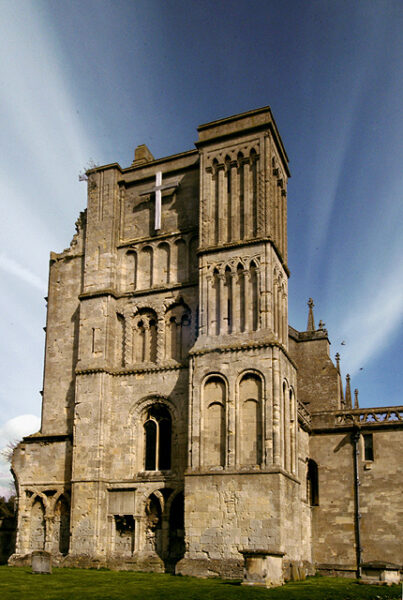
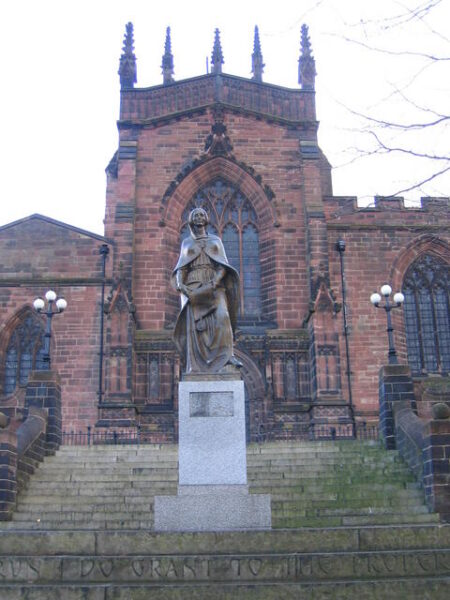
Feminine given names are generally scarce. Old English examples in Suffolk place-names include Ælfflǣd in Alpheton, Ælfwynn in Aveley Hall (in Assington parish), *Denegifu in Dennington and Wīgswīth in Wissington. Old Scandinavian feminine personal names are also occasionally found, as in Sigríthr in Sizergh in Westmorland and Hjalp in Helperby in the North Riding of Yorkshire. Like other personal names, women’s names were sometimes added to existing place-names as affixes. Wolverhampton in Staffordshire contains the Old English female name Wulfrūn, which was added to Old English (æt) Hēan-tūne (‘(at) the high estate/village’) after a powerful lady of that name acquired an estate there in 985; she donated it to a monastery soon after.
Forming given names in early medieval England
Naming in medieval England
In the UK today, names tend to be selected from a range of possible forms (e.g., taking examples from the most common baby names from the UK in 2023: Olivia, Amelia, Isla and Muhammad, Noah and Theo). In the early medieval period, most names were formed instead by drawing on a set of elements (or themes) that were commonly used in naming. Some names were monothematic, consisting of a single element, as in Old English Beadu (compare Old English beadu ‘war’) or Old Cornish Ceneu (compare Welsh cenau ‘whelp’). However, combining elements was a very important method of forming personal names, so we also find dithematic (two-element) names like Old English Beadu-heard (beadu ‘war’ + heard ‘hard, brave’), Old Scandinavian Ás-leikr and Áslákr (áss, óss ‘god’ + leikr ‘play, battle’) and Old Irish Mail-dub (má(i)l ‘prince’ + dub ‘black’) where name-elements are combined.
As time went on, there was a tendency for this system of combining elements to be replaced by a system more like that common today, where ‘indivisible’ names were used instead. This change to indivisible names was probably beginning before the Norman Conquest but is especially pronounced after the Norman Conquest, which introduced many indivisible names like (Biblical) John and (the saint’s name) Margaret. Some dithematic names survive as fossilized, indivisible names, for example English Edward (Old English Ēad-weard) and Scottish Gaelic Dòmhnall and Irish Dónall (Old Irish Domn-all). Many of the indivisible names introduced via French after the Norman Conquest also originated as compounds formed in Germanic languages used on the continent; an example is Robert, from West Frankish *Hrōde-berht. Naming children by selecting from a stock of indivisible names has been very common since the late medieval period, and it is these selected given names which enter into late-medieval and modern place-names.
However, the older types of naming are worth exploring in more detail. The examples given above are taken from a range of languages used in the past in England. These languages are Old English and Old Scandinavian from the Germanic language family, and Cornish, Old Irish and Scottish Gaelic from the Celtic language family. The similarities in the methods used to form given names are not coincidental. These languages are all Indo-European languages which means that they developed from one much older language known as (Proto-)Indo-European, from which different language families like the Celtic and Germanic language groupings eventually developed. Because they developed from a common ancestor, there are inherited similarities between the types of personal names which are found in different Indo-European languages.
Name-types: monothematic and dithematic personal names
The method of forming given names by drawing upon a stock of name-elements and combining two of these elements to form dithematic personal names is part of this Indo-European inheritance. The earliest examples come from Roman-period records, and include *Lugu-walos, from which the British name for Roman Carlisle, Luguvalium, was formed. (The second element of Carlisle is from this British place-name.) There are further examples of dithematic names in Celtic languages from later periods, for example Old Cornish *Gor-gi (recorded in independent use as Wurci) in Hallworthy in Cornwall. There are also many Old English examples in place-names, such as Briht-helm (from earlier Beorht-helm) in Brighton in Sussex, Cēol-mǣr in Chelmsford in Essex, and Cyne-sige in Kensington in London. From Old Scandinavian, we have Ás-lákr in Aslackby in Lincolnshire and Aslockton in Nottinghamshire, and the feminine Ingiríthr (from earlier Ingi-fríthr) in Ingerthorpe in the West Riding of Yorkshire. The name-elements used in the languages differed, but the method of combining name-elements was a very ancient one.
In some dithematic personal names elements seem to have been combined in ways that created meaningful compounds, as for example in Old English Heathu-wulf ‘battle-wolf’. These compounds are very similar to the kennings — compact, metaphorical descriptions of people or objects — used in poetry in the older Germanic languages. However, in other names, elements seem to be combined arbitrarily and we should probably not think of them as ever having meaning as compounds. This is the case in, for example, the common Old English personal name Wulf-stān ‘wolf-stone’ or Old Cornish Bleyð-cuf ‘wolf-dear’.
There are also monothematic (or single-element) names of various types, which cannot always be differentiated from each other with certainty. Some of these name-types draw on the same stock of name-elements used in forming dithematic names. This is the case for names that are hypocoristic forms (pet-names or familiar forms) of dithematic names. For example, Old English Beonna is believed to derive from names with Beorn- as first element. This form is found in the Lincolnshire names Benington and Benniworth. Similarly, Old Scandinavian Ási in the two Lincolnshire places named Aisby may be a hypocoristic form of names with Ás- as the first element (in Aisby in Heydour, Kesteven, the name may be that of the 1066 tenant, Áslákr). Commonly, suffixes were added to name-elements to form hypocoristic forms. Amongst Old English examples are those with a Germanic ‑k‑suffix, as in *Lēofeca in the Oxfordshire place-name Lewknor, and those with an ‑l‑suffix as in *Myndel in Mendlesham, Suffolk. Similar are the Gaelic suffix -án in the given name Glassán in the Cumberland place-name Glassonby, and Old Cornish ‑o in Wasso in Trewassa in Cornwall.
Other monothematic personal names were originally bynames. Old English given names in this category include Boda, from Old English boda ‘messenger’, which is assumed in several place-names including Bodham in Norfolk, and Wada from the verb wadan ‘to go, advance’ in Wadenhoe in Northamptonshire. There are also several Old Scandinavian given names that originated as bynames, such as Ormr, from Old Scandinavian ormr ‘snake’ in the places called Orm(e)sby in Norfolk, Lincolnshire and North Yorkshire, and Ápi, from Old Scandinavian ápi ‘fool’, in Apethorpe in Northamptonshire. (However, not all bynames were monothematic: bynames can be composed of two elements, as in Old Scandinavian Hálf-dan in Holdenby in Northamptonshire, a personal name formed from two Old Scandinavian elements, hálfr ‘half’ and Danr ‘Dane, Danish’, and denoting a person with one Danish parent.) Finally, some single-element names are what are known as lall names, that is, names formed from the speech patterns of infants, for example Dudda in Duddenhoe in Essex.
Both the stock of name-elements and the vocabulary used in forming names overlap considerably with vocabulary used more widely in naming, which is one of the main reasons we often cannot tell whether a place-name contains a personal name or another word. For example, we do not know if York (Roman Eburacum) contains a British personal name *Eburos or the British noun *eburo- ‘yew-tree’. Similarly, Brotherton in the West Riding of Yorkshire could contain either the Old Scandinavian personal name Bróthir or a noun meaning ‘brother, monk’ (either Old Scandinavian bróthir or Old English brо̄thor).
Old English personal names
Old English personal names were used very widely throughout the pre-Conquest period, including in areas like Cornwall by the tenth century. Most Old English personal names only fell out of use (being replaced by names of Continental origin) in the centuries following the Norman Conquest. This means that Old English personal names were very common in most of England.
In Old English place-names, Old English specifics precede generics, so given names occur as the first elements of place-names. Genitive forms are commonly found. The Old English masculine form usually has ‑es as, for instance, in Rendlesham (Suffolk) ‘Rendel’s homestead’, or ‑an as in Tottenham (Middlesex) ‘Totta’s homestead’ (where ‑an later developed to ‑en). The Old English feminine form of the genitive can also be ‑an but ‑e is also common, as in (Great and Little) Wilbraham (Cambridgeshire) ‘Wilburg’s homestead’, which was recorded as Wilburgeham around the year 1000.
Old Scandinavian personal names
Old Scandinavian given names are very frequent in place-names in East Anglia, the East Midlands, north-west England and Yorkshire. In these areas, Old Scandinavian personal names were introduced in substantial numbers by Scandinavians who settled there in the ninth and tenth centuries (and perhaps later in places). Some of the Scandinavians in northern England came from or via Gaelic-speaking areas, and maintained contacts with Gaelic-speaking areas while in England.
The given names that are found reflect a range of Scandinavian backgrounds. Many names, like Áslákr in Aslackby, are recorded in medieval sources from across Scandinavia. However, others are typical of particular Scandinavian regions. For example, the given name Vestlithi in Westlaby (Lincolnshire) and Westleton (Suffolk) is typically ‘West Scandinavian’ (i.e., from the areas of modern Norway, Iceland and the Faroes). However, Tóki in Tugby in Leicestershire is characteristically Danish, and Thialfi in Thelveton in Norfolk is typically Swedish. The occurrence of Gaelic given names in otherwise Scandinavian place-names like Melmerby in Cumberland and the North Riding of Yorkshire (see Celtic personal names) may indicate that some people we think of as Scandinavians had Gaelic given names, though we do not know whether they saw themselves as Scandinavians, Gaels, both Scandinavians and Gaels, or something else entirely.
As in Old English place-names, personal name specifics in Old Scandinavian place-names typically precede generics. Where genitive endings are found, they vary in form depending on the particular given name used. The most common is ‑s as in Flixton in Lancashire, Suffolk and the North Riding of Yorkshire, which have Old Scandinavian Flík (genitive Flíks) or Flikkr (genitive Flikks) as specifics. Sometimes, a distinctively Scandinavian genitive in ‑ar is found, as in Helperby, which has the feminine given name Hjalp (genitive Hjalpar) as specific, surviving as ‑er. The usual pattern where a personal name used as a specific precedes the generic is reversed in the place-names sometimes known as inversion compounds, which frequently contain Old Scandinavian personal names as specifics that follow generics. These names – in which element order is typical of medieval Celtic languages — are discussed in more detail in the following section on Celtic personal names.
Celtic personal names
Celtic personal names in England’s place-names come from both Brittonic and Goidelic (or Gaelic) sub-groupings of the Celtic languages and were formed in a range of different contexts.
Some of the Brittonic personal names go back to the Roman period (or earlier), like *Lugu‑walos in the name for Roman Carlisle, Luguvalium. Brittonic personal names continued to be used in forming linguistically Brittonic place-names in later periods, as in the numerous place-names in Cornwall containing Cornish personal names like Kenhoarn in Linkinhorne and Sulyen in Tresillian. However, Brittonic personal names were also adopted by English-speakers and used to form Old English place-names as is the case with *Wassa in Washingborough ‘the fortified place of the followers of Wassa’ in Lincolnshire. In this place-name, the personal name is followed by the Old English group-name forming suffix ‑ingas in the genitive form ‑inga‑, showing that the place-name was formed in Old English. However, the personal name was borrowed from Brittonic and we can compare such Continental Celtic personal names as Vasso-rix and Dago-uassus. Similarly, the Welsh personal name Madoc is found in a tenth-century name in Berkshire, Maduces lea ‘Madoc’s clearing or open woodland’ and, in this name too, the Old English ‑es genitive ending also shows that the place-name was formed in Old English. Finally, Breton names like Uuicon in Wiggonby in Cumberland were brought to England by the followers of William the Conqueror (along with other names from Normandy, Flanders, Picardy and Artois).
Most of the Gaelic personal names in England’s place-names are found in Viking-Age place-names and developed in the context of contacts between Scandinavians and Gaelic speakers around the Irish Sea (in what is approximately the Middle Irish period). In many of these names, a Gaelic personal name specific is combined with an Old Scandinavian generic. This is the case in the places called Melmerby in Cumberland and near Leyburn in the North Riding of Yorkshire, both of which contain the Middle Irish given name Máel Muire. Goosnargh ‘Gussán’s shieling (seasonal pasture)’ in Lancashire is similar, but in this case the generic element, a word meaning ‘shieling’ (Old Scandinavian *ǽrgi), is itself a borrowing from Gaelic. Some Gaelic personal names are found in place-names in north-west England that are linguistically entirely Gaelic, such as Greysouthen ‘Suthán’s rock’ in Cumberland (explained below). These names may be related to the expansion of Scottish Gaelic in adjacent areas of south-west Scotland in the tenth and eleventh centuries. There are also occasional examples of place-names with Gaelic personal names that developed in other contexts, like Malmesbury in Wiltshire, where Maeldub (again with an Old English ‑es genitive) was reputedly the founder of the monastery.
In Celtic place-names formed in the medieval period and later, the generic usually precedes the specific in a construction termed a name phrase. This means that personal names follow generics in most Celtic place-names (unless they are very early) and it is this name-phrase word-order we see in the place-names Greysouthen ‘Suthán’s rock’ (Middle Irish craicc ‘rock’ + pers.n. Suthán). A similar word-order is seen in some place-names from north-west England and south-west Scotland in which the generic (usually of Old Scandinavian origin) precedes the specific. These names are conventionally known as inversion compounds. Several of the inversion compounds have Gaelic given names as specifics, for examples Setmurthy ‘Muiredach’s shieling’ (Old Scandinavian sǽtr ‘shieling’ + Middle Irish pers.n. Muiredach) in Cumberland. These names may have been formed in Old Scandinavian by speakers whose word-order had been heavily influenced by Gaelic, or formed in Gaelic using vocabulary (and sometimes personal names) of non-Gaelic origin. On the other hand, the personal name specifics precede generics in Melmerby (Middle Irish pers.n. Máel Muire + Scandinavian bý ‘farm village’) and Goosnargh (Middle Irish pers.n. Gussán + Old Scandinavian *ǽrgi ‘shieling’, a borrowing from Gaelic). This order of elements – which is typical of Old Scandinavian (and Old English) but not medieval Celtic languages – strongly suggests that these names were formed in Old Scandinavian not Gaelic.
Continental Germanic
A final group of medieval given names found in place-names are those that are from Continental Germanic, that is, from the Germanic languages of mainland Europe. These names are commonly West Frankish names transmitted via Old French, Old Low Franconian or Middle Dutch names (that is, from a precursor of Modern Dutch), and Old Saxon/Middle Low German names. Some people with Continental Germanic names are recorded in tenth- and eleventh-century England. However, names of Continental Germanic origin, such as Richard and Alice, became much more common after the Norman Conquest and came to dominate the stock of given names used in England in the later middle ages.
Being closely related to other Germanic languages, these names are similar to Old English and Old Scandinavian given names. However, some name-elements like the first element of Tanc-red in Tankersley in the West Riding of Yorkshire are typical of Continental Germanic and not of Old English or Old Scandinavian. (Tancred is a Norman French form comparable with Old Low Franconian and Old Saxon Thankrād.) Sometimes, the forms of the names show that they have come via French, as with Tancred and many other names, such as Malbert (an Old French form of West Frankish Madalbert), in Mablethorpe in Lincolnshire.
Family names
Family names are not usually found as specifics of medieval settlement-names. However, by the thirteenth and fourteenth centuries, family names are very commonly found in manorial affixes such as Milton Keynes and Newport Pagnell, where the affixes are from the family names of important local landholders (often lords of the manor). Family names in affixes (and occasionally standing alone) are discussed under manorial affixes in Introducing the place-names of England. Different types of family names are discussed in Family names of Britain and Ireland. After the medieval period, family names are common in minor names. These names are discussed in the next section.
A very rare example of a personal name and family name forming a place-name specific is provided by Whatstandwell in Derbyshire. Whatstandwell was first recorded as Wattestanwell ford in 1390. In this name, the specific elements are the Middle English given name Watte (a hypocoristic form of Walter) and the family name Stonewell (also recorded as Stondewell and Standewell’). Watte Stonewell was a tenant of a house next to the ford at Wattestanwell ford, and gave his name to the river crossing. The element ford was later dropped from the place-name leaving a place-name ending in -well that looks like a standard place-name with straightforward topographical origins, but actually has very unusual origins.
Personal names in modern place-names
Personal names continue to be important to the naming of places right up to the present day: we only need to think of the thousands of street-names that commemorate local or national heroes, or the few major place-names based on the names of great men: developer Sir Peter Fleetwood in Fleetwood (Lancashire), trade unionist Peter Lee in Peterlee (Durham), industrialist Sir Titus Salt in Saltaire (West Riding of Yorkshire), and engineer Thomas Telford in Telford (Shropshire).
Minor features such as fords, wells, small woods or hills often bear witness to people who presumably owned them or lived nearby. On the second edition Ordnance Survey maps of around 1900 (transcribed by the GB1900 project), for instance, we can see what appear to be given names in Adam’s Wood, Andrew’s Wood, or Anna’s Wood, or (with hypocoristic or pet forms of given names) Tom’s Wood, Dick’s Copse or Harry’s Hill. All of these occur at least twice.
Other minor names are likely to contain family names, both as specifics of compound names and on their own with a genitive ending. In many cases the family bearing the name can be found in local or national records. In Abbotsbury in Dorset, people called John and Matilda Rede (or Reede) are recorded in the late fourteenth century, and it is probably this family whose name is the specific in Reeds End. Also in Abbotsbury, the family of Richard and Thomas Coward, who are recorded in seventeenth-century taxation records, gave its name to Coward’s Lake and Coward’s Lane. Elsewhere in Dorset, Daggons and Daggons Farm in Alderholt are probably named from the family of Richard Dagon, who is recorded in fourteenth-century records.
Selected sources
Briggs, Keith (2024), An Index to Personal Names in English Place-Names (3rd revised edn) [available as a free download from the linked page].
Fellows-Jensen, G. (1968), Scandinavian Personal Names in Lincolnshire and Yorkshire.
Gelling, Margaret (1978), Signposts to the Past [chapter 7: ‘Personal names in place-names’].
Hough, Carole (2002), ‘Women in English place-names’, in ‘Lastworda Betst’. Essays in Memory of Christine E. Fell with her Unpublished Writings, ed. Carole Hough and Katherine A. Lowe, pp. 41–106.
Insley, John (2003), ‘Pre-conquest personal names’, in Reallexikon der Germanischen Altertumskunde, 23, pp. 367–96.
Insley, John (2013), ‘Personal names in place-names’, in Perceptions of Place: Twenty-First Century Interpretations of English Place-Name Studies, ed. Jayne Carroll and David N. Parsons, pp. 209–49.
Nelson, J. L., et al. (2005–), Prosopography of Anglo-Saxon England [a database of people recorded in England between the sixth and eleventh centuries].
O’Brien, M. A. (1973), ‘Old Irish personal names”, Celtica 10, pp. 211–36.
Padel, Oliver (1988), A Popular Dictionary of Cornish Place-Names [especially pp. 14–18 ‘Personal names and place-names’ and pp. 203–12 ‘Index of personal names’].
Rivet, A. L. F. and Colin Smith (1979), The Place-Names of Roman Britain.
© Ellie Rye with Keith Briggs, John Insley, Oliver Padel and Diana Whaley 2024