Back to Mills & Boon part 1: Mills
Mills & Boon part 2: Boon
The surname Boon
Charles Boon’s father, another Charles, was not born a Londoner but came to London from Suffolk to find work and a wife. According to the 1851 census, he was born in Sutton in about 1843, from where his father, William Boon, a carpenter journeyman, had moved to neighbouring Shottisham. Sutton and Shottisham were in the Woodbridge registration district, where most Suffolk families with this surname then lived, as can be seen in Steve Archer’s map of the 1881 census data.
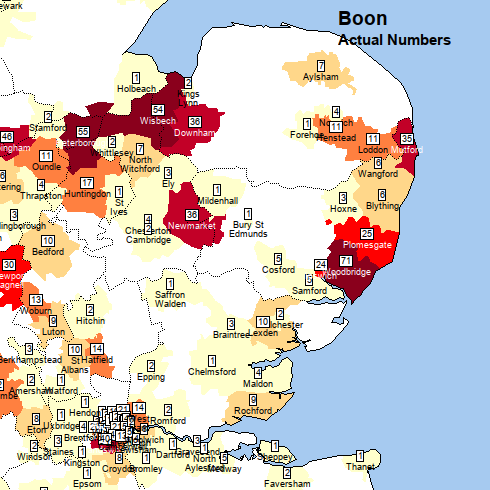
In previous centuries the surname was centred further west, for example in the Cosford registration district, where John Boon is recorded in Elmsett parish in 1788 and Mary Boon in Hadleigh parish in 1637. Remarkably, a John de Boun was taxed in Elmsett in 1327. He may have been the progenitor of all the later Boon families in Suffolk.
The surname Boon is found in many other counties, especially in Lancashire, the West Midlands and Devon. It has at least two origins, a nickname from Old French bon ‘good’ and a toponymic surname from a French place-name. The 1327 Elmsett name points conclusively to the latter. John de Boun will have been a member of one of the most powerful Norman families in England, named de Bohun or de Boun, that held estates in many parts of England. He may even have been the John de Bohun, 5th Earl of Hereford and 4th Earl of Essex, who was the son of Humphrey de Bohun, 4th Earl of Hereford and Elizabeth of Rhuddlan, a daughter of Edward I. Alternatively he may have been a member of the other major branch of the family, the Bohuns of Midhurst (Sussex).
The earls of Hereford were descended from Humphrey de Bohun, tenant-in-chief of William the Conqueror in 1086. He was one of perhaps a score of different Normans named Humphrey in Domesday Book, some of whom were given distinguishing bynames of one kind or another, either from place-names, nicknames, terms of office or patronymics. He, his son and his grandson were all known at one time or another as Humphrey de Bohun, affirming through their names their family origin in St-Georges de Bohon in Manche (Normandy), their right of inheritance in the male line and their status as Norman lords in England. The use of bynames, non-hereditary and hereditary, to individuate people bearing the same forename and to reinforce tenurial rights and social power, became a hallmark of the new Anglo-Norman nation. By the end of the medieval period hereditary bynames (surnames in the modern sense) had spread to all sections of English society.
Inheriting a surname, however, is no guarantee of continuity of social status. Younger sons in high-status families might inherit little or no landed property, and their descendants might find themselves having to marry into the yeomanry. In the second half of the 15th century a yeoman branch of the Suffolk Bohuns became prominent landowners in and around Fressingfield in the north of the county, acquiring gentry status and a coat of arms. The family is notable for having assembled a private cartulary collecting documents relating to their landholdings.
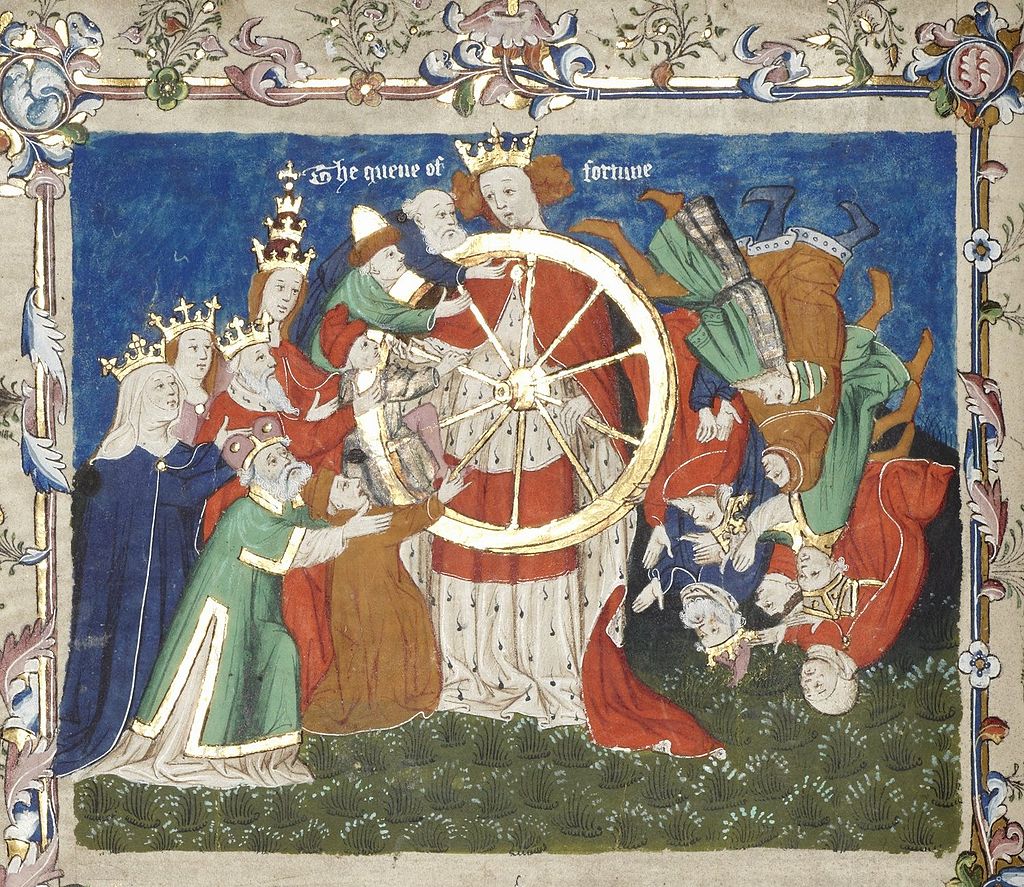
The ups and downs of the wheel of fortune pre-occupied the minds of the late medieval gentry. Its rotation paid no respect to class or wealth. Whether Charles Boon of London descended from the Fressingfield branch or from a different Suffolk branch, his own story is similarly one of changing social fortunes. For all the poverty into which he was born, he seems to have had an illustrious ancestry going back ultimately to a Norman lord, who would doubtless have employed a peasant miller to grind corn on any of the manors that he owned. The surname histories of Mills and Boon encapsulate an impermanence of social status and wealth and a geographical mobility that can be found in most families.

Select Sources
Ancestry (2002–2024), Ancestry.co.uk.
Hanks, P., R. Coates and P. McClure eds (2016), Oxford Dictionary of Family Names in Britain and Ireland.
Intellectual Reserve, Inc. (–2024), FamilySearch.
Keats-Rohan, K. S. B. (1999), Domesday People, a Prosopography of Persons occurring in English Documents, 1066–1166, I, Domesday Book, p. 272.
Keats-Rohan, K. S. B. (2002), Domesday Descendants, a Prosopography of Persons occurring in English Documents, 1066–1166, II, Pipe Rolls to Cartae Baronum, pp. 331–32.
Loyd, L. C. (1951), The Origins of Some Anglo-Norman Families, p. 16.
McClure, P. (2020), ‘Personal names as evidence for migrants and migration in medieval England’, in Migrants in Medieval England, c.500–c.1500, ed. W. M. Ormrod, et al., pp. 120–43 (especially pp. 122–23).
McKinley, R. A. (1990), A History of British Surnames, pp. 25–39.
Waugh, S. L. (2023), ‘Bohun, Humphrey de‘, in Oxford Dictionary of National Biography.
Wells-Furby, B. ed. (2012), The Bohun of Fressingfield Cartulary.
Text © Peter McClure 2025