Hamilton part 3: Where do we find Hamiltons today?
Where do we find Hamiltons today?
Surnames are not only about lineage and inheritance, they are about journeys. Most Hamiltons are now in America, where there were 201,746 people with the name in the 2010 US census, largely descendants of economic migrants from Ireland and Scotland, starting in the 18th century. Scottish Hamiltons also migrated in significant numbers to the British colonies of Canada, Australia and New Zealand, and there are numerous places named from the surname in all three countries as well as in the USA, where 33 towns are so named, not to mention a similar number of smaller communities, often in memory of Alexander, the founding father.
The city of Hamilton, Victoria, is one of five places with this name in Australia and is known to its inhabitants as ‘The Wool Capital of the World’. It originated in 1839 as a small, squatters’ wool station known as The Grange, on exceptionally fertile land taken at gun point from the local aboriginal tribes. It rapidly prospered and in 1850 it was officially laid out as a town and re-named Hamilton by the government surveyor Henry Wade of Sydney, thereby ingratiating himself with an influential local Scottish family named Hamilton.
Not all of the émigrés will have been descended from the aristocratic family, but there is little doubt that, over the centuries, this family was highly productive of male offspring, most of whom had to find their own means of income in one of the professions, especially the church and the military, or in trade and industry.
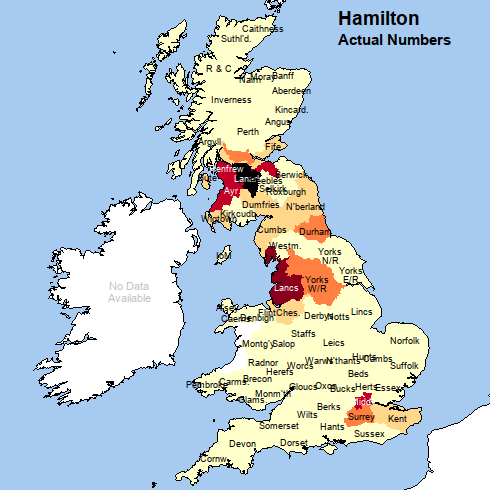
In Britain, too, economic migration has spread the name into all parts, though unevenly.
In Steve Archer’s British 19th Century Surname Atlas, based on the 1881 census, Hamilton has a wide distribution, chiefly through migration from Scotland to England but also from Ireland. The distribution in Ireland is not shown on the map, but the Irish 1911 census lists 8,221 bearers, chiefly in Ulster, especially Tyrone. In 1880s Britain it had an especially heavy presence not only in Lanarkshire (6,800 bearers), Ayrshire (1,539) and Renfrewshire (1,208), where you would expect it, but also in Lancashire (1,665) and the London area (over 2,000), which were major destinations for Irish as well as Scottish people seeking work.
Select sources
Ancestry (2002–2024), Ancestry.co.uk.
Archer, S. (2003–15), British 19th Century Surname Atlas, version 1.20.
Black, G. F. (1946), The Surnames of Scotland.
Hanks, P., R. Coates and P. McClure eds (2016), Oxford Dictionary of Family Names in Britain and Ireland.
Hanks, P. and S. Lenarčič with P. McClure eds (2022), Dictionary of American Family Names, 2nd edn, 5 vols.
Lewis, A. C. (2004) ‘Hamilton, Sir William Rowan (1805–1865)’, in Oxford Dictionary of National Biography.
Muhr, K. and L. Ó hAisibéil eds (2021), The Oxford Dictionary of Family Names of Ireland.
Newton, M. E. (2019), Discovering Hamilton.
Text © Peter McClure 2023